We’re hiring people who love them like we do. Join us careers@pawsandco.comSee open roles
UAE Government Licensed MOCCAE
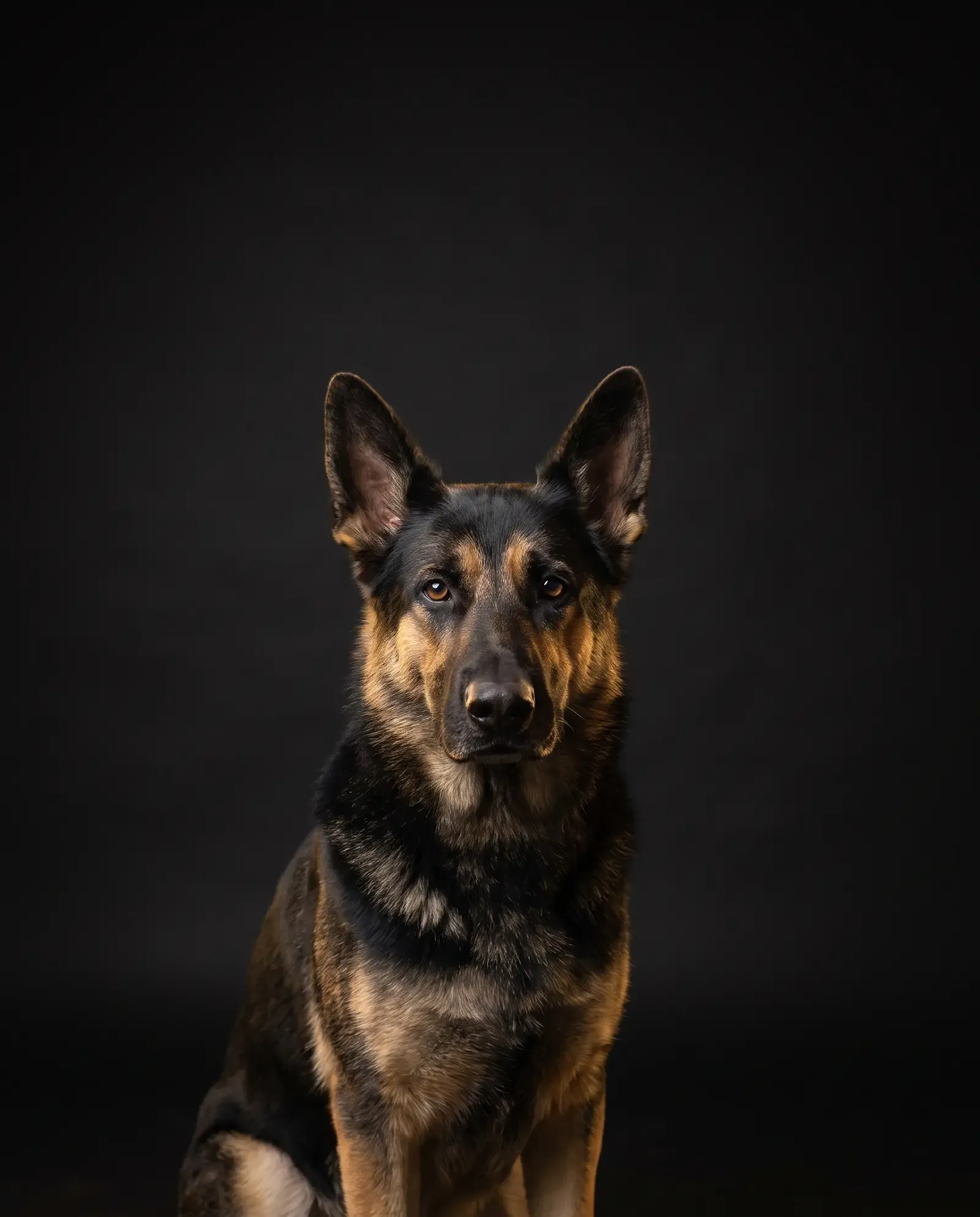
German Shepherd Dog in Dubai, studio portrait of a black and tan adult sitting calmly against a dark background

Breed guide  ·  Dogs

German Shepherd Dog

He sheds enough to build a second dog. I've stopped buying black trousers.

Lifespan
9 to 13 years
Size
Large
Weight
22.5 to 41 kg
Shedding
Heavy

Last updated 14 October 2026

Join the founding families. AED 1,999 of essential care for AED 199.

No payment now. We'll be in touch by email and WhatsApp as we open enrolment.

✓
Thank you.

We will be in touch soon to confirm.

German Shepherd traits

What they brought with them.

Tap a card to see what is going on.

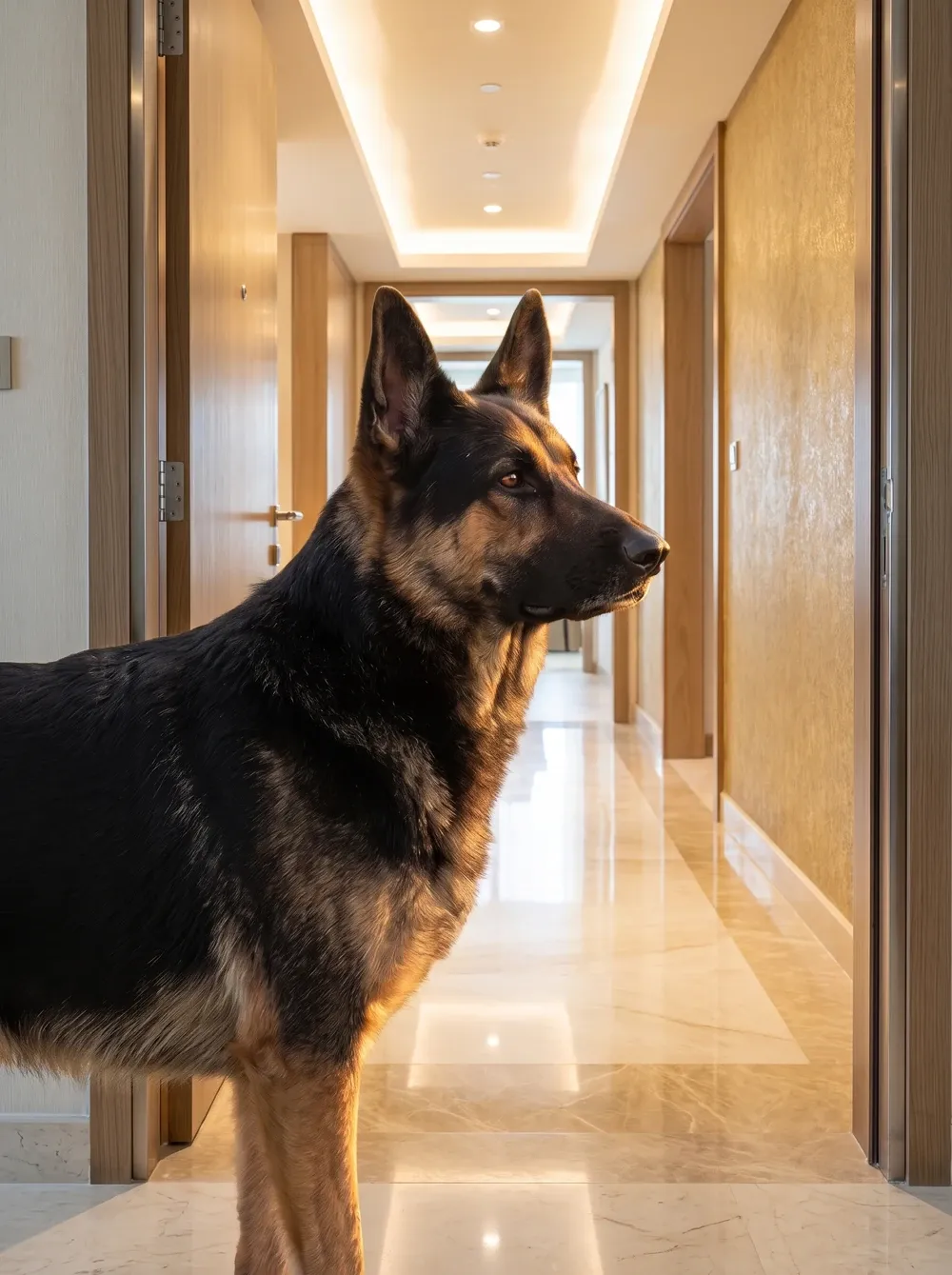
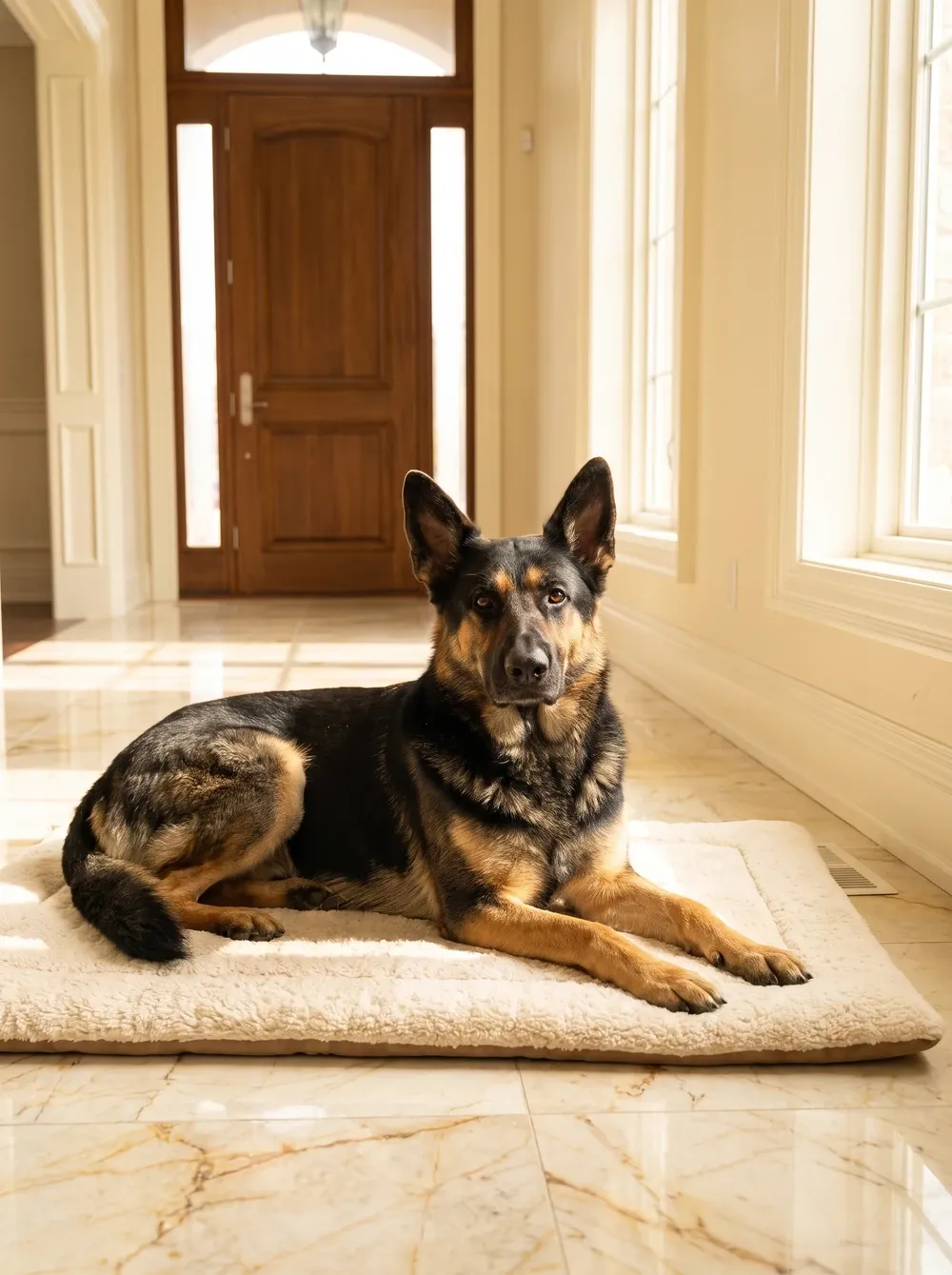
German Shepherd Dog, a black and tan adult lying on a fleece mat in a bright marble hallway by the front door

At home

Why German Shepherds bark at the door

The doorbell, the lift, footsteps in the corridor. They bark, then stand between you and the door.

What's going onGerman Shepherds were bred to watch over a flock and tell the shepherd when anything came near. The delivery driver is the thing coming near. Give them a mat away from the door, and a reason to go to it.
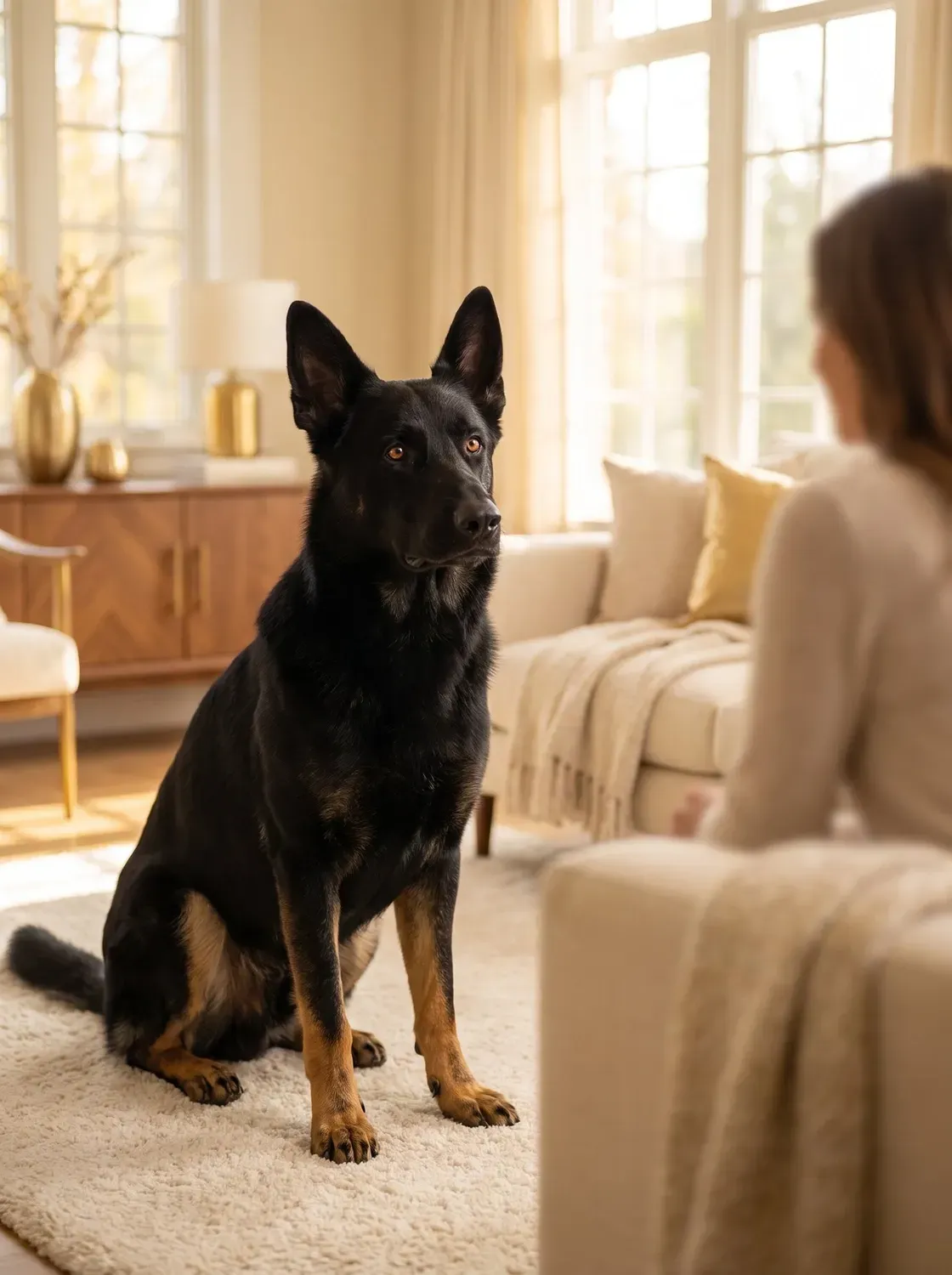
German Shepherd Dog, a black adult with tan legs sitting calmly in a living room as a guest relaxes nearby

At home

They take their time with guests

Warm with the family, polite or cool with visitors, and slow to relax around someone new.

What's going onThey were bred to judge strangers, not to love them on sight. Let them choose when to say hello, and ask visitors not to lean over them or reach for their head.

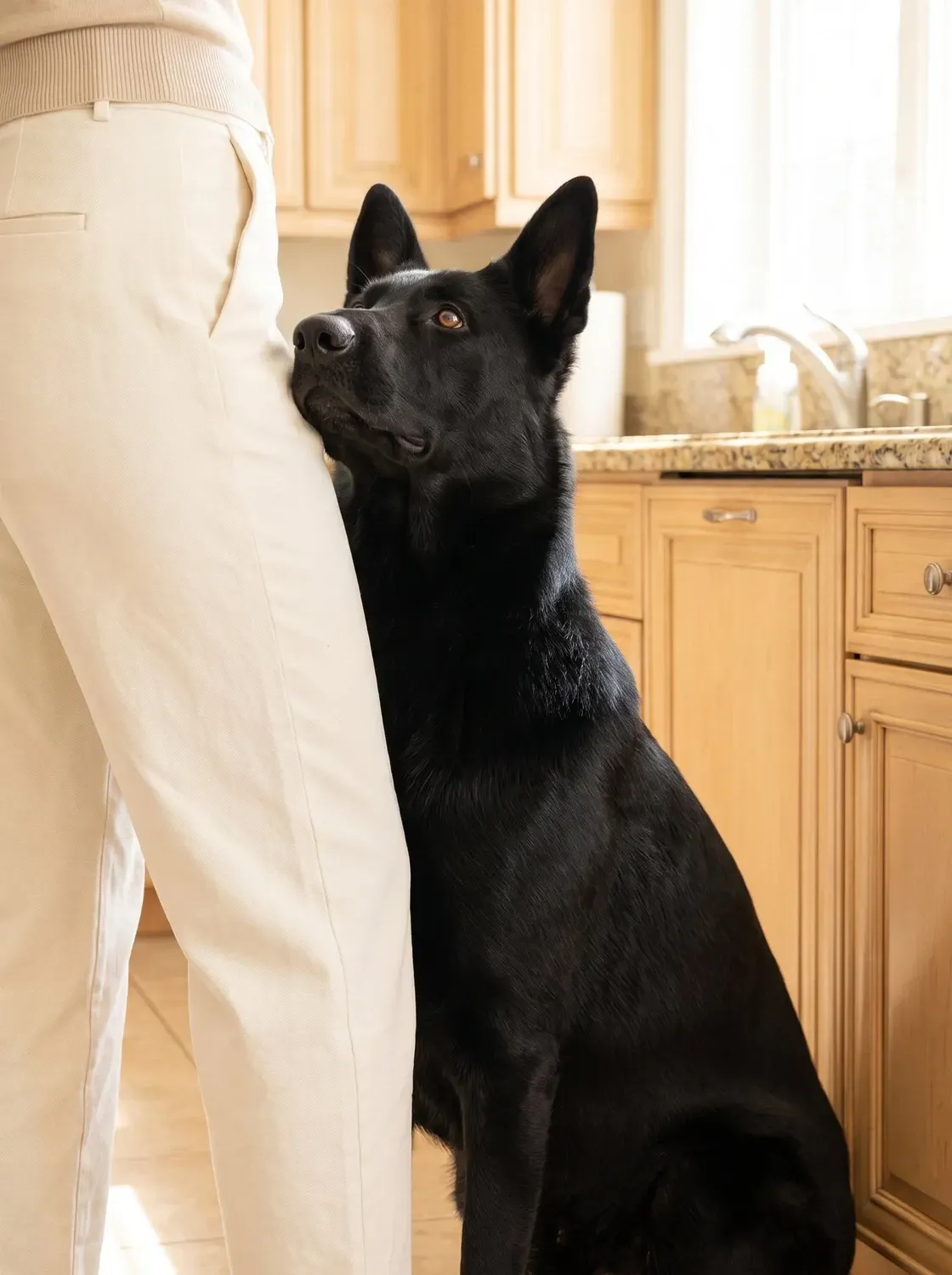
German Shepherd Dog, a black adult leaning against a pet parent's legs in a sunny kitchen, looking up

At home

They lean their whole weight on your legs

They follow you room to room all day, then lean their full weight on your legs while you cook.

What's going onThey were bred to work beside one person all day, and a long day alone is the hardest part of flat life for them. If they are distressed when you leave, contact your vet.

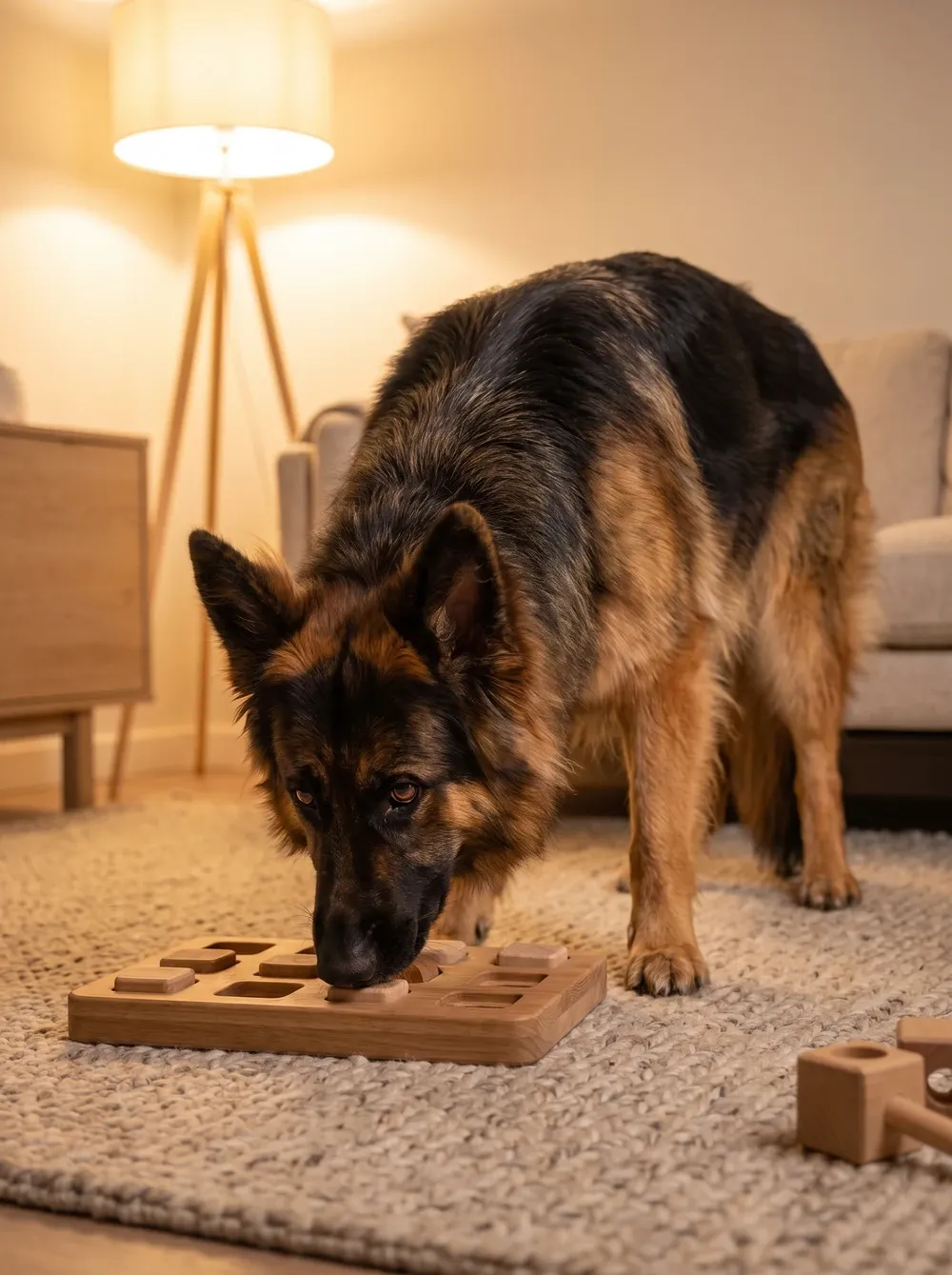
German Shepherd Dog, a long-coated adult nosing a wooden puzzle feeder on a rug in the evening

At home

Restless every evening

Pacing at dusk, and teeth marks on the skirting board.

What's going onA long run makes them fitter, so they need more of it tomorrow. Training, a new trick or dinner hidden around the flat tires the part of them that was bred to work.

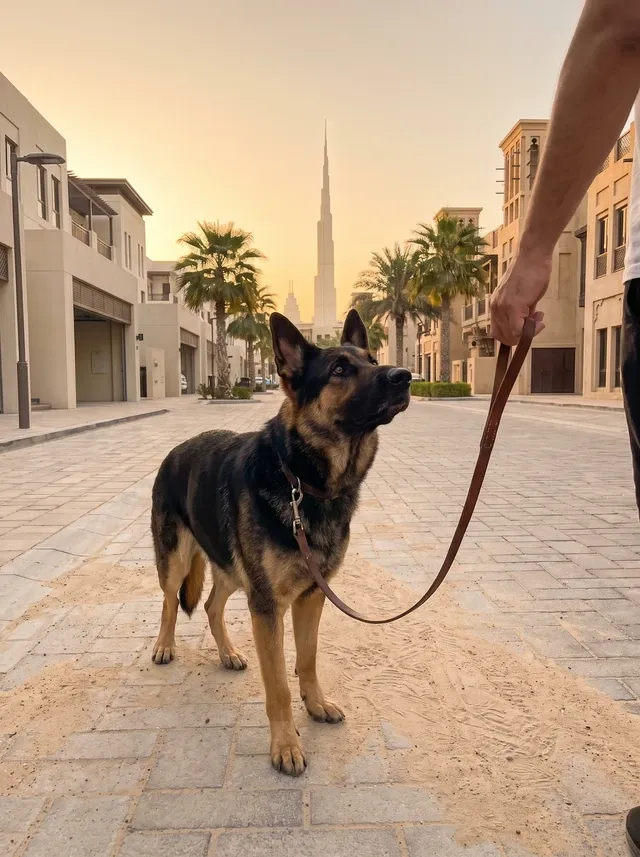
German Shepherd Dog in Dubai, a black and tan adult on a loose lead on a palm-lined street, Burj Khalifa behind

At home

They read your mood on the lead

You tense up as a dog comes the other way, and they stiffen and bark before you do.

What's going onThey were bred to work with a handler, and a tight lead and a raised voice tell them something is wrong. Keep the lead loose, your voice low, and cross the road early. Never punish a growl: it is their early warning.

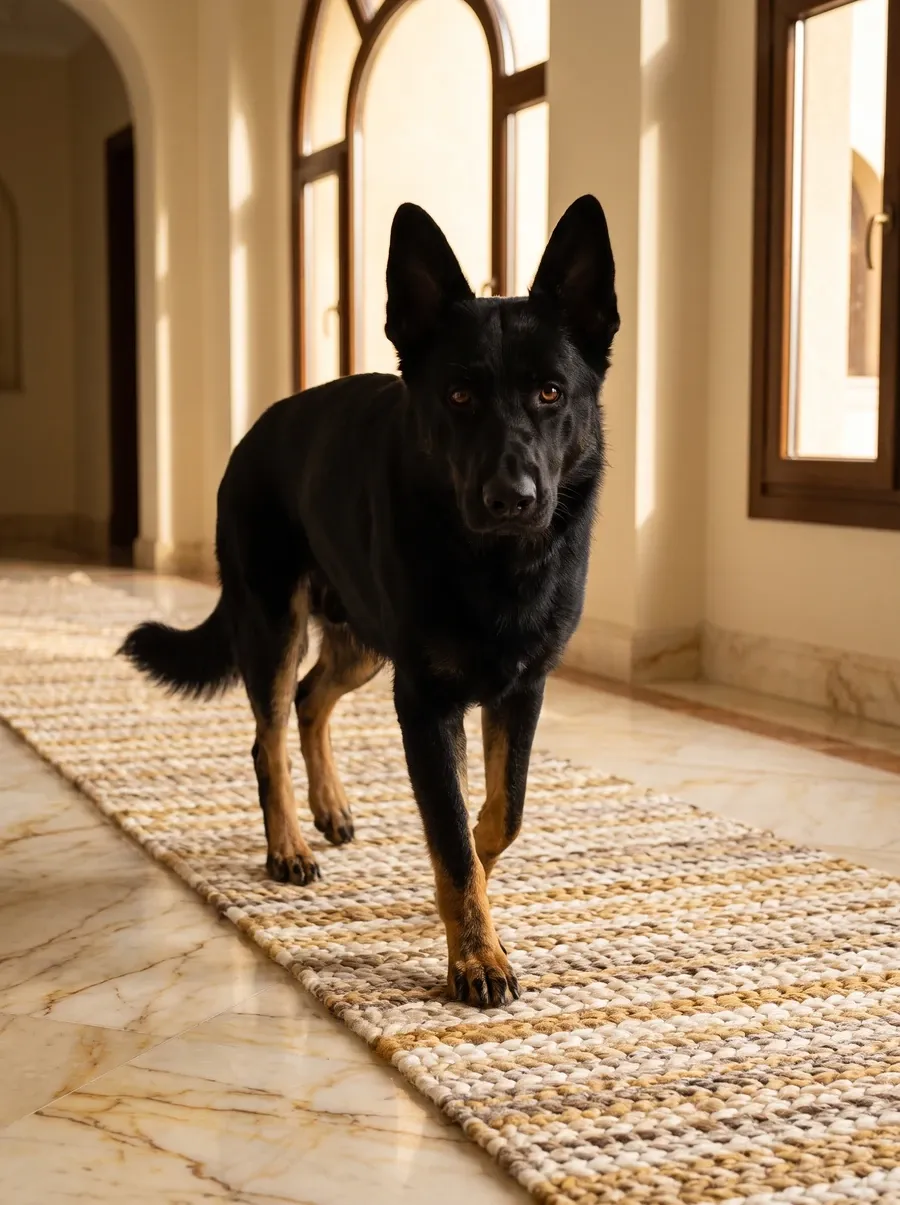
German Shepherd Dog, a black adult with tan legs walking along a runner on a marble villa floor

At home

A wobble in the back legs

Scuffed nails on the back feet, a slip on the marble, a little slower on the stairs.

What's going onHip problems and a slow weakening of the back legs are both on their health record. It starts without pain and is easy to put down to age. Tell your vet, at any age.

A German Shepherd in Dubai

The bit nobody tells you.

Their day

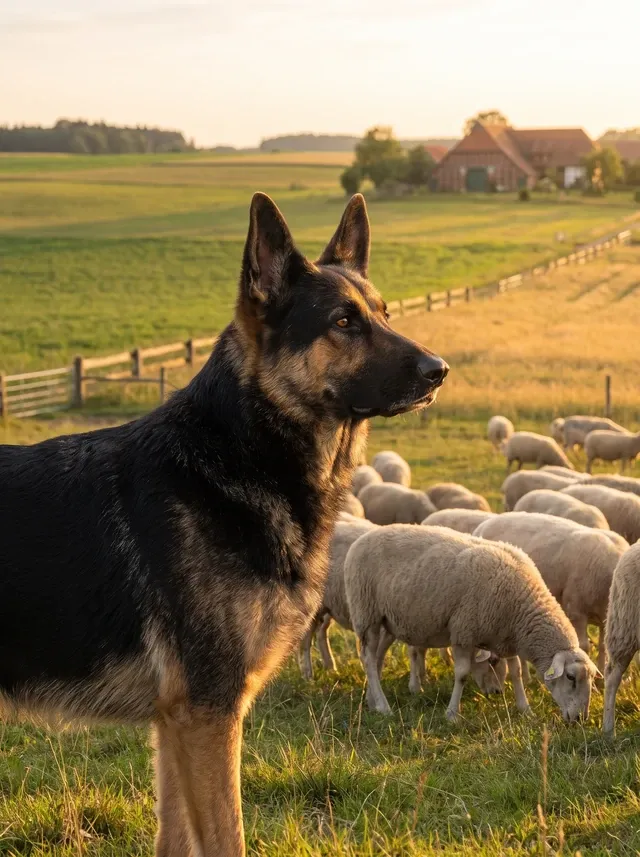
Built for: Walking the edge of a field all day, beside one shepherd.

In Dubai: Often a flat, with their person at work.

Their door

Built for: Watching for anything that came near the flock.

In Dubai: A corridor where strangers pass every few minutes.

Their ground

Built for: Open German farmland.

In Dubai: A hallway to patrol, in 45°C heat.

The barking, the pacing and the chewed skirting board mostly come from that gap.

You cannot give them a flock. You can give them a job and a rule for the door, and the ten things below are how.

Your plan is built around their breed: the health risks for a German Shepherd at every age, and the care that goes with each one.

Join the founding families. AED 1,999 of essential care for AED 199.

Daily care for a German Shepherd

Ten things that make their life better.

Many of them are free, and most matter at every age.

  1. They will tell you someone is there either way. A rule keeps them out of the doorway.

    Every age, most of all 6 months to 2 years

    AED 100 to 400 for a mat or bed

    Why

    They will tell you someone is there either way. A rule keeps them out of the doorway.

    What to do

    Put a mat a few metres from the front door and teach them that going there pays. When the bell goes, thank them once, send them to the mat and reward them there. While they are learning, have deliveries left outside. If they have lunged or snapped at anyone, contact your vet before you go further.

  2. They judge strangers by the people they have already met.

    Every age, most of all puppies

    FreeIn your plan

    Why

    They judge strangers by the people they have already met.

    What to do

    In their first months, let them watch all kinds of people from a distance they are happy at, with a treat for each: men in caps, children, people in uniform. Until their vaccinations are finished, carry them or use clean ground. Carry on through their teens, because German Shepherds often grow warier as they mature.

  3. The lift is a small box where strangers walk straight at them.

    Every age, most of all 6 months to 2 years

    Free

    Why

    The lift is a small box where strangers walk straight at them.

    What to do

    Wait for an empty lift, or stand them in the back corner with you in front. Step aside in corridors, keep the lead short and loose near entrances, and ask building staff not to reach for them.

  4. They were bred to work, and a bored German Shepherd finds their own work.

    Every age, most of all 6 months to 2 years

    Under AED 150 for a puzzle feeder

    Why

    They were bred to work, and a bored German Shepherd finds their own work.

    What to do

    Two or three short training sessions a day, and part of their dinner hidden around the flat or served in a puzzle feeder. Stop while they still want more. In older dogs, scent games stay easy on the joints and keep the mind busy.

  5. Bloat (Gastric Dilatation-Volvulus, GDV, a twisted stomach) is on their health record from about six months.

    Every age, the meal routine from 6 months

    Free

    Why

    Bloat (Gastric Dilatation-Volvulus, GDV, a twisted stomach) is on their health record from about six months.

    What to do

    From May to September, walk before sunrise and after dark. Put the back of your hand on the pavement for five seconds: if you cannot keep it there, they cannot walk on it. Feed two or three smaller meals, with an hour of rest before and after each. A swollen belly and retching with nothing coming up is an emergency: contact your vet now. Ask your vet about gastropexy (an operation that tacks the stomach in place) at the same time as neutering or spaying.

  6. A basket muzzle they are used to lets them pant and drink, and keeps a stressful moment calm.

    Every age, easiest under 2 years

    Under AED 200

    Why

    A basket muzzle they are used to lets them pant and drink, and keeps a stressful moment calm.

    What to do

    Teach it while they are young and nothing is wrong: show it, treat, nose in, treat, a second longer each day. Keep it familiar with a minute or two a week. Never put it on for the first time in a hurry.

  7. A vet is a stranger who touches their paws, ears and mouth.

    Every age

    Free

    Why

    A vet is a stranger who touches their paws, ears and mouth.

    What to do

    A few minutes a few times a week: lift a paw, look in an ear, lift a lip, run a hand down each leg, and reward each one. Practise standing still on a mat. Stop before they get uneasy, and go gently around sore joints as they age.

  8. Pulling, testing and new worries are normal, and new guarding often shows between one and three years.

    6 months to 3 years

    Free

    Why

    Pulling, testing and new worries are normal, and new guarding often shows between one and three years.

    What to do

    Reward the calm behaviour you want, every time. Use a flat collar or a harness, never tools that hurt or frighten them, and never punish a growl. Keep sessions short. If new guarding appears, contact your vet early.

  9. Hip Dysplasia (a poorly fitting hip joint) and Elbow Dysplasia (a poorly fitting elbow joint) are their first two health risks from puppy to young adult.

    Every age, evaluation before 2 years

    Free to AED 1,000 for rugs and a rampIn your plan

    Why

    Hip Dysplasia (a poorly fitting hip joint) and Elbow Dysplasia (a poorly fitting elbow joint) are their first two health risks from puppy to young adult.

    What to do

    Rugs where they turn on marble, a ramp for the car, few stairs while they grow, and a lean body. Book their hip and elbow evaluation before they turn two, and ask about the genetic test for Degenerative Myelopathy (DM, progressive weakness in the back legs) at the same time.

  10. They can hide pain well, and heart disease appears on their health record as a senior.

    Every age, most of all from 7 years

    Free

    Why

    They can hide pain well, and heart disease appears on their health record as a senior.

    What to do

    Once a week, run your hands over their ribs, spine, hips, legs and paws, and look at their back feet for scuffed nails. Weigh them monthly. A new lump, a limp or faster breathing is worth telling your vet the same week.

Two of these are in your plan. The rest you can do at home.

Join the founding families. AED 1,999 of essential care for AED 199.

German Shepherd health by age

Their health, at every age.

In a German Shepherd, a change in the back legs, the gut or the skin is often the first sign that something is wrong. Choose their age to see what to watch for, and the care that goes with it.

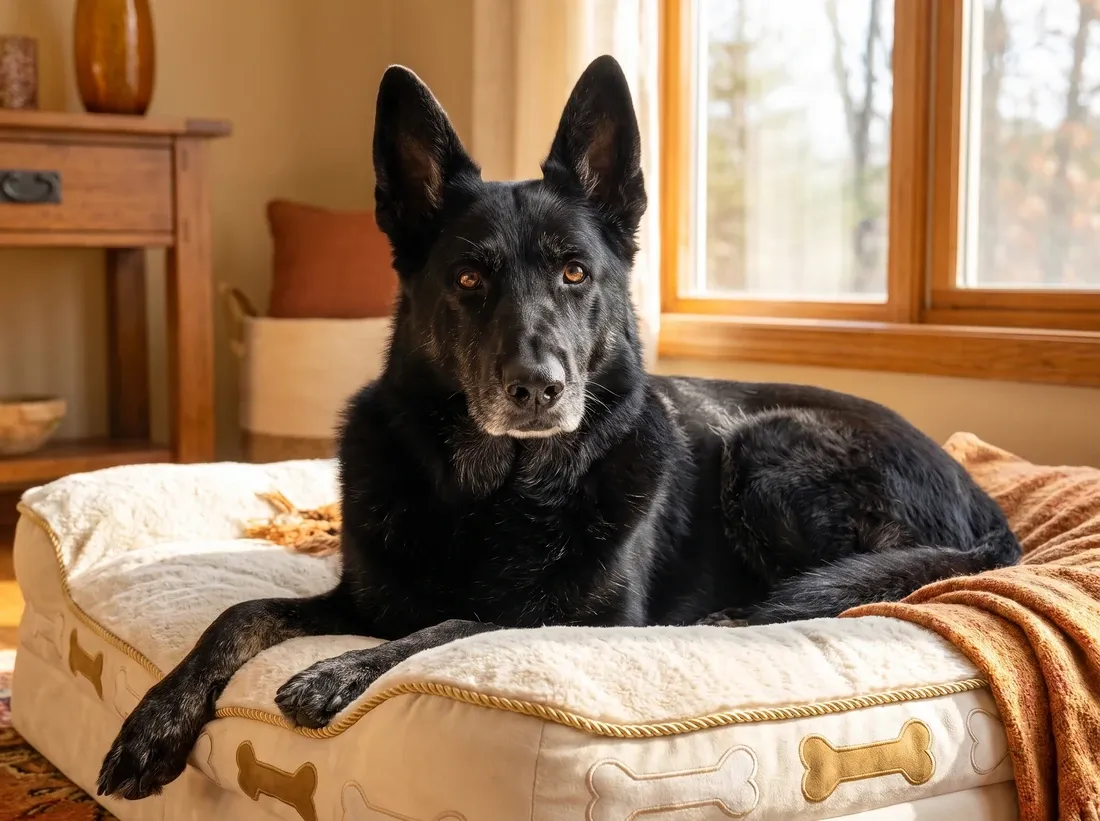
German Shepherd Dog, an older black dog with a greying muzzle resting on a thick, soft bed

How old are they?

Their age

German Shepherd Puppy health

the first six months

What to watch for

  1. Developmental or early clinical signs of Hip Dysplasia (HD, poorly fitting hip joint)
  2. Developmental or early clinical signs of Elbow Dysplasia (ED, poorly fitting elbow joint)
  3. Early neurological signs or inherited risk related to Degenerative Myelopathy (DM, progressive weakness in the back legs), Early
  4. Gastrointestinal upset and conformation-related feeding intolerance
  5. Juvenile onset of allergies / atopic dermatitis

The care that goes with it

  1. Core vaccinations, microchip and Dubai Municipality registration
  2. Deworming, and flea and tick prevention
  3. Growth and nutritional evaluation, and early socialisation
  4. Hip Dysplasia (HD, a poorly fitting hip joint) screening
  5. Early follow-up for any signs of Elbow Dysplasia (ED, a poorly fitting elbow joint)
The full care detail
  • Core vaccination programme, microchipping and Dubai Municipality registration. Titre testing discussion where clinically appropriate; not a substitute for completing the core vaccine series
  • Deworming and external parasite prevention tailored to Dubai exposure
  • Body Condition Score (BCS, a check on whether they are the right weight), Muscle Condition Score (MCS, a check on their muscle), dental, growth and nutritional evaluation, and early socialisation
  • Baseline screening focused on Hip Dysplasia (HD)
  • Early diagnostic follow-up for signs suggestive of Elbow Dysplasia (ED)

Their age

German Shepherd Juvenile health

6 months to 2 years

What to watch for

  1. Emerging Hip Dysplasia (HD) with exercise intolerance or lameness
  2. Emerging Elbow Dysplasia (ED) with exercise intolerance or lameness
  3. Typical age-of-onset presentation of Degenerative Myelopathy (DM), Early
  4. Developing risk of Bloat / Gastric Dilatation-Volvulus (GDV, a twisted stomach)
  5. Recurrent or persistent allergies / atopic dermatitis

The care that goes with it

  1. Hip and elbow evaluation (x-rays that grade the joints) by age 2, and a lean weight
  2. Degenerative Myelopathy (DM) genetic testing, and a talk with your vet if it is positive
  3. Neutering or spaying, timed for a large breed
  4. Two or three smaller meals a day, with no exercise for an hour before and after, to help prevent bloat
  5. Finding the cause of any back-leg weakness that keeps coming back, rather than putting it down to early DM
The full care detail
  • Hip and elbow evaluation (OFA or PennHIP) by age 2; maintain lean body weight to reduce joint stress
  • Degenerative Myelopathy (DM) genetic test (SOD1 gene); discuss implications with vet if positive
  • Neuter/spay timing discussion that accounts for large-breed growth and disease risk
  • Bloat prevention: feed 2-3 smaller meals daily; avoid exercise 1 hour before and after meals
  • Investigate recurrent signs rather than repeatedly treating presumed DM (Early)

Their age

German Shepherd Young Adult health

2 to 4 years

What to watch for

  1. Hip Dysplasia (HD)
  2. Elbow Dysplasia (ED)
  3. Degenerative Myelopathy (DM), Early
  4. Bloat / Gastric Dilatation-Volvulus (GDV)
  5. Allergies / Atopic Dermatitis

The care that goes with it

  1. Hip and elbow evaluation if not done by age 2, and a lean weight
  2. Degenerative Myelopathy (DM) genetic testing, if not done yet
  3. Smaller meals, with an hour of rest before and after each, to help prevent bloat
  4. Gastropexy (an operation that tacks the stomach in place) considered at the same time as neutering or spaying
  5. A food elimination trial (a diet test for allergies) if skin or tummy problems keep coming back
The full care detail
  • Hip and elbow evaluation (OFA or PennHIP) by age 2; maintain lean body weight to reduce joint stress
  • Degenerative Myelopathy (DM) genetic test (SOD1 gene); discuss implications with vet if positive
  • Bloat prevention: feed 2-3 smaller meals daily; avoid exercise 1 hour before and after meals
  • Consider prophylactic gastropexy (stomach tacking) during spay/neuter surgery to prevent Gastric Dilatation-Volvulus (GDV)
  • Identify allergens early; conduct food elimination trial if recurrent skin or GI issues are present

Their age

German Shepherd Prime Adult health

4 to 7 years

What to watch for

  1. Hip Dysplasia (HD), Progressive
  2. Bloat / Gastric Dilatation-Volvulus (GDV), High Risk
  3. Degenerative Myelopathy (DM), Progressive
  4. Allergic Skin Disease
  5. Exocrine Pancreatic Insufficiency (EPI, the pancreas not making enough digestive enzymes)

The care that goes with it

  1. Hip management: joint supplements, physiotherapy and weight control, with surgery if it is severe
  2. Knowing the signs of bloat: a swollen belly and retching with nothing coming up is an emergency
  3. Exocrine Pancreatic Insufficiency (EPI) testing (a blood test) if they lose weight with diarrhoea despite a good appetite
  4. Allergy management: allergen-specific immunotherapy (to build tolerance), daily or monthly
  5. Physiotherapy and hydrotherapy to keep them moving for as long as possible if DM develops
The full care detail
  • Hip management: joint supplements, physiotherapy, and weight management; surgical options if severe
  • Bloat vigilance: know the signs (distended abdomen, unproductive retching), this is a life-threatening emergency
  • Exocrine Pancreatic Insufficiency (EPI) screening if weight loss and diarrhoea are present despite good appetite; trypsin-like immunoreactivity (TLI) test
  • Allergy management: allergen-specific immunotherapy (daily or monthly)
  • Degenerative Myelopathy (DM): physiotherapy and hydrotherapy to maintain mobility as long as possible

Their age

German Shepherd Senior health

7 to 10 years

What to watch for

  1. Degenerative Myelopathy (DM), Advanced
  2. Hip Dysplasia (HD), Severe Arthritis
  3. Cancer (Haemangiosarcoma)
  4. Kidney Disease
  5. Heart Disease

The care that goes with it

  1. DM support: a wheelchair cart, physiotherapy, and help with bladder and bowels
  2. Hip and arthritis care: hydrotherapy, acupuncture, pain relief and joint supplements
  3. Annual abdominal ultrasound (a scan of the belly) from age 7, to look for haemangiosarcoma
  4. Renal panel (a kidney blood test) twice a year, and a senior diet
  5. Annual echocardiogram (an ultrasound scan of the heart) from age 7
The full care detail
  • Degenerative Myelopathy (DM) management: wheelchair cart, physiotherapy, and bladder/bowel support
  • Advanced hip management: hydrotherapy, acupuncture, NSAIDs, and joint supplements
  • Annual abdominal ultrasound for haemangiosarcoma surveillance from age 7
  • Bi-annual renal panel; transition to senior diet with controlled phosphorus and sodium
  • Annual echocardiogram from age 7; cardiac medication when indicated

Their age

German Shepherd Geriatric health

10 years and over

What to watch for

  1. Degenerative Myelopathy (DM), Severe
  2. Cancer (Advanced)
  3. Severe Arthritis / Mobility Loss
  4. Chronic Kidney Disease (CKD, long-term kidney failure)
  5. Cognitive Dysfunction Syndrome (dementia in older pets)

The care that goes with it

  1. Mobility support: a wheelchair cart, slings, physiotherapy, and bladder and bowel care
  2. Kidney and heart medication, adjusted regularly
  3. Cognitive enrichment (games that keep their mind busy) and a steady daily routine
  4. Quality-of-life assessments
  5. Palliative care (comfort care), and end-of-life planning with your vet team
The full care detail
  • Mobility support: wheelchair cart, slings, physiotherapy, and bladder/bowel management
  • Renal and cardiac management with regular medication adjustments
  • Cognitive enrichment and consistent daily routine to slow cognitive dysfunction progression
  • Quality-of-life assessments
  • Tailored palliative and comfort-focused care plan
  • Compassionate end-of-life planning with your veterinary team

Breed predispositions indicate an increased risk rather than certainty of disease. What is right for them always comes from their own history and an evaluation.

Getting a German Shepherd puppy in Dubai

Before they come home.

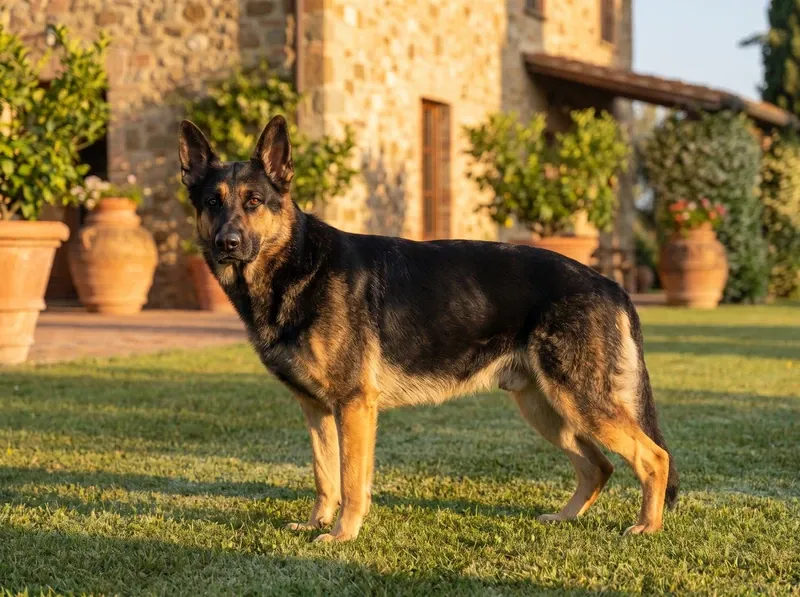
German Shepherd Dog, a black and tan adult with a level back standing side-on on a villa lawn

Working or show line

Two kinds of German Shepherd

Working lines are bred to work hard and stay steady under pressure: they usually need more to do each day, and more careful handling around strangers. Show lines are bred for the show ring, with a sloping back and a long, flowing trot, and are often calmer.

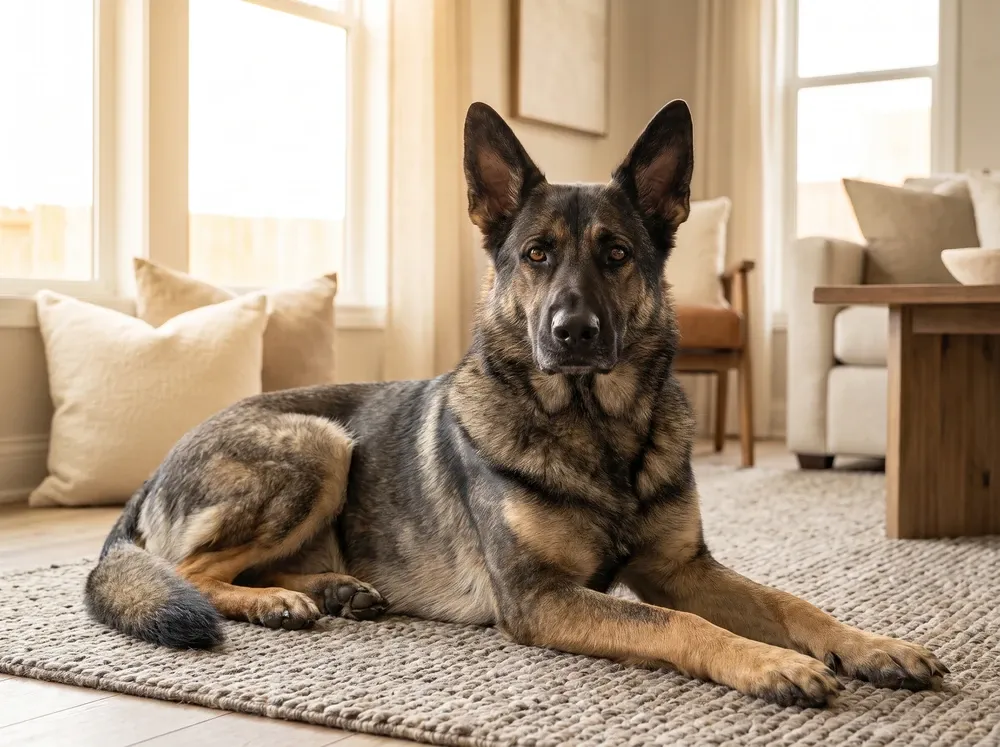
German Shepherd Dog, a sable adult lying head up on a woven rug in a bright room

Colours

Black and tan, black and gold, sable, bi-colour or solid black

German Shepherds come in black and tan, black and gold, sable, bi-colour and solid black, and some have a long coat. White German Shepherds are much loved too.

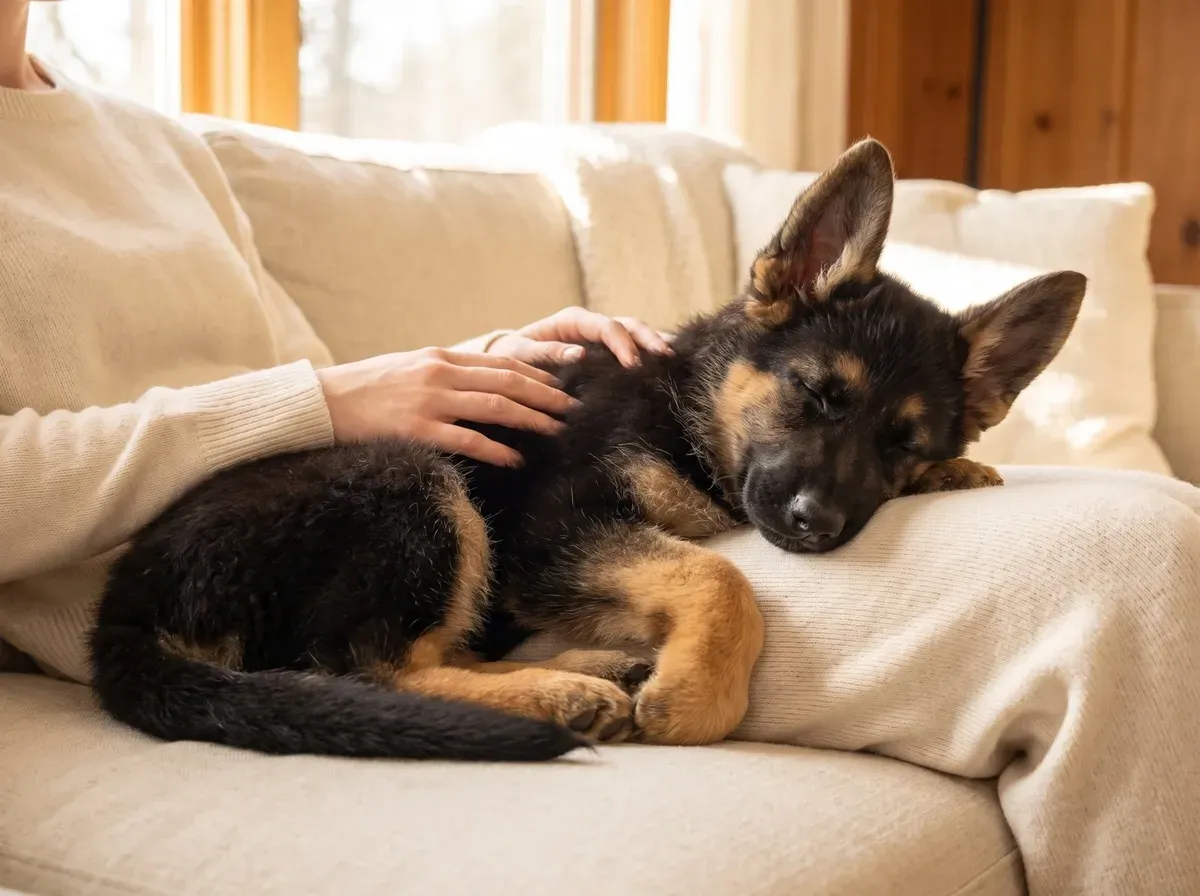
German Shepherd Dog, a black and tan puppy asleep in a pet parent's lap on the sofa

The first six months

Caring for a German Shepherd puppy

Their full vaccination course, microchip and Dubai Municipality registration come first. Then let them meet the world: people of every kind, from a distance they are happy at, with a treat for each.

Puppy health, 0 to 6 months
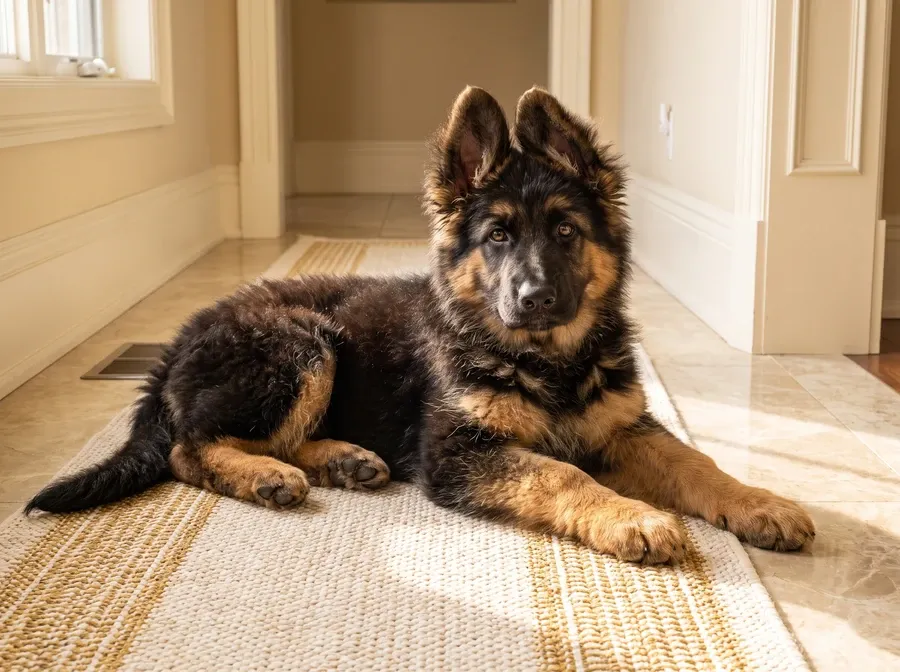
German Shepherd Dog, a long-coated puppy lying on a runner in a bright marble hallway

Getting the flat ready

A mat by the door, rugs on the marble

Set up a mat a few metres from the front door before the first delivery arrives. Put rugs or runners where they turn on marble, and lift them in and out of the car, or use a ramp, while their joints grow.

Ten things that make their life better
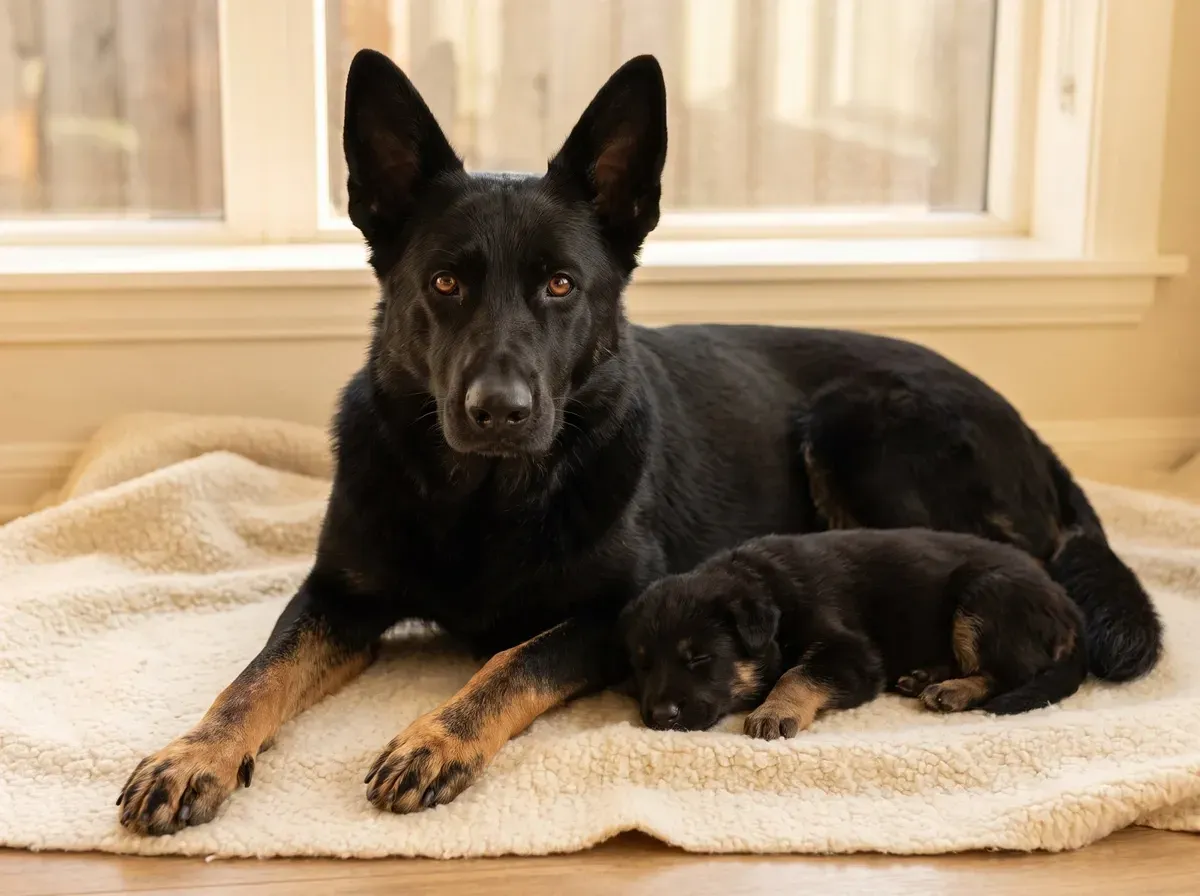
German Shepherd Dog, a black mother lying on a fleece blanket beside a sleeping puppy

Before you commit

Ask for the parents' scores

Ask the breeder which line the puppy comes from, and for both parents' hip and elbow scores, the x-ray grades of how well the joints fit. Hip and elbow problems are the first two health risks for a young German Shepherd.

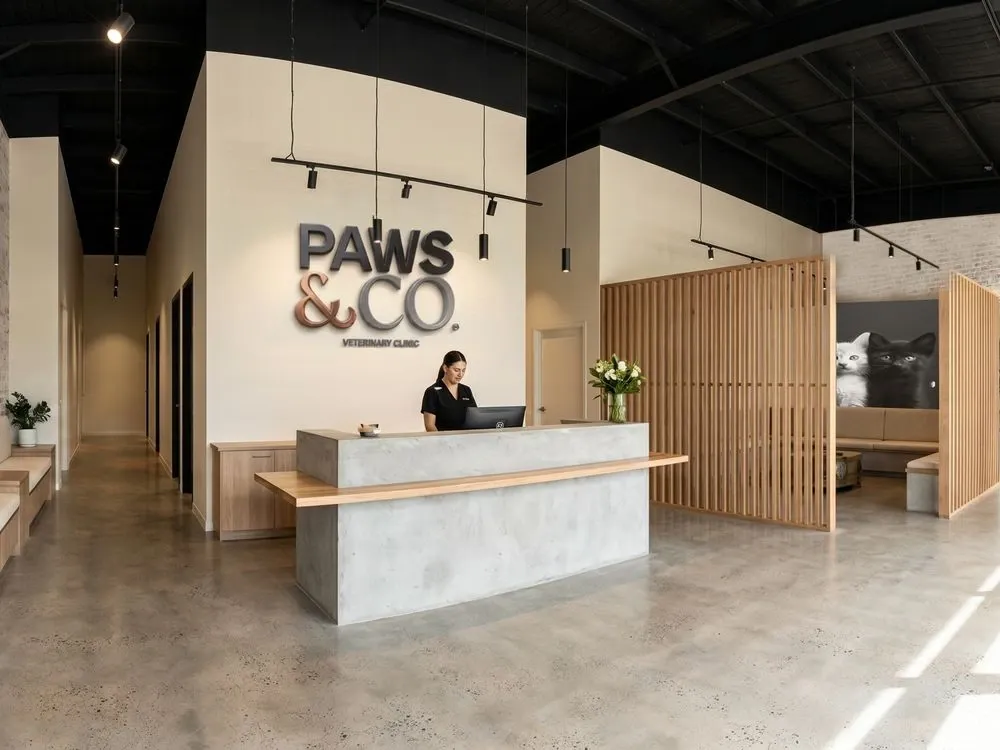
The reception of a Paws & Co clinic, with long cream benches and a stone reception desk

Before the clinics open

Join the founding families

AED 1,999 of essential care for AED 199. No payment now.

When to see a vet

When it is not behaviour.

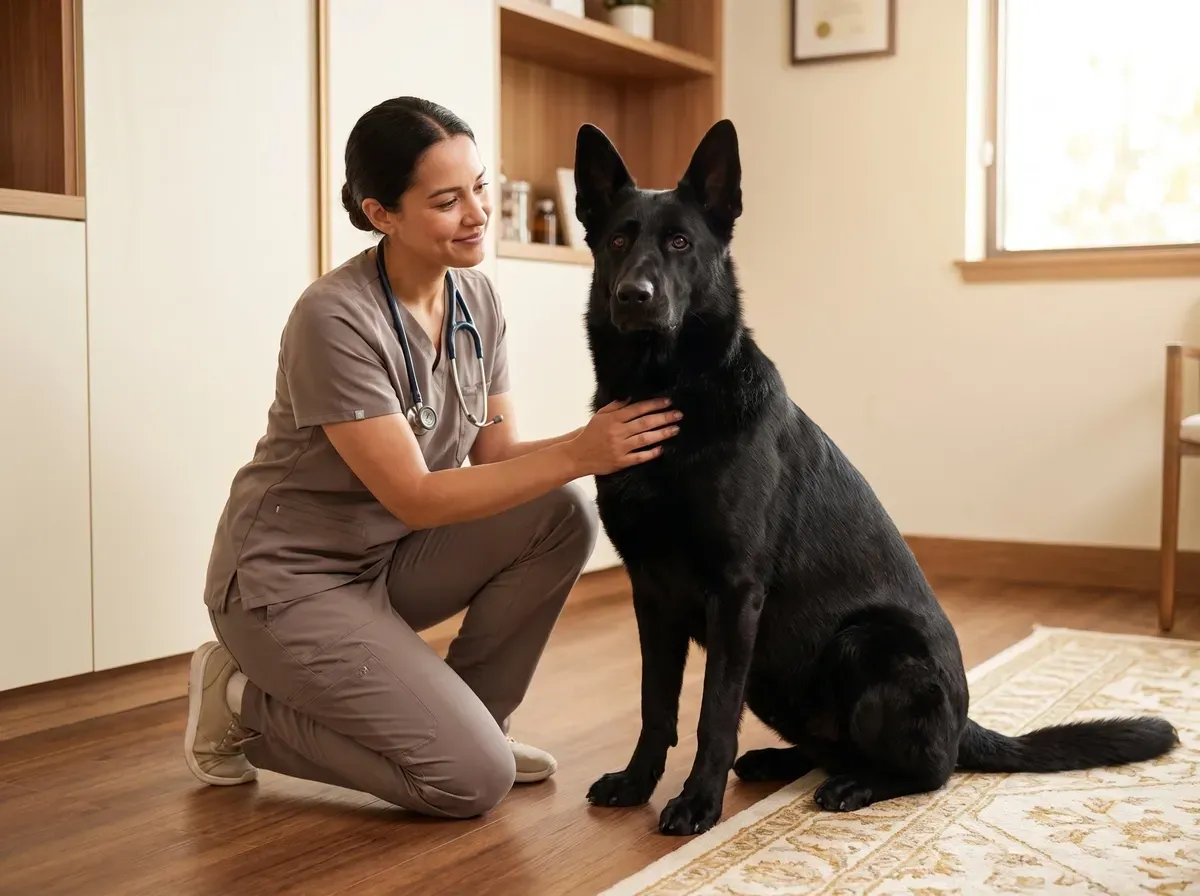
German Shepherd Dog, a black adult sitting as a vet in taupe scrubs kneels alongside, a hand on the dog's chest

Some of this is not a training problem, and treating it like one wastes time your dog may not have. If they are distressed when you leave, if they growl or guard their food, their toys or you, if they are frightened on the lead, or if anything about them changes suddenly at any age, contact your vet the same day. A tip from a website, ours included, is not the answer. If it cannot wait, contact your nearest emergency vet now.

With a German Shepherd, watch their back end and their gut. A wobble, scuffed back nails or trouble on the stairs can be their hips or Degenerative Myelopathy (DM, progressive weakness in the back legs). Endless paw licking is often a skin problem. If they lose weight on a good appetite, contact your vet. A swollen, tight belly, retching with nothing coming up, restlessness or drooling is an emergency: contact your vet now, day or night. And a Shepherd who is suddenly snappy when touched, or no longer wants to guard the door, may be in pain. It is easy to put it down to temperament, and that can cost months.

They'll keep dressing you in fur. If it starts coming out in patches, tell your vet.

German Shepherd history

Before they were yours.

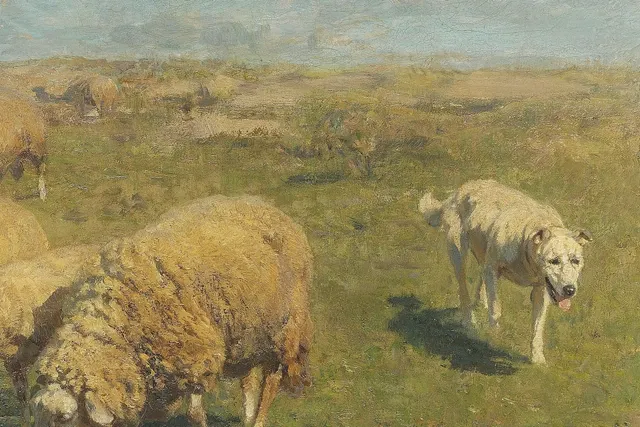
  1. German Shepherd Dog history, a painting of a herding dog with grazing sheep, Heinrich von Zügel, around 1911
    Heinrich von Zügel, Sheep with a herding dog on the pasture, around 1911.

    Before 1899

    German farmland

    On unfenced farms across Germany, sheepdogs walked the edge of the grazing all day, kept the flock off the crops and watched for anything that came near.

    What they still carryThe patrol. Pacing the hallway is the same job.

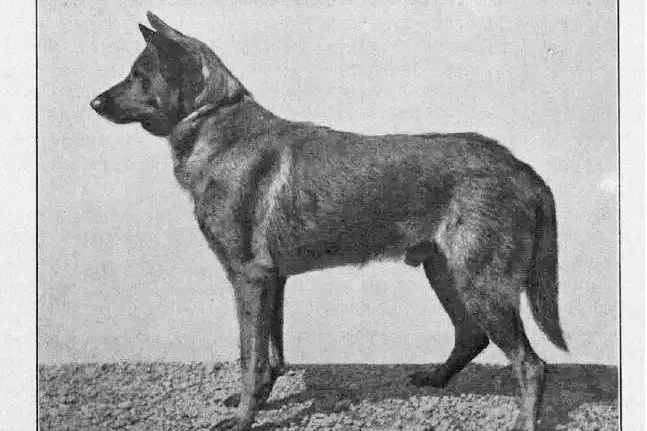
  2. German Shepherd Dog history, Horand von Grafrath, the first registered dog, standing side-on, 1910
    Horand von Grafrath, the first registered German Shepherd, from Max von Stephanitz's breed book, 1910.

    1899

    Horand, number one

    In April 1899 the cavalry officer Max von Stephanitz bought Hektor Linksrhein at a show, renamed the dog Horand von Grafrath, and founded the German Shepherd Dog club that month. Horand was registered as number one.

    What they still carryA breed made on purpose to be useful, and a dog who still wants a task.

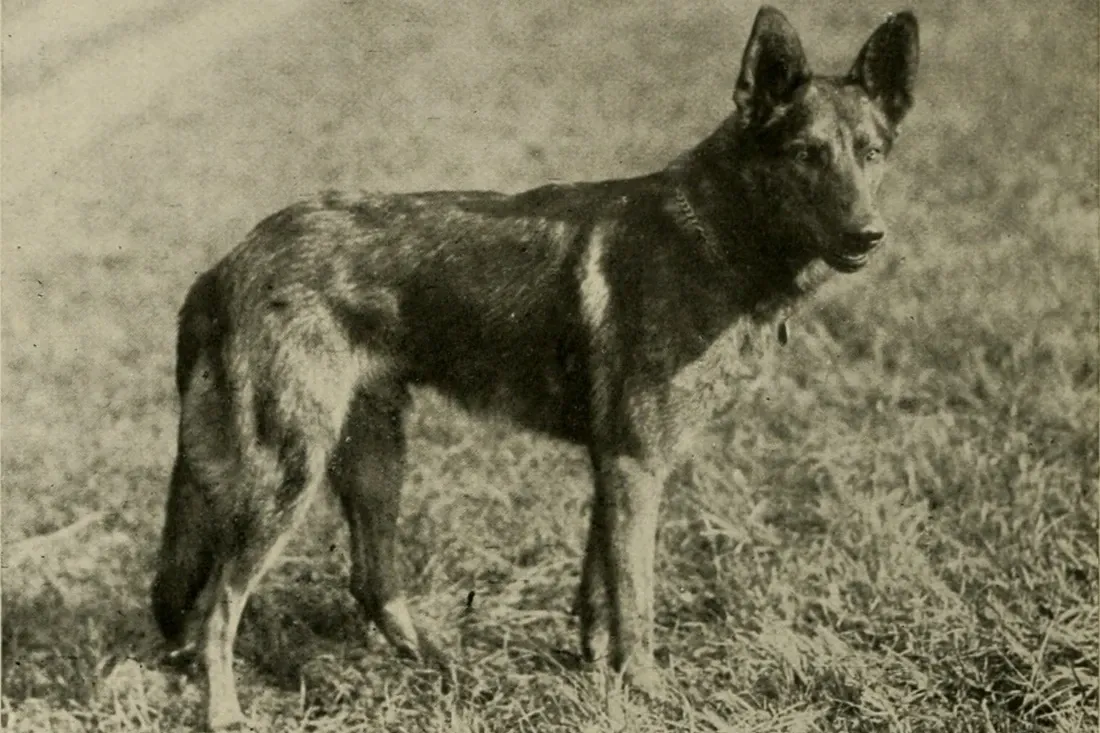
  3. German Shepherd Dog history, an early adult standing in a field, from a German breed book, 1921
    A German Shepherd in Max von Stephanitz's Der deutsche Schäferhund in Wort und Bild, 1921.

    1908

    Recognised in America

    The American Kennel Club recognised the breed in 1908. Over the century it split into show lines and working lines.

    What they still carryTwo kinds of German Shepherd, which look and behave differently.

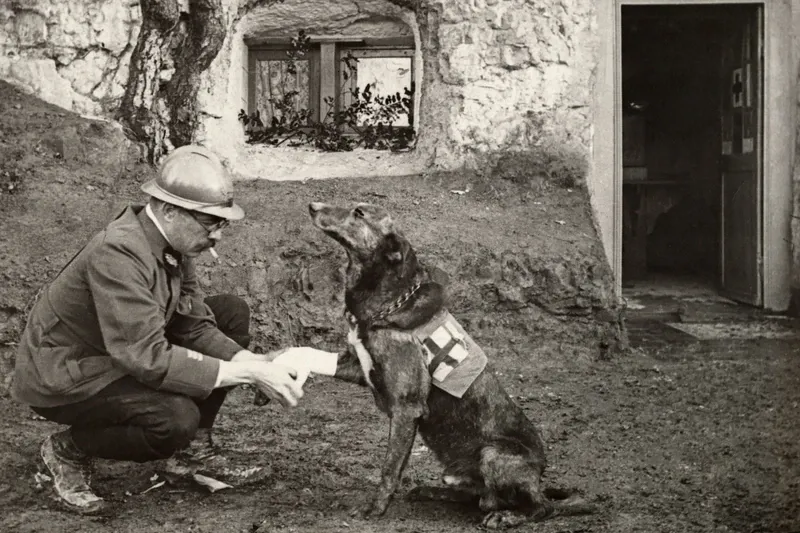
  4. German Shepherd Dog history, a soldier bandaging a Red Cross dog's paw, Belgian trenches, 1917
    A soldier bandages a Red Cross dog's paw in the Belgian trenches, 1917. Photo: Harriet Chalmers Adams.

    1914 to 1918

    Police and war work

    As herding work shrank, the breed moved into police work. In the First World War, German Shepherds carried messages, stood sentry and found the wounded.

    What they still carryThe protective streak, and a dog who watches their person for the next instruction.

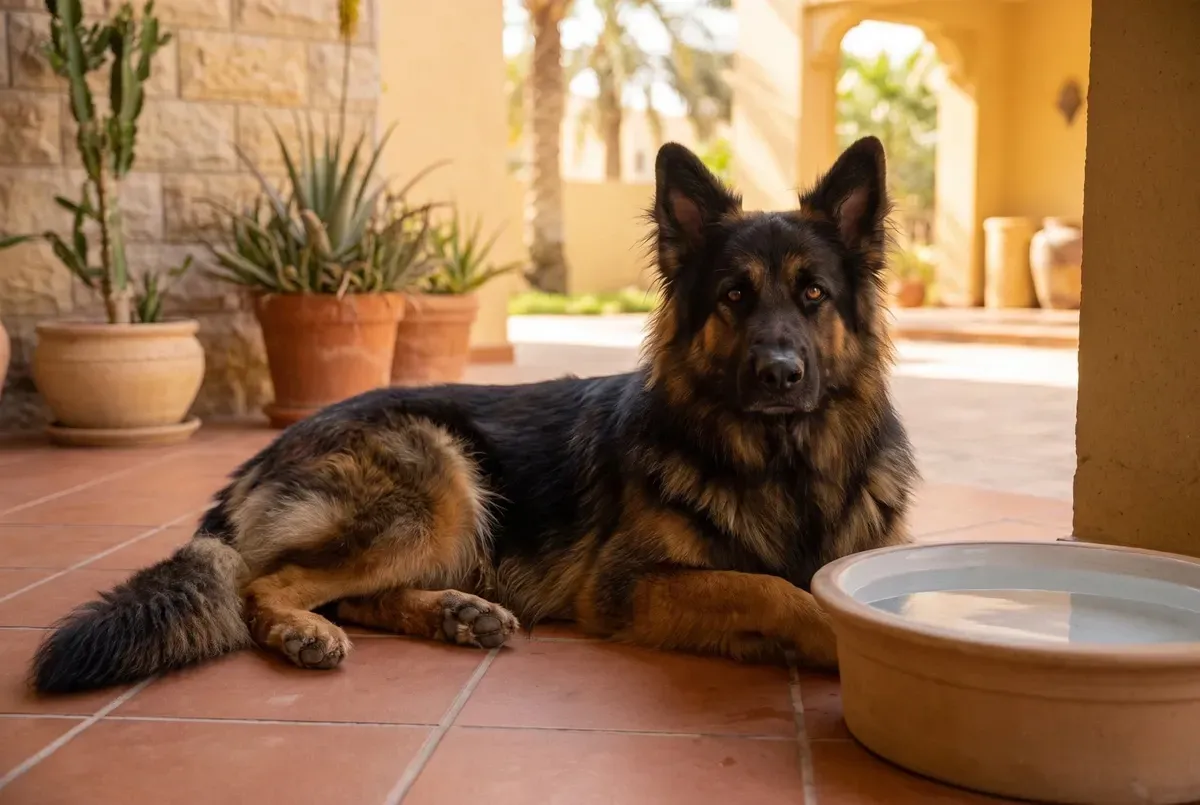
  5. German Shepherd Dog history, the breed today, a long-coated adult lying on a Dubai villa terrace by a water bowl

    Today

    In Dubai

    In the UAE a German Shepherd is a family dog, a guard and a working dog, often in a flat with a front door onto a busy corridor.

    What they still carryA dog built to patrol farmland beside one shepherd, now in 45°C heat.

German Shepherd questions

The ones you type at midnight.

Most of these get asked late at night, by someone watching their dog and not sure what they are seeing.

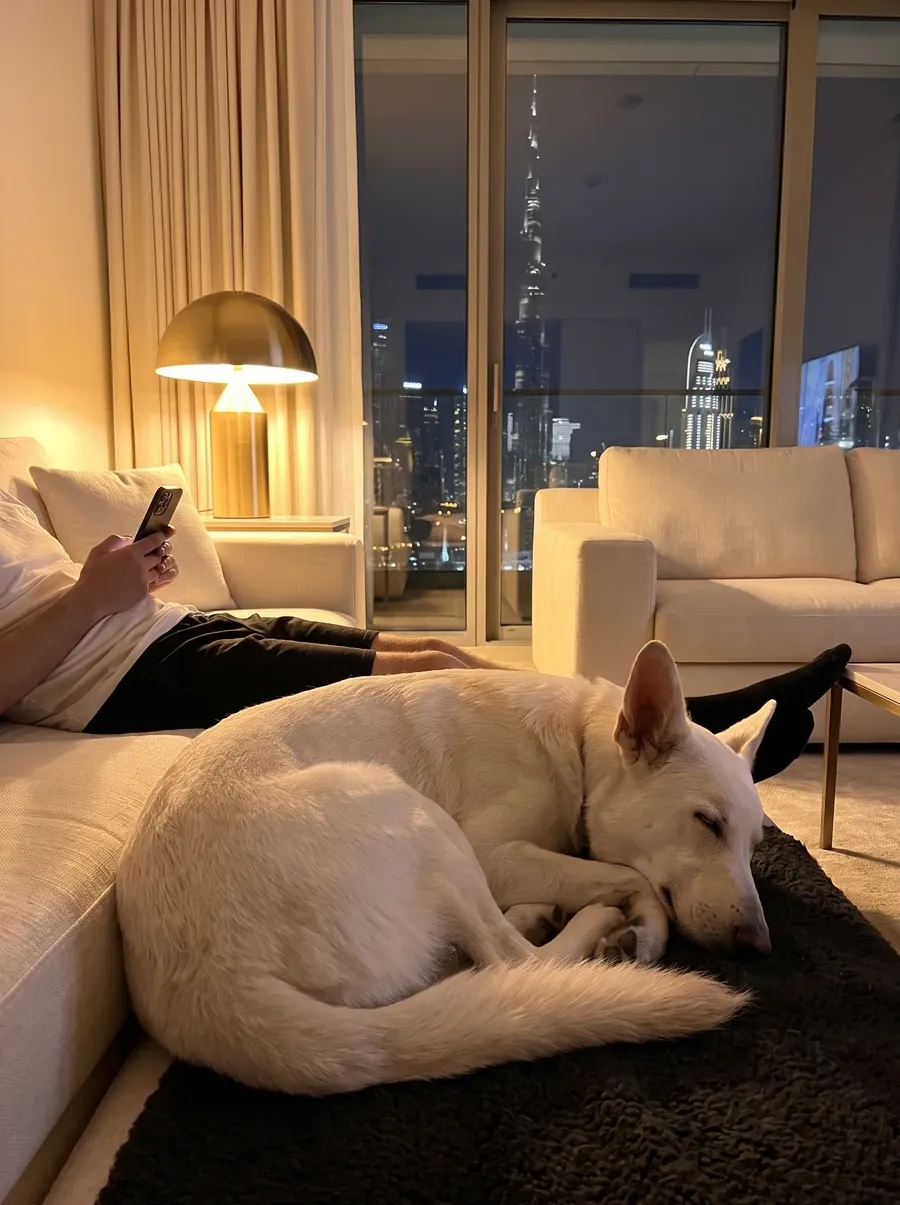
German Shepherd Dog in Dubai, a white adult asleep on a dark rug as a pet parent reads a phone, Burj Khalifa behind
How long do German Shepherds live?

German Shepherds usually live 9 to 13 years. In a UK study of German Shepherds seen by vets, the median was 10.3 years.

How big is a full grown German Shepherd?

A full grown German Shepherd is a large dog. Males usually weigh 29.5 to 41 kg and females 22.5 to 32 kg.

What is the German Shepherd temperament like?

German Shepherds are clever, loyal and deeply devoted to their own people, and naturally reserved with strangers. Most are happiest with a job to do.

Do German Shepherds shed?

Yes, German Shepherds shed heavily, and all year round. Brush them more than once a week.

What colours do German Shepherds come in?

German Shepherds come in black and tan, black and gold, sable, bi-colour and solid black, and some have a long coat. White German Shepherds are much loved too.

What is the difference between working line and show line German Shepherds?

Working line German Shepherds are bred to work hard and stay steady under pressure, and usually need more to do each day. Show lines are bred for a sloping back and a flowing trot, and are often calmer.

Are German Shepherds good with strangers?

Most German Shepherds are polite but reserved with strangers, because they were bred to judge them. Let them choose when to say hello. If they have lunged or snapped at anyone, contact your vet soon.

What is bloat in German Shepherds?

Bloat in German Shepherds is a twisted stomach, and it is an emergency. If you see a swollen belly and retching with nothing coming up, contact your vet now, day or night.

Can a German Shepherd live in Dubai?

Yes, a German Shepherd can live well in Dubai with care in the heat. Walk before sunrise and after dark from May to September, and give their head a job every day.

Worried about them? Contact your vet today.