We’re hiring people who love them like we do. Join us careers@pawsandco.comSee open roles
UAE Government Licensed MOCCAE
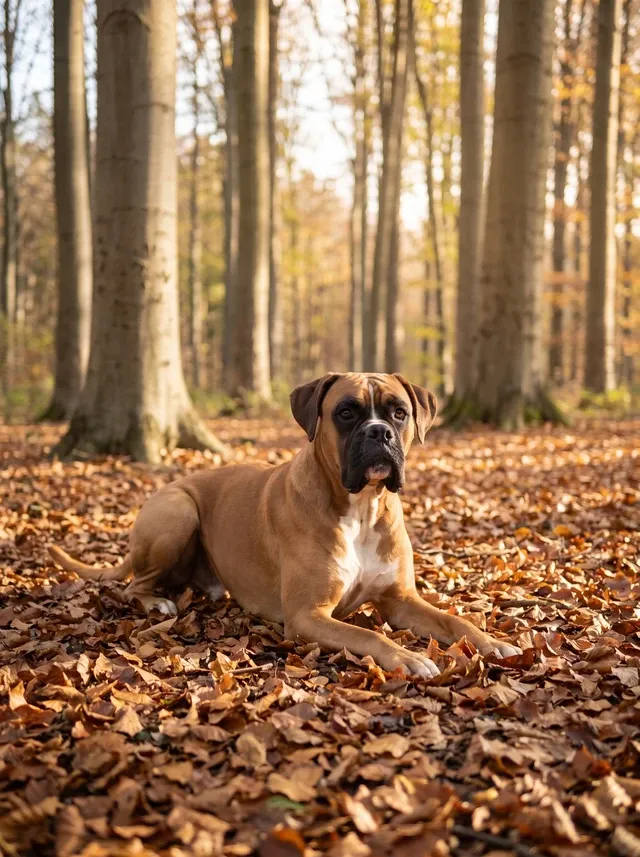
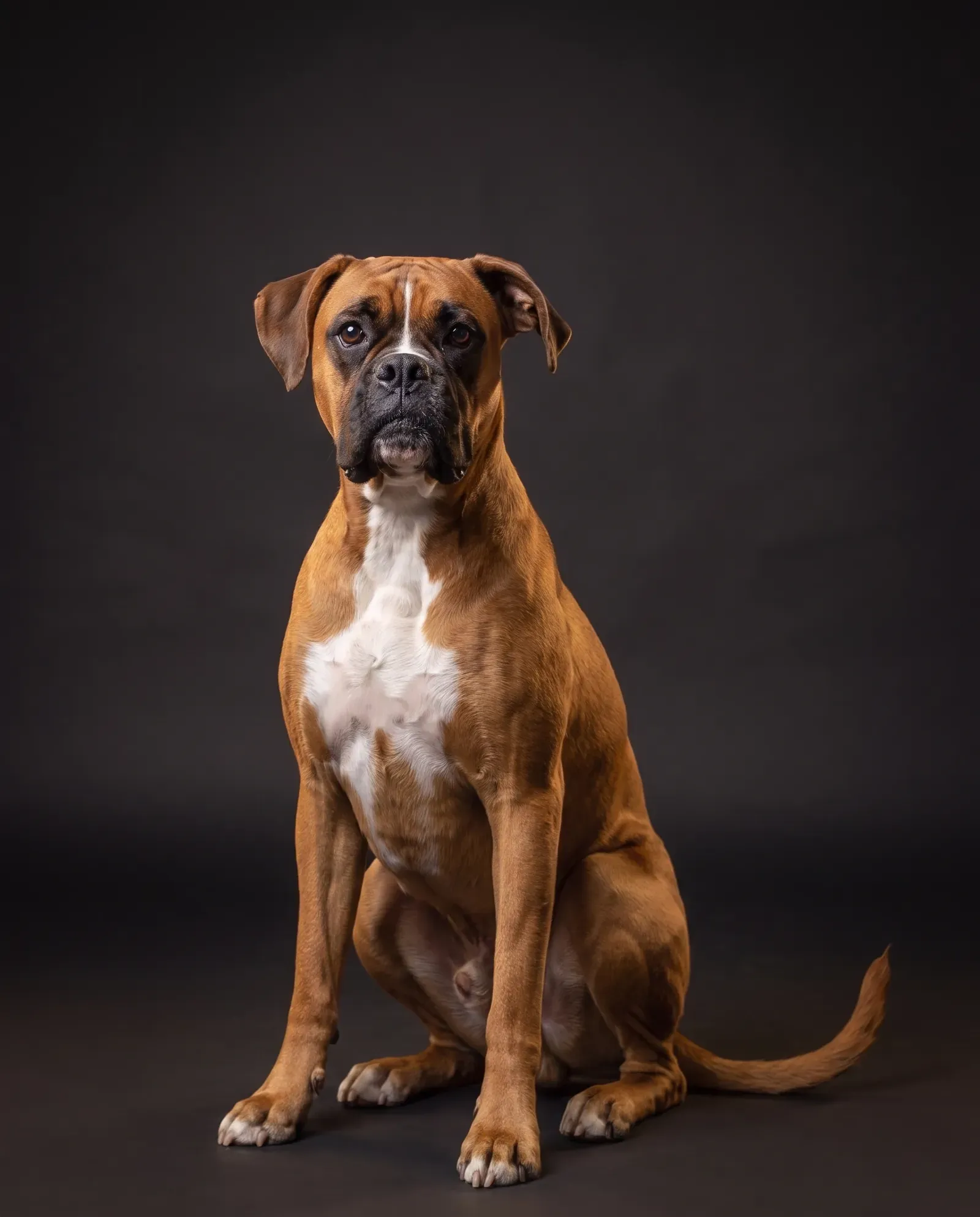
Boxer in Dubai, studio portrait of a calm fawn adult with a white blaze and bib, sitting

Breed guide  ·  Dogs

Boxer

He wants to play fetch at noon in August. I walk him before sunrise all summer.

Lifespan
10 to 12 years
Size
Large
Weight
23 to 36 kg
Shedding
Light to moderate

Last updated 12 October 2026

Join the founding families. AED 1,999 of essential care for AED 199.

No payment now. We'll be in touch by email and WhatsApp as we open enrolment.

✓
Thank you.

We will be in touch soon to confirm.

Boxer traits

What they brought with them.

Tap a card to see what is going on.

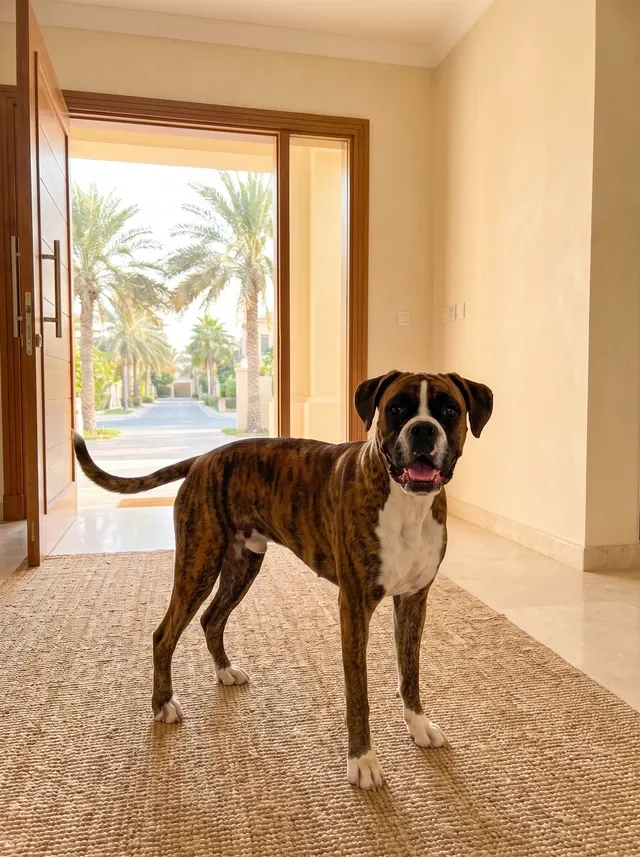
Boxer in Dubai, a brindle adult wiggling on a jute mat inside an open villa door onto palms

At home

Why does my Boxer wiggle at the door?

A whole-body wiggle for every arrival, a happy woo-woo sound, and for some guests, a bark first.

What's going onBoxers were bred to guard a yard, so the front door still matters to them. A mat a few metres from the door gives the welcome somewhere to go, and a treat there gives them a job they can get right.

Boxer in Dubai, a mahogany fawn adult lying on cool tiles with the skyline behind sheer curtains

At home

Why does my Boxer dog pant so much?

Panting hard after a short game, even in the evening.

What's going onTheir short nose cools them less well than a longer one. From May to September, walk them before sunrise and after dark, and keep hard play indoors in the cool. Loud, fast panting that does not settle in the shade means stop, cool them and contact your vet now.

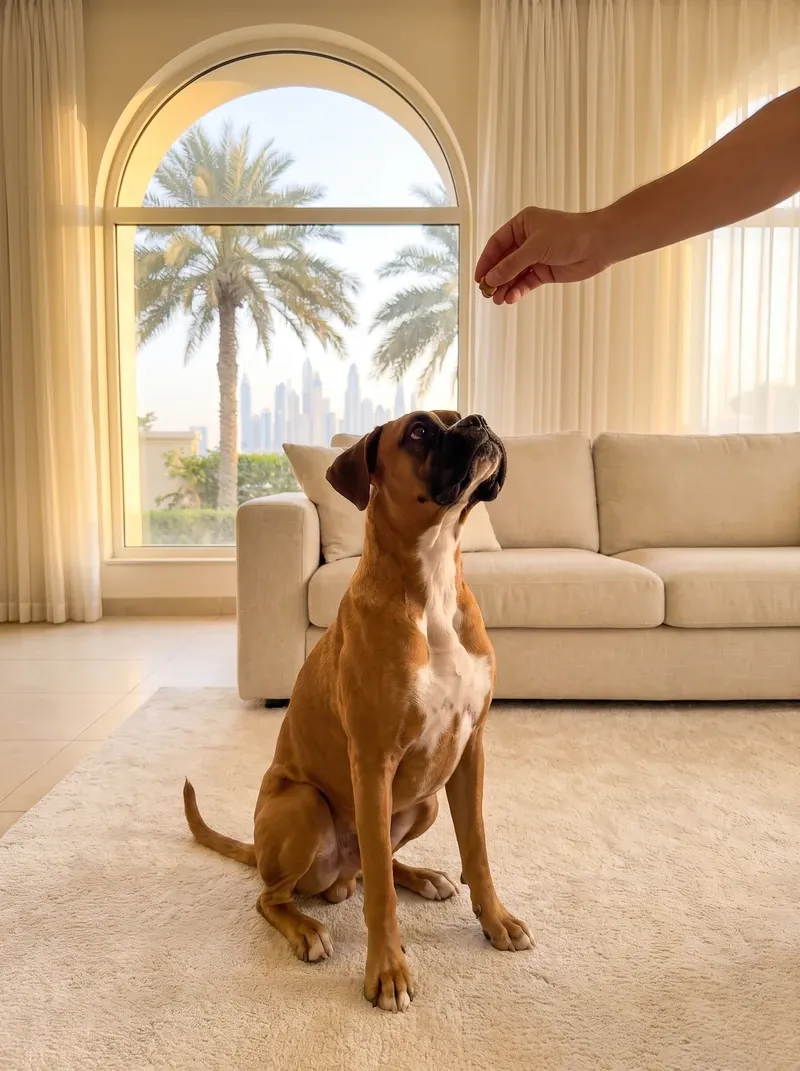
Boxer in Dubai, a young fawn dog sitting on a rug looking up at a treat, palms through an arched window

At home

A puppy until they aren't

Jumping up, boxing with their front paws and zooming round the flat at ten at night.

What's going onBoxers stay bouncy for years. Jumping up is funny at twelve weeks and a problem at full size, so reward four paws on the floor from the first day.

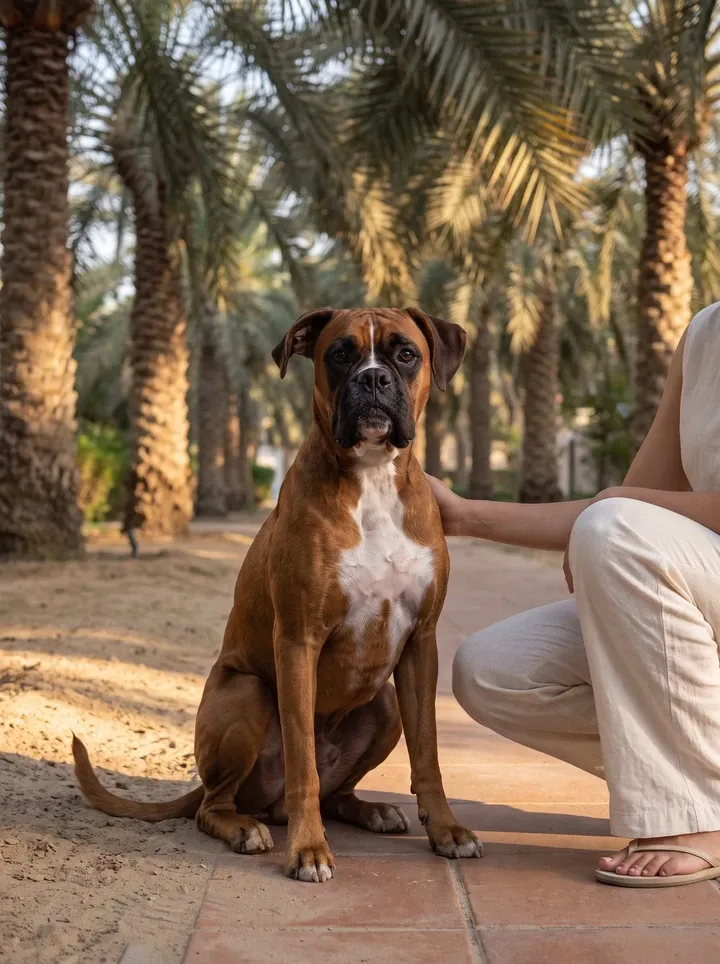
Boxer in Dubai, a red fawn adult resting in the shade of date palms beside a crouching pet parent

At home

Why is my Boxer tired on walks?

Tiring early on a walk, when they used to keep going.

What's going onAortic Stenosis (a narrowing where blood leaves the heart) is on the breed's health record from puppyhood, and Cardiomyopathy (a disease of the heart muscle) from about age four. A murmur heard at a puppy visit is worth following up. For fainting, a cough or faster breathing while they sleep, contact your vet now.

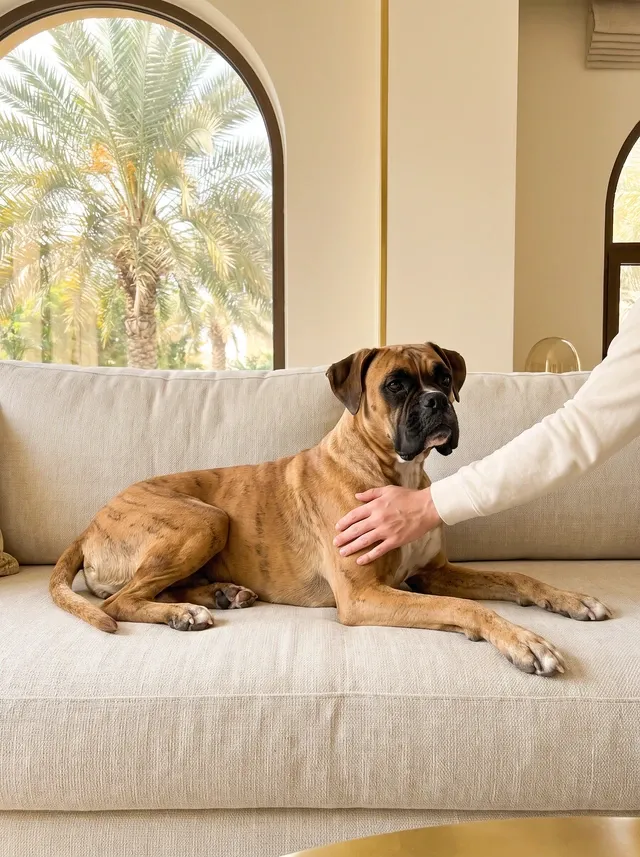
Boxer in Dubai, a light brindle adult on a linen sofa as a hand runs along their side, palms behind

At home

Is that lump on my Boxer serious?

A new bump on the skin that looks like an insect bite.

What's going onCancers, including Mast Cell Tumours (a common skin cancer in dogs), are on the breed's health record from about age four, and some look like a harmless bump. Feel them over every week, photograph any new lump with a coin beside it, and show your vet.

Boxer, a fawn adult lying on a cushion bed in a cream kitchen beside an empty steel bowl

At home

Rest after dinner

Dinner finished, and straight into a game of chase round the flat.

What's going onBloat, Gastric Dilatation-Volvulus (GDV, a twisted stomach), is on the breed's health record from about six months. Two or three smaller meals, with an hour of quiet before and after each one, is the simplest protection they have.

A Boxer in Dubai

The bit nobody tells you.

Their bursts

Built for: Short, hard bursts in a cool German forest.

In Dubai: A summer outside that their short nose struggles with.

Their company

Built for: A busy family yard.

In Dubai: A flat, with their people at work.

Their watch

Built for: Guarding the yard.

In Dubai: The corridor outside the front door.

The jumping, the zoomies at ten at night and the barking at the corridor mostly come from that gap.

You cannot give them a forest. You can give them cool hours and a job for their head, and the ten things below are how.

Your plan is built around their breed: the health risks for a Boxer at every age, and the care that goes with each one.

Join the founding families. AED 1,999 of essential care for AED 199.

Daily care for a Boxer

Ten things that make their life better.

Many of them are free, and most matter at every age.

  1. They will greet everyone who arrives, one way or another. A rule gives the greeting somewhere to go.

    Every age, most of all 6 months to 2 years

    AED 100 to 400 for a mat or bed

    Why

    They will greet everyone who arrives, one way or another. A rule gives the greeting somewhere to go.

    What to do

    Teach them that a mat a few metres from the door pays, long before any visitor. When the bell goes, thank them once and send them there. While they are learning, have deliveries left outside. If they have lunged or snapped at anyone, tell your vet instead.

  2. They decide what a stranger is from the people they have already met.

    Every age, most of all under 2 years

    FreeIn your plan

    Why

    They decide what a stranger is from the people they have already met.

    What to do

    In their first months, let them watch all kinds of people from a distance they are happy at, with a treat for each, and reward them for keeping their paws on the floor when they say hello. Carry them, or use clean ground, until their vaccinations are finished.

  3. The lift is a small box where strangers walk straight at them, and not everyone wants a Boxer's paws on their shirt.

    Every age, most of all 6 months to 2 years

    Free

    Why

    The lift is a small box where strangers walk straight at them, and not everyone wants a Boxer's paws on their shirt.

    What to do

    Wait for an empty lift, or stand them in the back corner with you in front. Keep the lead short and loose near entrances, and ask building staff not to reach for them.

  4. A bored Boxer invents their own games, usually with your sofa.

    Every age, most of all 6 months to 2 years

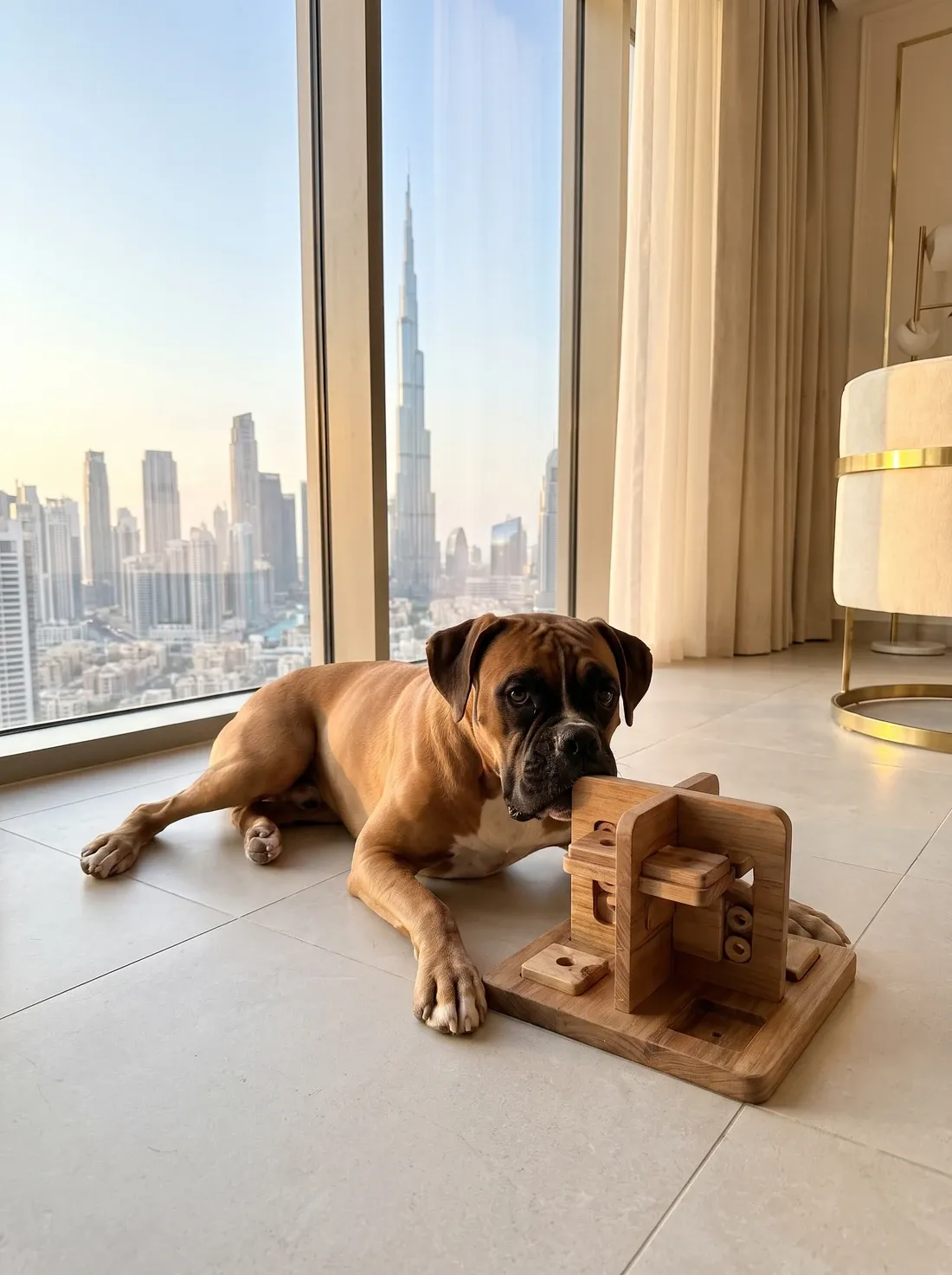
    Under AED 150 for a puzzle feeder

    Why

    A bored Boxer invents their own games, usually with your sofa.

    What to do

    Two or three short training sessions a day, indoors in the cool, and part of their dinner hidden around the flat or served in a puzzle feeder. Stop while they still want more.

  5. Their short nose makes heat harder for them, and bloat (a twisted stomach) is a risk from about six months.

    Every age, most of all puppies and from 6 months

    Free

    Why

    Their short nose makes heat harder for them, and bloat (a twisted stomach) is a risk from about six months.

    What to do

    From May to September, walk before sunrise and after dark, and check the pavement with the back of your hand. Feed two or three smaller meals, with an hour of rest before and after each. Panting that will not settle, or a swollen belly and retching with nothing coming up, is an emergency: contact your vet now. Ask your vet about the meal routine and about gastropexy (an operation that tacks the stomach in place).

  6. A basket muzzle they are used to keeps a stressful moment calm, at the vet or anywhere else.

    Every age, easiest under 2 years

    Under AED 200

    Why

    A basket muzzle they are used to keeps a stressful moment calm, at the vet or anywhere else.

    What to do

    Choose a basket shaped for a short face, so they can still pant freely. Teach it young and slowly: show it, treat; nose in, treat. Never put it on for the first time in a hurry.

  7. They will have a heart scan as a juvenile and again as a young adult, and both go easier when standing still is something they already know.

    Every age, start as a puppy

    Free

    Why

    They will have a heart scan as a juvenile and again as a young adult, and both go easier when standing still is something they already know.

    What to do

    A few minutes a few times a week: lift a paw, look in an ear, lift a lip, and practise standing calmly on a mat for a reward. Brush their teeth every day, and give the short coat a weekly brush. Stop before they get wriggly.

  8. Boxers are bouncy for years, and guarding can start to show between one and three years old.

    6 months to 3 years

    Free

    Why

    Boxers are bouncy for years, and guarding can start to show between one and three years old.

    What to do

    Reward calm, every time, and give the bounce short bursts of play with clear endings. Use a flat collar or a harness, never anything that hurts or frightens them. A growl is a warning, so never punish it. If new guarding appears, tell your vet early.

  9. Hip Dysplasia (a poorly fitting hip joint) is one of their main health risks from puppy to young adult, and arthritis follows from prime adulthood.

    Every age, most of all while growing and from 7 years

    Free to AED 1,000 for rugs and a rampIn your plan

    Why

    Hip Dysplasia (a poorly fitting hip joint) is one of their main health risks from puppy to young adult, and arthritis follows from prime adulthood.

    What to do

    Rugs where they turn on marble, a ramp for the car, few stairs while they grow, and a lean body. Ask your vet for an orthopaedic evaluation (joint and bone exam) as a juvenile.

  10. A new lump, or faster breathing while they sleep, is something you can spot at home before anyone else.

    Every age, most of all from 4 years

    FreeIn your plan

    Why

    A new lump, or faster breathing while they sleep, is something you can spot at home before anyone else.

    What to do

    Once a week, run your hands over them from nose to tail, and photograph any new lump. Weigh them monthly. Show your vet a new lump the same week you notice it, and tell your vet about faster breathing straight away.

Three of these are in your plan. The rest you can do at home.

Join the founding families. AED 1,999 of essential care for AED 199.

Boxer health by age

Their health, at every age.

In a Boxer, tiring early, a new lump or a sudden loss of interest in play is often the body talking, not them growing up. Choose their age to see what to watch for, and the care that goes with it.

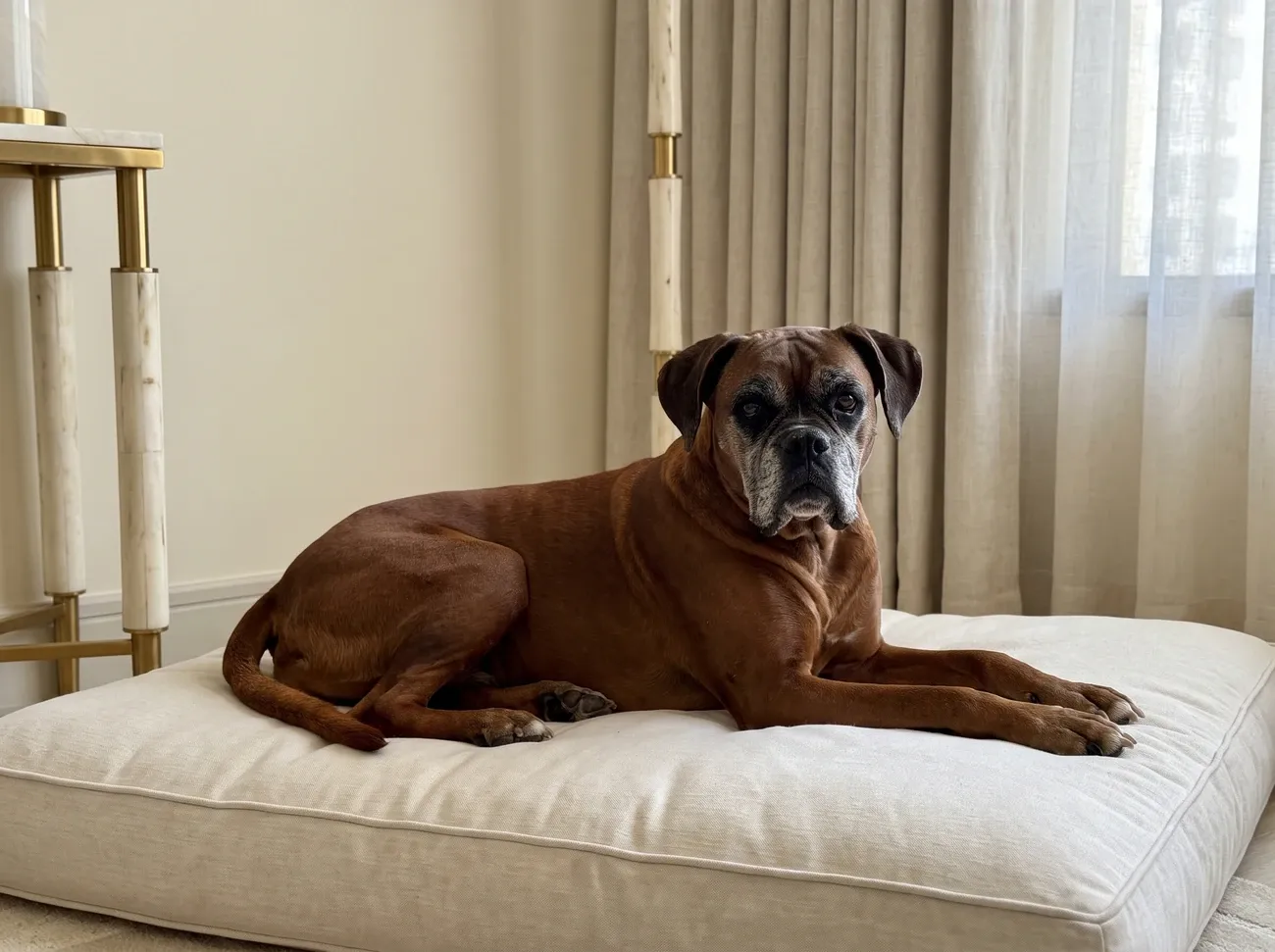
Boxer, an older mahogany dog with a greying muzzle resting on a cushioned orthopaedic bed

How old are they?

Their age

Boxer Puppy health

the first six months

What to watch for

  1. Developmental or early clinical signs of Hip Dysplasia (HD, poorly fitting hip joint)
  2. Congenital murmur or early cardiac abnormality related to Aortic Stenosis (a narrowing where blood leaves the heart)
  3. Genetic predisposition to Hypothyroidism (an underactive thyroid), no clinical disease expected at this stage
  4. Gastrointestinal upset and conformation-related feeding intolerance
  5. Juvenile onset of allergies

The care that goes with it

  1. Core vaccinations, microchip and Dubai Municipality registration
  2. Deworming, and flea and tick prevention
  3. Body Condition Score (a check on whether they are the right weight), dental, growth and nutritional evaluation, and early socialisation
  4. Hip Dysplasia (HD, a poorly fitting hip joint) screening, as a baseline
  5. Early follow-up for any signs of Aortic Stenosis (a narrowing where blood leaves the heart)
The full care detail
  • Core vaccination programme, microchipping and Dubai Municipality registration. Titre testing discussion where clinically appropriate; not a substitute for completing the core vaccine series
  • Deworming and external parasite prevention tailored to Dubai exposure
  • Body Condition Score (BCS), Muscle Condition Score (MCS), dental, growth and nutritional evaluation, and early socialisation
  • Baseline screening focused on Hip Dysplasia (HD)
  • Early diagnostic follow-up for signs suggestive of Aortic Stenosis

Their age

Boxer Juvenile health

6 months to 2 years

What to watch for

  1. Emerging Hip Dysplasia (HD, poorly fitting hip joint) with exercise intolerance or lameness
  2. Early clinical or screening evidence of Aortic Stenosis
  3. Genetic predisposition to Hypothyroidism, monitoring only
  4. Developing risk of Gastric Dilatation-Volvulus (GDV, a twisted stomach), Bloat
  5. Recurrent or persistent allergies

The care that goes with it

  1. Orthopaedic evaluation (joint and bone exam)
  2. Cardiac ultrasound (a scan of the heart)
  3. A discussion with your vet on when to neuter or spay, with their large-breed growth in mind
  4. Thyroid screening, with treatment only if signs are confirmed
  5. Finding the real cause of signs that keep coming back
The full care detail
  • Orthopaedic evaluation
  • Cardiac ultrasound
  • Neuter/spay timing discussion that accounts for large-breed growth and disease risk
  • Thyroid screening for breed predisposition; treat only if clinical signs are confirmed
  • Investigate recurrent signs rather than repeatedly treating presumed Hypothyroidism

Their age

Boxer Young Adult health

2 to 4 years

What to watch for

  1. Hip Dysplasia (HD, poorly fitting hip joint)
  2. Aortic Stenosis
  3. Genetic predisposition to Hypothyroidism
  4. Gastric Dilatation-Volvulus (GDV, a twisted stomach), Bloat
  5. Allergies

The care that goes with it

  1. Orthopaedic evaluation (joint and bone exam)
  2. Cardiac ultrasound (a scan of the heart)
  3. Thyroid screening, with treatment only if signs are confirmed
  4. Gastrointestinal monitoring (keeping watch on their stomach and gut)
  5. Allergy management
The full care detail
  • Orthopaedic evaluation
  • Cardiac ultrasound
  • Thyroid screening for breed predisposition; treat only if clinical signs are confirmed
  • Gastrointestinal monitoring
  • Allergy management

Their age

Boxer Prime Adult health

4 to 7 years

What to watch for

  1. Cancer (Lymphoma, a cancer of the lymph glands; Mast Cell Tumours, a common skin cancer in dogs)
  2. Heart Disease (Cardiomyopathy, a disease of the heart muscle)
  3. Hip Dysplasia (HD, poorly fitting hip joint)
  4. Hypothyroidism (an underactive thyroid)
  5. Arthritis

The care that goes with it

  1. Oncology screening (checks for cancer)
  2. Heart care
  3. Joint supplements
  4. Thyroid treatment, if hypothyroidism is confirmed
  5. Pain relief, where it is needed
The full care detail
  • Oncology screening
  • Cardiac care
  • Joint supplements
  • Thyroid therapy
  • Pain management

Their age

Boxer Senior health

7 to 10 years

What to watch for

  1. Cancer
  2. Heart Disease
  3. Arthritis
  4. Kidney Disease
  5. Dental Disease

The care that goes with it

  1. Cancer care, if cancer is found
  2. Heart medication, as your vet directs
  3. Pain relief
  4. Kidney monitoring
  5. Dental cleaning
The full care detail
  • Oncology care
  • Cardiac medications
  • Pain relief
  • Renal monitoring
  • Dental cleaning

Their age

Boxer Geriatric health

10 years and over

What to watch for

  1. Cancer
  2. Kidney Disease
  3. Heart Disease
  4. Arthritis
  5. Cognitive Dysfunction (dementia in older pets)

The care that goes with it

  1. Cancer treatment, where it is right for them
  2. Kidney support
  3. Heart care
  4. Pain relief
  5. Care for cognitive dysfunction (dementia in older pets)
  6. Quality-of-life assessments
  7. Palliative care (comfort care)
  8. End-of-life planning with your vet team, when the time comes
The full care detail
  • Oncology treatment
  • Renal support
  • Cardiac care
  • Pain management
  • Cognitive therapy
  • Quality-of-life assessments
  • Tailored palliative and comfort-focused care plan
  • Compassionate end-of-life planning with your veterinary team

Breed predispositions indicate an increased risk rather than certainty of disease. What is right for them always comes from their own history and an evaluation.

Getting a Boxer puppy in Dubai

Before they come home.

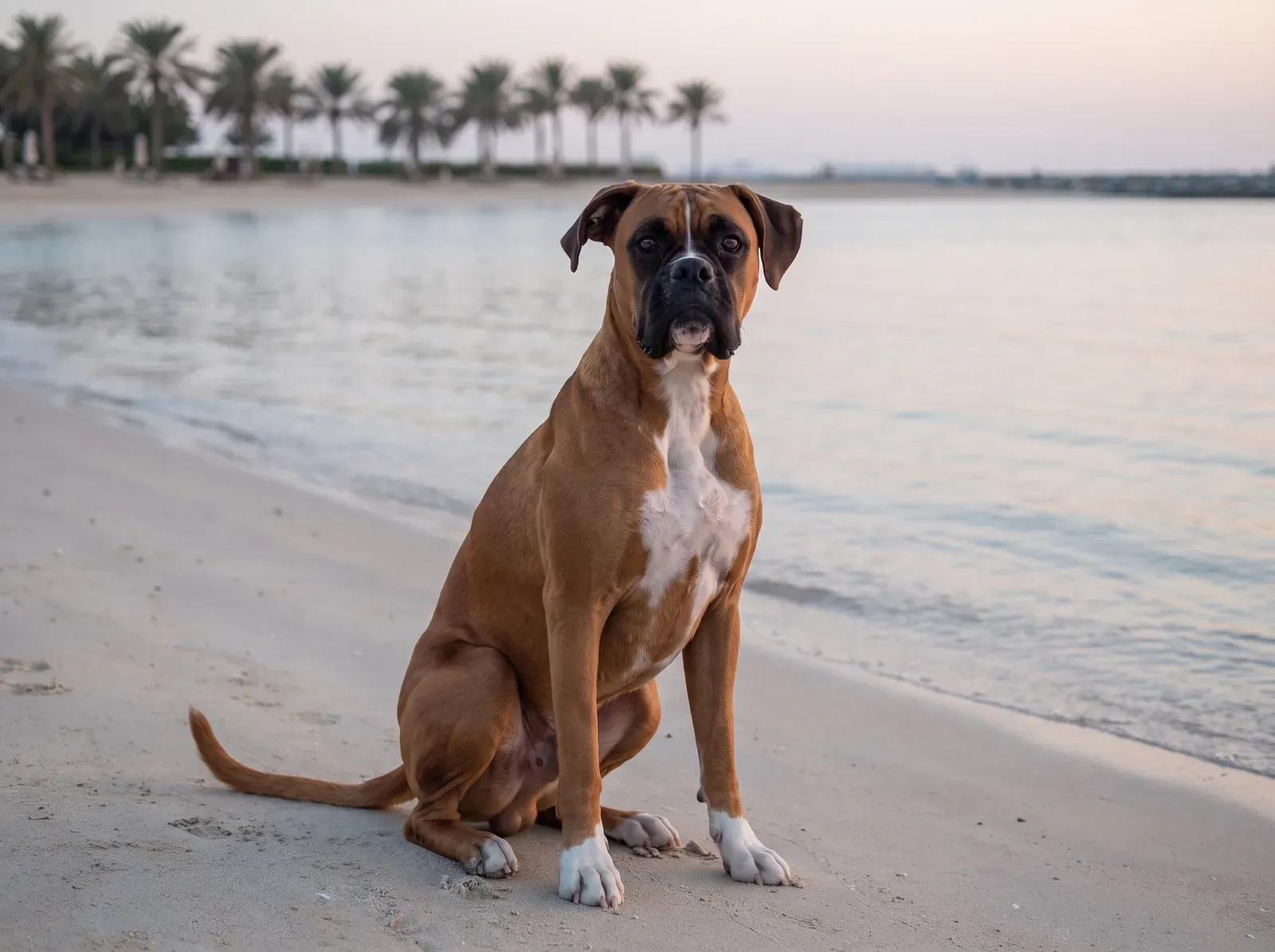
Boxer in Dubai, a fawn adult sitting at the water's edge on a beach at dusk, palms behind

Where they come from

A German dog at heart

The Boxer was shaped in Germany: the first Boxer club was founded in Munich in 1895. The American Kennel Club registered its first Boxer in 1904.

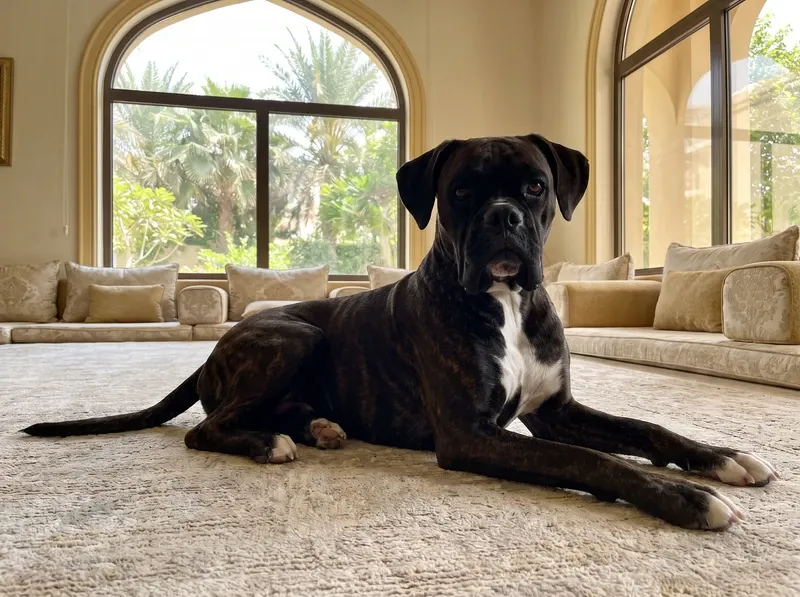
Boxer in Dubai, a dark brindle adult lying on a rug in a majlis below an arched window onto palms

Colours

Fawn or brindle, with a black mask

Boxers come in fawn or brindle. Fawn runs from light tan to mahogany. Brindle runs from a few clear black stripes to so many the fawn barely shows through. Both wear the black mask. Some have white markings, which can run up between the eyes, and a plain fawn or brindle Boxer is just as much a Boxer.

Boxer in Dubai, a light brindle puppy asleep on a linen sofa as a hand rests on their back, skyline behind

The first six months

Boxer puppy care

Core vaccinations come first, with a microchip and Dubai Municipality registration. A baseline look at their hips, a follow-up for any heart murmur, four paws on the floor from day one, and calm meetings with all kinds of people matter most now. Keep them out of the midday heat.

Puppy health, 0 to 6 months
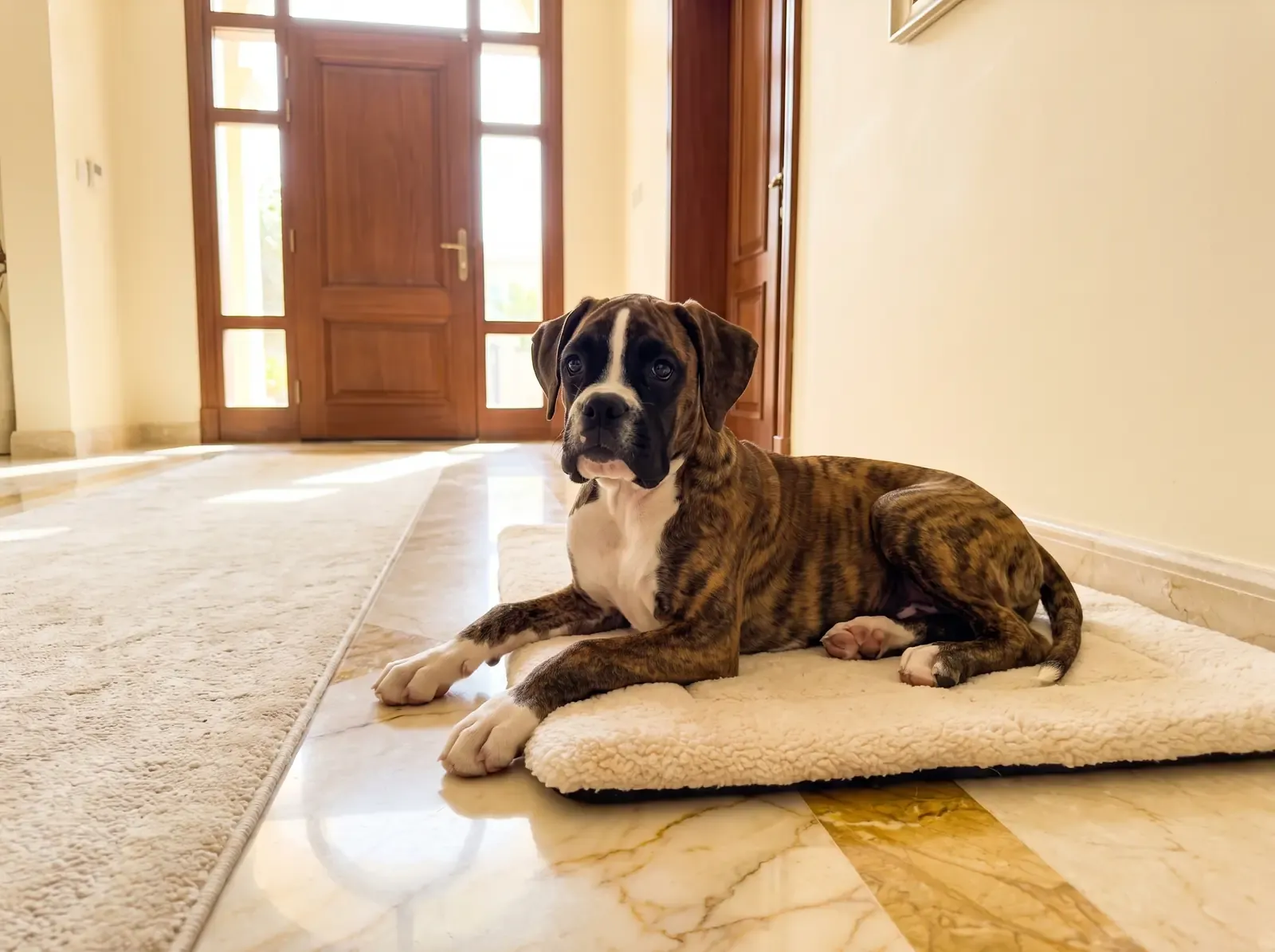
Boxer, a brindle puppy with a white blaze lying on a mat in a marble villa hallway

Getting the home ready

A mat, rugs and a cool room

Put a mat a few metres from the front door before they arrive, and rugs where they will turn on marble. Plan a ramp for the car, a cool room for summer days, and two or three mealtimes with quiet either side.

Ten things that make their life better
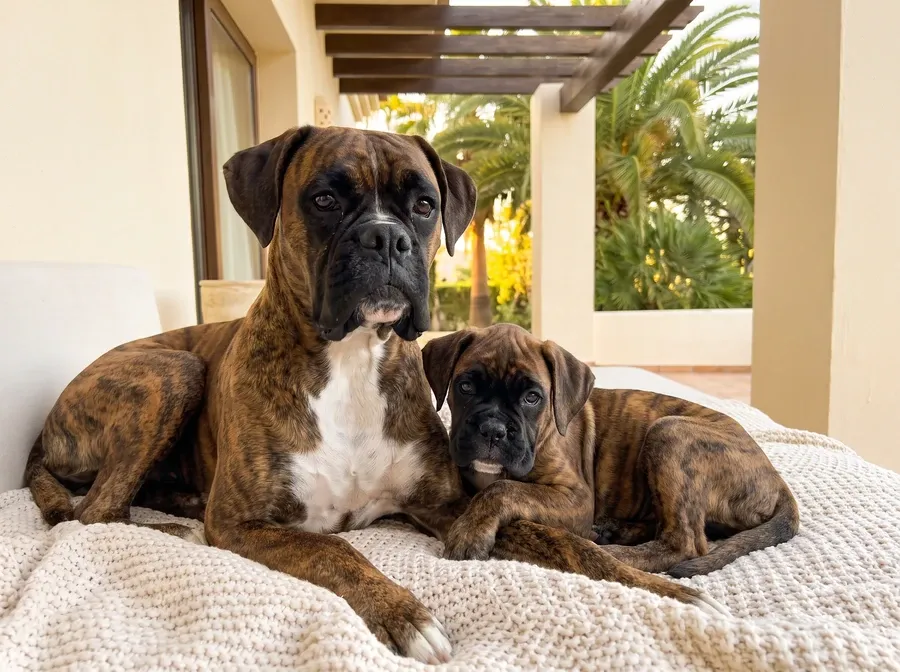
Boxer in Dubai, a brindle mother lying with one puppy on a shaded villa terrace with palms beyond

Before you commit

Ask about hearts and hips

Hip Dysplasia (a poorly fitting hip joint) and Aortic Stenosis (a narrowing where blood leaves the heart) sit at the top of the Boxer's health record from puppyhood. Ask your vet about both before you commit, because they shape the first vet visits and the years that follow.

The reception of a Paws & Co clinic, with long cream benches and a stone reception desk

Before the clinics open

Join the founding families

AED 1,999 of essential care for AED 199. No payment now.

When to see a vet

When it is not behaviour.

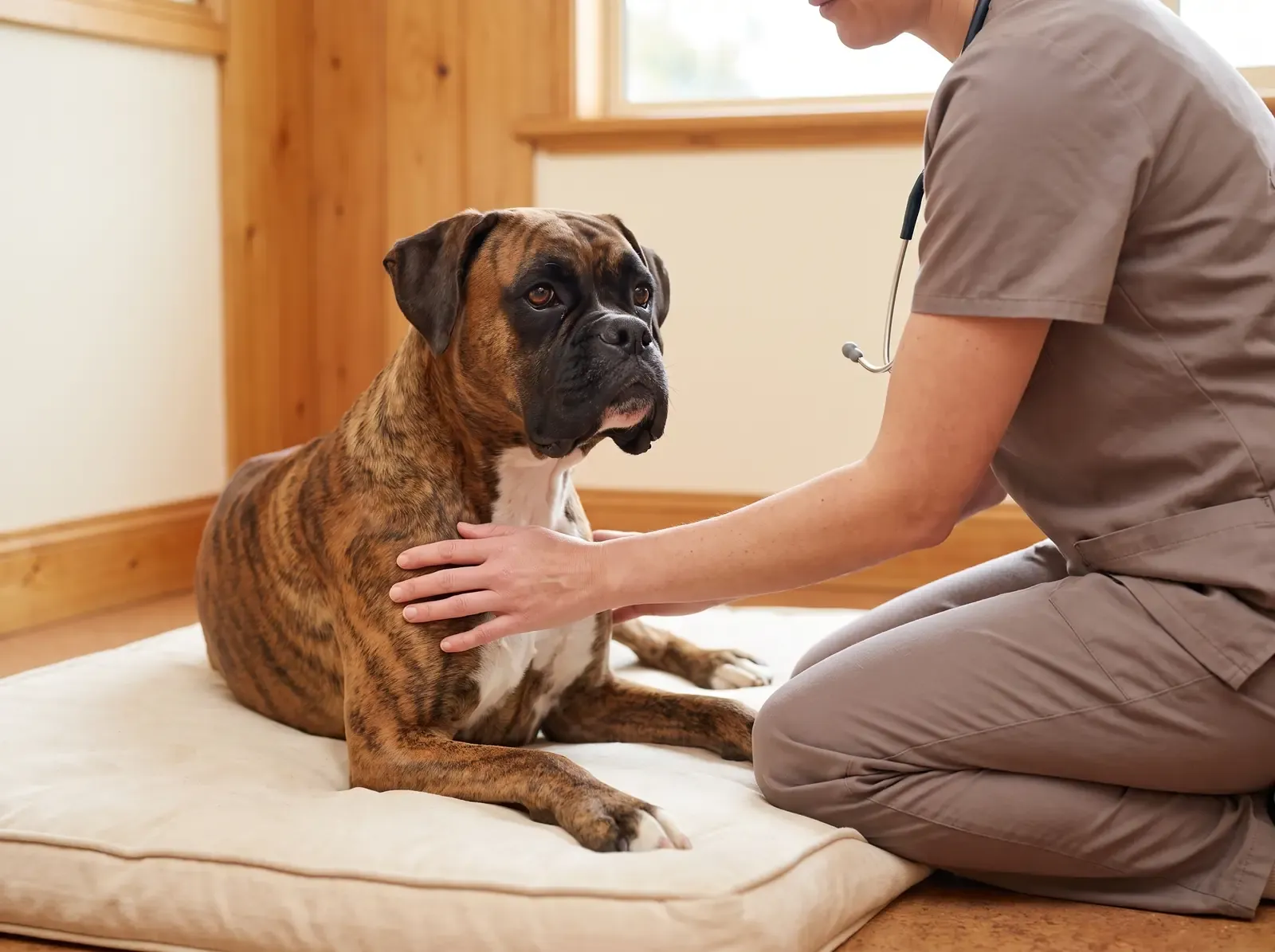
Boxer, a brindle adult lying on a padded mat as a vet in taupe scrubs rests a hand on their chest

Some of this is not a training problem, and treating it like one wastes time your dog may not have. If they are distressed when you leave, if they growl or guard their food, their toys or you, if they are frightened on the lead, or if anything about them changes suddenly at any age, contact your vet the same day. A tip from a website, ours included, is not the answer. If it cannot wait, contact your nearest emergency vet now.

With a Boxer, watch their heart, their skin and their breathing in the heat. Tiring early can be their heart, so tell your vet. For fainting or faster breathing while they sleep, contact your vet now. A new lump can be a Mast Cell Tumour (a common skin cancer in dogs), however harmless it looks, so show your vet the same week. A swollen, tight belly, retching with nothing coming up, restlessness or drooling is an emergency: contact your vet now. So is loud, fast panting that will not settle in the shade: cool them and contact your vet now. A Boxer who suddenly stops wanting to play, or growls when touched, may be in pain. It is easy to put it down to growing up, so tell your vet early.

They'll still ask for fetch at noon. Say no, and if they flag on the dawn walk too, tell your vet.
Boxer history

Before they were yours.

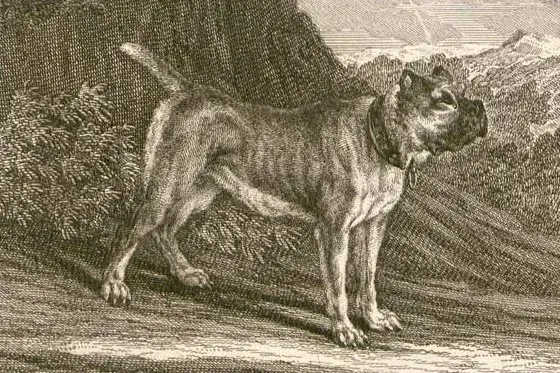
  1. Boxer history, a Bullenbeisser type dog standing in a rocky landscape, etching by Johann Elias Ridinger, Germany, 1738
    A smaller bear-biter, the Bullenbeisser type, etched by Johann Elias Ridinger, 1738.

    Before the Boxer

    The Bullenbeisser

    The Boxer comes from the Bullenbeisser, a German hunting dog that caught boar and deer and held them until the hunter arrived. It needed a broad jaw and a nose set back so it could breathe while it held on.

    What they still carryThe short muzzle and the strong front end, and the reason they feel the heat faster than a long-nosed dog.

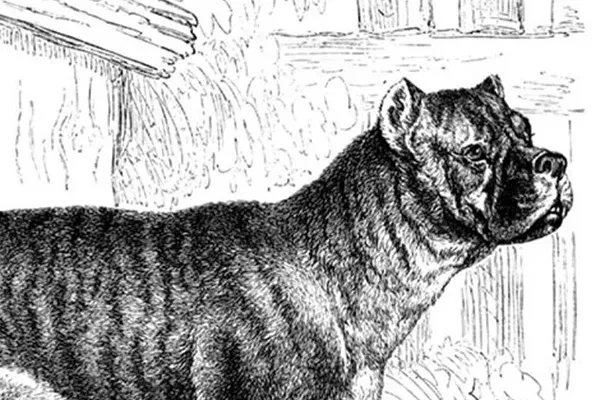
  2. Boxer history, head and shoulders of a brindle Bullenbeisser with cropped ears, engraving, Germany, 1860s
    A Bullenbeisser, from Brehms Thierleben, 1860s.

    The 1800s

    Butchers' and cattle dogs

    When the big hunts ended, the dogs moved to towns and farms, holding cattle for butchers and guarding yards.

    What they still carryThe guarding instinct and the strength. The goofiness came later.

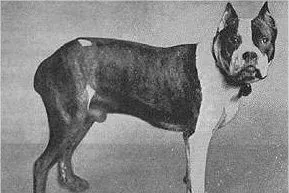
  3. Boxer history, Mühlbauer's Flocki, an early dog of the Munich breed club, Munich, 1895
    Mühlbauer's Flocki, from the Boxer Klub München, 1895.

    1895 to 1904

    Munich, and the first club

    In 1895 a club in Munich set out to make a lighter, friendlier dog with the same face, and the American Kennel Club registered its first Boxer in 1904.

    What they still carryA family dog built on a working frame, and the famous playfulness.

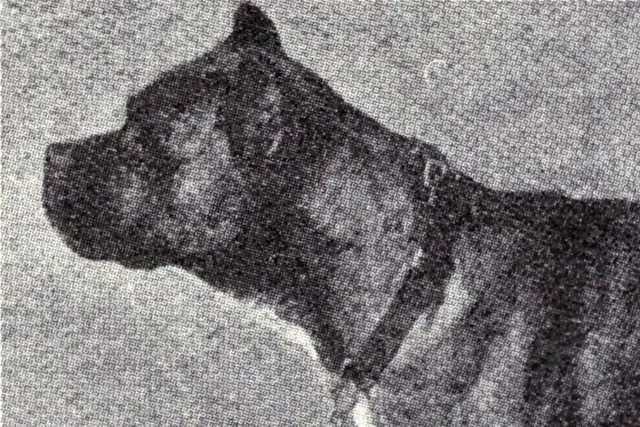
  4. Boxer history, head and shoulders of a brindle dog with cropped ears and a collar, photograph, 1915
    A brindle Boxer, photographed in 1915.

    The First World War

    Messengers

    In the First World War, Boxers carried messages for the German army.

    What they still carryThe alertness at the door, and a dog who wants to be where their people are.

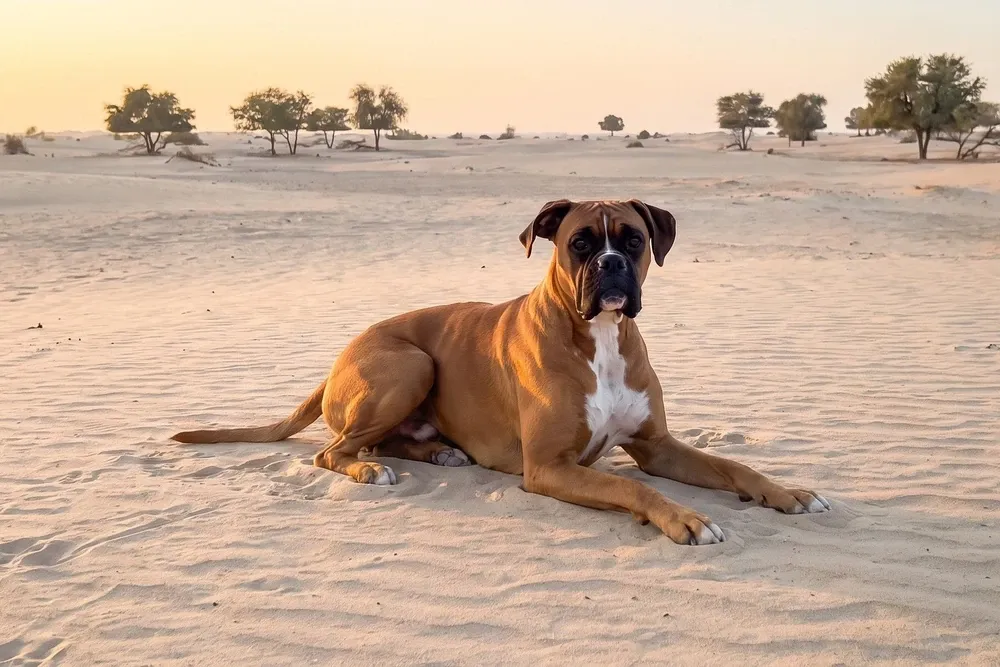
  5. Boxer history, the breed today, a red fawn adult lying on pale desert sand, Dubai, 2026

    Today

    In Dubai

    Today a Boxer has no boar to catch. They have a family to clown for, and a Dubai summer their short nose was never built for.

    What they still carryA short muzzle built for short bursts in a German forest, now living through a 45°C summer in a flat.

Boxer questions

The ones you type at midnight.

Most of these get asked late at night, by someone watching their dog and not sure what they are seeing.

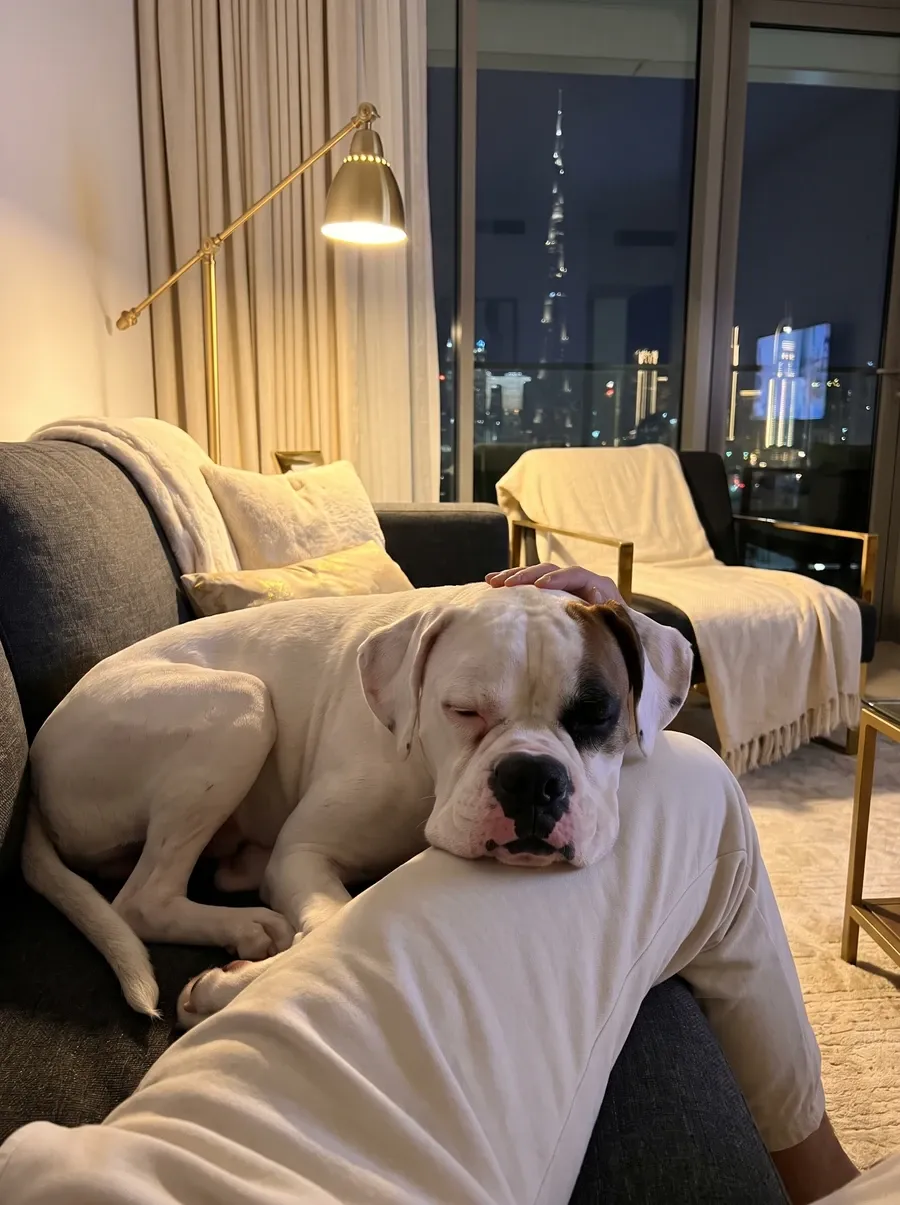
Boxer in Dubai, a white adult asleep with their head on a knee, the lit skyline behind
How long do Boxer dogs live?

Most Boxers live 10 to 12 years. In a study of Boxers seen by vets in the UK, the median was 10.5 years.

How big is a Boxer dog?

An adult Boxer weighs 23 to 36 kg. Males usually weigh 29.5 to 36 kg, and females a little less.

Are Boxer dogs good with families?

Yes, Boxers are devoted family dogs who adore their people and love a game. They stay playful for years, so teach four paws on the floor early, especially around small children.

Can a Boxer dog cope with the heat in Dubai?

A Boxer feels the heat quickly because of their flatter face, so the heat needs real care here. From May to September, walk before sunrise and after dark, keep hard play indoors in the cool, and never leave them in a car.

What colours do Boxer dogs come in, and is there a white or black Boxer?

Boxers are fawn or brindle, and some have white markings too, covering up to a third of the coat. A heavily striped brindle can look almost black, with the fawn barely showing through.

Is a Boxer dog hypoallergenic?

No, a Boxer sheds lightly to moderately. Their short coat needs only a weekly brush.

What are common Boxer dog skin problems?

The main skin problem to know in a Boxer is Mast Cell Tumours (a common skin cancer in dogs), from about age four. Any new lump, however harmless it looks, is worth showing your vet. Allergies are on their health record from puppyhood too.

What is bloat in a Boxer?

Bloat, Gastric Dilatation-Volvulus (GDV), is a twisted stomach, on the Boxer's health record from about six months. A swollen belly and retching with nothing coming up is an emergency: contact your vet now.

How do I take care of a Boxer puppy?

Caring for a Boxer puppy starts with core vaccinations, a baseline look at their hips and a follow-up for any heart murmur. Keep them out of the heat, teach four paws on the floor, and let them meet calm people of every kind.

Worried about them? Contact your vet today.