We’re hiring people who love them like we do. Join us careers@pawsandco.comSee open roles
UAE Government Licensed MOCCAE
Weimaraner in Dubai, studio portrait of a calm silver grey adult sitting

Breed guide  ·  Dogs

Weimaraner

She greets me at the door with a shoe in her mouth, every time. I keep the good ones upstairs.

Lifespan
11 to 14 years
Size
Large
Weight
25 to 41 kg
Shedding
Moderate

Last updated 14 October 2026

Join the founding families. AED 1,999 of essential care for AED 199.

No payment now. We'll be in touch by email and WhatsApp as we open enrolment.

✓
Thank you.

We will be in touch soon to confirm.

Weimaraner traits

What they brought with them.

Tap a card to see what is going on.

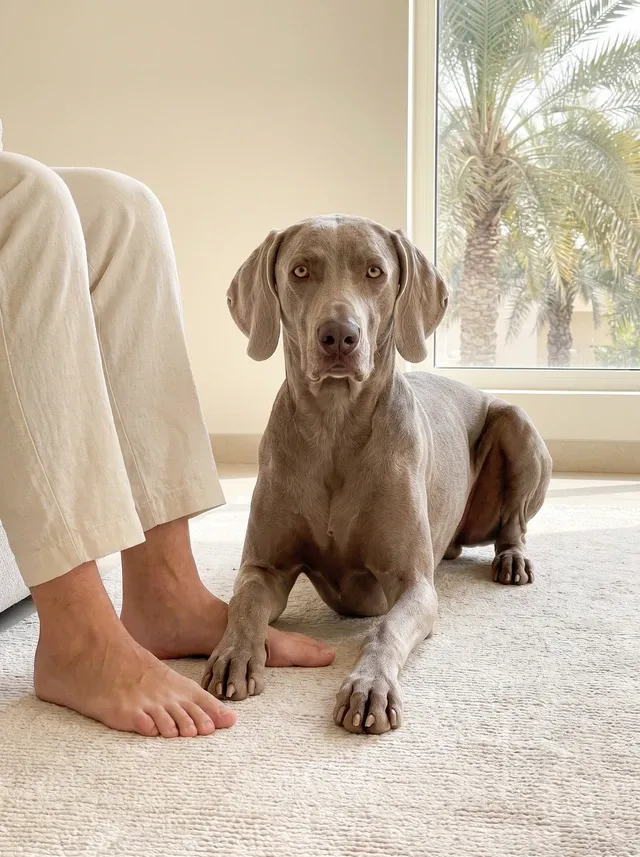
Weimaraner in Dubai, a silver grey adult lying at a pet parent's bare feet by the sofa, palms outside

At home

Why does my Weimaraner follow me everywhere?

Room to room, head on your foot, under the duvet given half a chance. You will not use the bathroom alone again.

What's going onWeimaraners were bred to work for one hunter and stay close to them all day, and yours has picked you. It is also why they are so keen to learn from you.

Weimaraner, a silver grey adult lying by the front door on a marble floor, chin on their paws, waiting

At home

Why does my Weimaraner panic when I leave?

Howling when the door closes, a chewed door frame, scratches round the lock.

What's going onThat panic has a name, separation distress, and it is treatable. Home fixes can make it worse, so a vet is the place to start.

Weimaraner, a roe grey adult walking down a bright hallway with a soft toy in their mouth

At home

Why does my Weimaraner always carry something?

Meets you at the door with a shoe, carries the post around, never seems to have an empty mouth.

What's going onThey were bred to carry game back to the hunter. Now it is your shoe, the remote or a cushion. Give them things that are theirs to carry, and swap for the rest.

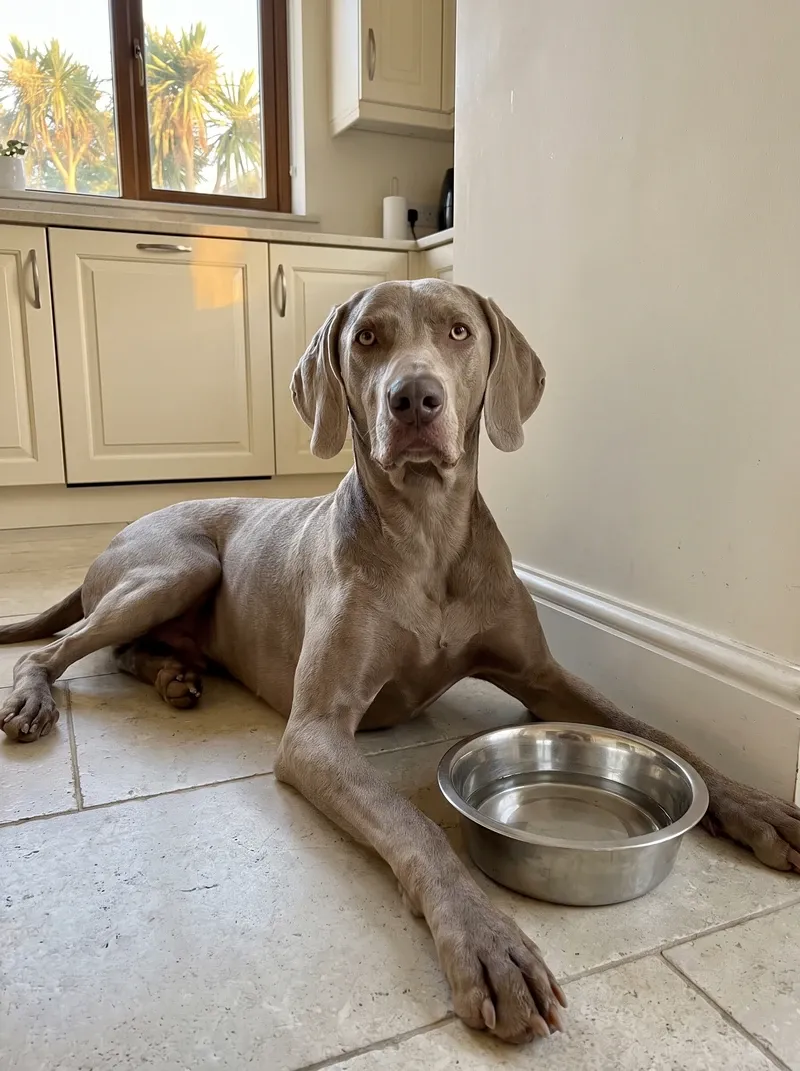
Weimaraner in Dubai, a silver grey adult resting on kitchen tiles beside an empty bowl, palms outside

At home

What are the signs of bloat in a Weimaraner?

Restless after dinner, pacing, trying to be sick with nothing coming up.

What's going onWith a swollen, tight belly, that is bloat (GDV, a twisted stomach), and it cannot wait. Contact your vet now, and keep a 24-hour emergency vet's number in your phone.

Weimaraner in Dubai, a roe grey adult in a harness sitting on a villa street at dawn, watching, palms behind

At home

Why does my Weimaraner chase cats?

Locks on to the cats by the bins, freezes, then launches, with real strength on the end of the lead.

What's going onWeimaraners were first bred to hunt boar and deer, not only birds, so there is real power behind the chase. Start the harness and the stop whistle in puppyhood, before they are strong enough to pull you over.

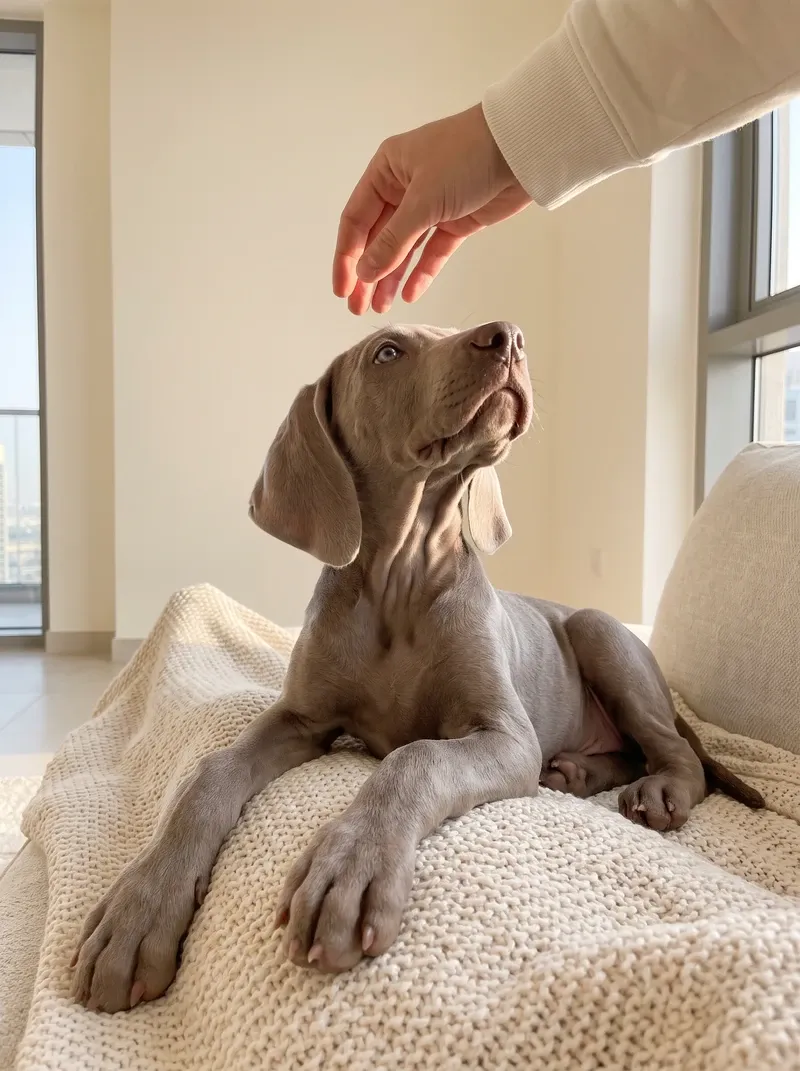
Weimaraner, a silver grey puppy on a cream blanket looking up at a pet parent's hand

At home

Why is my Weimaraner puppy limping?

A puppy who suddenly won't walk, cries when you touch their legs or goes off their food.

What's going onHypertrophic Osteodystrophy (HOD, painful bone inflammation in growing pups) is something Weimaraner puppies can get. If you see any of these signs, contact your vet the same day. Keep puppy walks short and on soft ground.

A Weimaraner in Dubai

The bit nobody tells you.

Their day

Built for: Tracking and pointing beside one hunter.

In Dubai: Their person is out at work.

Their weather

Built for: Cool German forest.

In Dubai: Pavement too hot for half the year.

Their work

Built for: A day on the trail, then sleep at the hunter's feet.

In Dubai: Nothing to track.

The destroyed cushions, the stolen shoes and the panic at the door mostly come from that gap.

You cannot give them a forest, or stay home every day. You can give them a job, a cool walk and a plan for the hours you are out, and the ten things below are how.

Your plan is built around their breed: the bloat, hip and skin risks that run in Weimaraners at every age, and the care that goes with each one.

Join the founding families. AED 1,999 of essential care for AED 199.

Daily care for a Weimaraner

Ten things that make their life better.

Many of them are free, and most matter at every age.

  1. Searching tires them more than a walk, and smaller meals are kinder to a stomach at risk of bloat.

    Every age, with easy searches at floor level from 7 years

    Free, or under AED 100 for a snuffle matIn your plan

    Why

    Searching tires them more than a walk, and smaller meals are kinder to a stomach at risk of bloat.

    What to do

    Split their food into two or three meals. Scatter part of one on the grass or on a towel indoors, or hide it around the room and let them find it. Search games indoors on the hottest days. Their plan includes a Body Condition Score (a check on whether they are the right weight) at their puppy visits, with bloat-prevention advice from six months.

  2. They were bred to follow scent a long way in front of one person.

    Every age, in short sessions on soft ground for puppies

    Under AED 150

    Why

    They were bred to follow scent a long way in front of one person.

    What to do

    A harness, a ten-metre line and a quiet, open space before sunrise. Let them work the ground, call them in every few minutes and reward them when they come. Keep it at least an hour away from meals.

  3. They are big, strong and fast, and a whistle reaches them when your voice does not.

    Every age, starting at mealtimes in puppyhood

    Under AED 50

    Why

    They are big, strong and fast, and a whistle reaches them when your voice does not.

    What to do

    One sound for "come back", one for "stop". Start at home at mealtimes, pay them every time, and only use it outside once it works indoors. Add a hand signal as they get older, in case their hearing fades.

  4. They will point a cat, then go for it. The stop does not come naturally, so it has to be taught.

    Every age, most of all 6 months to 2 years, when chasing peaks

    Free

    Why

    They will point a cat, then go for it. The stop does not come naturally, so it has to be taught.

    What to do

    At a distance where they still listen, ask for a stop when a cat or pigeon moves, reward them and walk on. Get closer over weeks. Keep the lead and harness on near roads and bins.

  5. A Weimaraner likes something in their mouth, and they will choose your shoe if you do not choose for them.

    Every age, most of all 6 months to 2 years

    Under AED 100

    Why

    A Weimaraner likes something in their mouth, and they will choose your shoe if you do not choose for them.

    What to do

    A sturdy soft toy or canvas dummy that is theirs. Five to ten throws along the ground, then stop. Swap anything they steal for a treat, and keep socks and small things out of reach.

  6. Their ears rarely give trouble, but handling them weekly makes vet visits easier. Their teeth need more attention, from puppyhood into prime adulthood.

    Every age, most of all up to 7 years

    Under AED 60 for a brush and dog toothpasteIn your plan

    Why

    Their ears rarely give trouble, but handling them weekly makes vet visits easier. Their teeth need more attention, from puppyhood into prime adulthood.

    What to do

    Once a week, lift their ears and look inside so they are used to being handled. Then lift their lip. As a puppy, look for baby teeth still sitting beside the new ones. From then on, brush their teeth every day. A dental evaluation (teeth and gum check) is in your plan at their puppy visits, and a professional dental clean every 6 to 12 months from age two.

  7. They are built to go all day and will not stop themselves in the heat. Hard exercise around meals adds to their bloat risk.

    Every age

    Free

    Why

    They are built to go all day and will not stop themselves in the heat. Hard exercise around meals adds to their bloat risk.

    What to do

    From May to September, walk before sunrise and after dark. Put the back of your hand on the pavement for five seconds: if you cannot keep it there, they cannot walk on it. No hard exercise for an hour before or after a meal. Carry water.

  8. They were bred to stay with one hunter all day, and their attachment to you is strong.

    Every age, most of all 6 months to 2 years

    Free, or the cost of a walker

    Why

    They were bred to stay with one hunter all day, and their attachment to you is strong.

    What to do

    If you are out more than a few hours, arrange a midday walk, a visit or daycare, and leave them a stuffed chew. If they howl, destroy the door or hurt themselves trying to get out, contact your vet. Home fixes can make it worse, so let your vet help with that part.

  9. Weimaraners are prone to skin allergies from puppyhood into prime adulthood.

    Every age, most of all up to 7 years

    Under AED 50 for a mittIn your plan

    Why

    Weimaraners are prone to skin allergies from puppyhood into prime adulthood.

    What to do

    A rubber mitt once a week. Look for red patches, bumps or thinning hair, and notice if they keep licking their paws. If their skin keeps flaring, tell your vet. From age two, a food elimination trial (a diet test for allergies) is in your plan, and allergy management from age four.

  10. Hip problems and bloat both run in the breed, and knowing their normal shape helps you spot trouble.

    Every age, most of all up to 2 years

    FreeIn your plan

    Why

    Hip problems and bloat both run in the breed, and knowing their normal shape helps you spot trouble.

    What to do

    Feel their ribs, spine, hips and belly once a week, so you know what normal feels like, and weigh them once a month. A swollen, tight belly with retching is an emergency: contact your vet now. Their plan covers a hip evaluation (a hip exam) by age two, and a talk about gastropexy (an operation that tacks the stomach in place) at their spay or neuter.

Four of these are in your plan. The rest you can do at home.

Join the founding families. AED 1,999 of essential care for AED 199.

Weimaraner health by age

Their health, at every age.

In a Weimaraner, restlessness after dinner or a puppy who suddenly won't walk can be the first sign something is wrong, so contact your vet. Choose their age to see what to watch for, and the care that goes with it.

Weimaraner in Dubai, an older dog with a frosted muzzle resting on a cream orthopaedic bed, palms outside

How old are they?

Their age

Weimaraner Puppy health

the first six months

What to watch for

  1. Developmental or early clinical signs of Hip Dysplasia (HD, a poorly fitting hip joint)
  2. Gastrointestinal upset and conformation-related feeding intolerance
  3. Early or congenital expression of Hypertrophic Osteodystrophy (HOD, painful bone inflammation in growing pups)
  4. Juvenile onset of allergies / atopic dermatitis (itchy allergic skin)
  5. Retained deciduous teeth (baby teeth still sitting beside the new ones), malocclusion (teeth that do not meet properly) or early dental crowding

The care that goes with it

  1. Core vaccinations, microchip and Dubai Municipality registration
  2. Deworming, and flea and tick prevention
  3. Body Condition Score (BCS, a check on whether they are the right weight), and dental, growth and nutritional evaluation
  4. Baseline Hip Dysplasia screening
  5. Contact your vet now at any sign of bloat (GDV, a twisted stomach)
The full care detail
  • Core vaccination programme, microchipping and Dubai Municipality registration. Titre testing (a blood test that shows if they are still protected) discussion where clinically appropriate; not a substitute for completing the core vaccine series
  • Deworming and external parasite prevention tailored to Dubai exposure
  • Body Condition Score (BCS, a check on whether they are the right weight), Muscle Condition Score (MCS, a check on their muscle), dental, growth and nutritional evaluation, and early socialisation
  • Baseline screening focused on Hip Dysplasia (HD)
  • Early diagnostic follow-up for signs suggestive of Bloat / Gastric Dilatation-Volvulus (GDV)

Their age

Weimaraner Juvenile health

6 months to 2 years

What to watch for

  1. Emerging Hip Dysplasia (HD, a poorly fitting hip joint) with exercise intolerance or lameness
  2. Developing risk of Bloat / Gastric Dilatation-Volvulus (GDV, a twisted stomach)
  3. Young-dog presentation of Hypertrophic Osteodystrophy (HOD, painful bone inflammation in growing pups)
  4. Recurrent or persistent allergies / atopic dermatitis (itchy allergic skin)
  5. Early periodontal disease (gum disease) and dental crowding

The care that goes with it

  1. Hip evaluation (a hip exam) by age 2, and keeping them lean
  2. Neutering or spaying, timed for a large breed
  3. Two or three smaller meals a day, and no hard exercise for an hour either side of a meal
  4. Bone pain that keeps coming back, looked into properly
The full care detail
  • Hip evaluation (OFA or PennHIP) by age 2; maintain lean body weight to reduce hip stress
  • Neuter/spay timing discussion that accounts for large-breed growth and disease risk
  • Feed 2-3 smaller meals daily; avoid exercise 1 hour before and after meals
  • Investigate recurrent signs rather than repeatedly treating presumed Hypertrophic Osteodystrophy (HOD)

Their age

Weimaraner Young Adult health

2 to 4 years

What to watch for

  1. Hip Dysplasia (HD, a poorly fitting hip joint)
  2. Bloat / Gastric Dilatation-Volvulus (GDV, a twisted stomach)
  3. Hypertrophic Osteodystrophy (HOD, painful bone inflammation in growing pups)
  4. Allergies / Atopic Dermatitis (itchy allergic skin)
  5. Dental Disease

The care that goes with it

  1. Hip evaluation (a hip exam) if not done yet, and keeping them lean
  2. Gastropexy (an operation that tacks the stomach in place), considered at spaying or neutering
  3. Still two or three smaller meals a day, and no hard exercise for an hour either side
  4. A food elimination trial if skin trouble keeps coming back
  5. Teeth brushed daily, and a professional dental cleaning every 6 to 12 months
The full care detail
  • Hip evaluation (OFA or PennHIP) by age 2; maintain lean body weight to reduce hip stress
  • Consider prophylactic gastropexy (an operation that tacks the stomach in place) during spay/neuter surgery to prevent life-threatening Gastric Dilatation-Volvulus (GDV)
  • Feed 2-3 smaller meals daily; avoid exercise 1 hour before and after meals
  • Identify allergens early; conduct food elimination trial if recurrent skin issues are present
  • Daily dental brushing; professional dental cleaning every 6-12 months

Their age

Weimaraner Prime Adult health

4 to 7 years

What to watch for

  1. Hip Dysplasia (HD, a poorly fitting hip joint), Progressive
  2. Bloat / Gastric Dilatation-Volvulus (GDV, a twisted stomach), Ongoing High Risk
  3. Allergic Skin Disease
  4. Hypothyroidism (an underactive thyroid)
  5. Dental Disease (Advanced)

The care that goes with it

  1. Hip care: joint supplements, physiotherapy and weight management
  2. Knowing the signs of bloat, with a 24-hour emergency vet's number ready
  3. Allergy management, including allergen-specific immunotherapy
  4. Thyroid panel (T4, a blood test) every year
  5. Dental X-rays every year
The full care detail
  • Hip management: joint supplements, physiotherapy, and weight management; surgical options if severe
  • Ongoing bloat vigilance: know the emergency signs and have 24-hour emergency vet contact ready
  • Allergy management: allergen-specific immunotherapy (daily or monthly)
  • Annual thyroid panel (T4); levothyroxine if hypothyroidism is confirmed
  • Annual dental X-rays; extract compromised teeth to prevent systemic infection

Their age

Weimaraner Senior health

7 to 10 years

What to watch for

  1. Hip Dysplasia (HD, a poorly fitting hip joint), Severe Arthritis
  2. Cancer
  3. Heart Disease
  4. Kidney Disease
  5. Cognitive Dysfunction Syndrome (dementia in older pets)

The care that goes with it

  1. Hip care: hydrotherapy, acupuncture, pain relief and joint supplements
  2. A yearly physical examination, including the lymph nodes
  3. Echocardiogram (an ultrasound scan of the heart) every year from age 7
  4. Renal panel (kidney blood tests) twice a year, and a senior diet
  5. Cognitive enrichment and a steady daily routine
The full care detail
  • Advanced hip management: hydrotherapy, acupuncture, NSAIDs, and joint supplements
  • Annual full physical examination with lymph node palpation for cancer screening
  • Annual echocardiogram (an ultrasound scan of the heart) from age 7; cardiac medication when indicated
  • Bi-annual renal panel; transition to senior diet with controlled phosphorus and sodium
  • Cognitive enrichment and consistent daily routine to slow cognitive dysfunction progression

Their age

Weimaraner Geriatric health

10 years and over

What to watch for

  1. Cancer (Advanced)
  2. Severe Arthritis / Mobility Loss
  3. Congestive Heart Failure
  4. Chronic Kidney Disease (CKD, long-term kidney failure)
  5. Cognitive Dysfunction Syndrome (Advanced)

The care that goes with it

  1. Mobility support: orthopaedic bedding, ramps, slings and physiotherapy
  2. Kidney and heart medication, adjusted regularly
  3. Cognitive enrichment and a steady daily routine
  4. Quality-of-life assessments
  5. Palliative care (comfort care), and end-of-life planning with your veterinary team
The full care detail
  • Mobility support: orthopaedic bedding, ramps, slings, and physiotherapy for arthritic dogs
  • Renal and cardiac management with regular medication adjustments
  • Cognitive enrichment and consistent daily routine to slow cognitive dysfunction progression
  • Quality-of-life assessments
  • Tailored palliative and comfort-focused care plan
  • Compassionate end-of-life planning with your veterinary team

Breed predispositions indicate an increased risk rather than certainty of disease. What is right for them always comes from their own history and an evaluation.

Getting a Weimaraner puppy in Dubai

Before they come home.

Weimaraner, a smooth-coated silver grey puppy sitting on a cream blanket in a bright flat

Two coats

Smooth or long-haired

Most Weimaraners have the short, sleek coat the breed is known for, and it needs very little grooming. There is also a long-haired Weimaraner, far less common. Underneath, both are the same gundog: a tracking nose, a soft mouth and a need to be near their person.

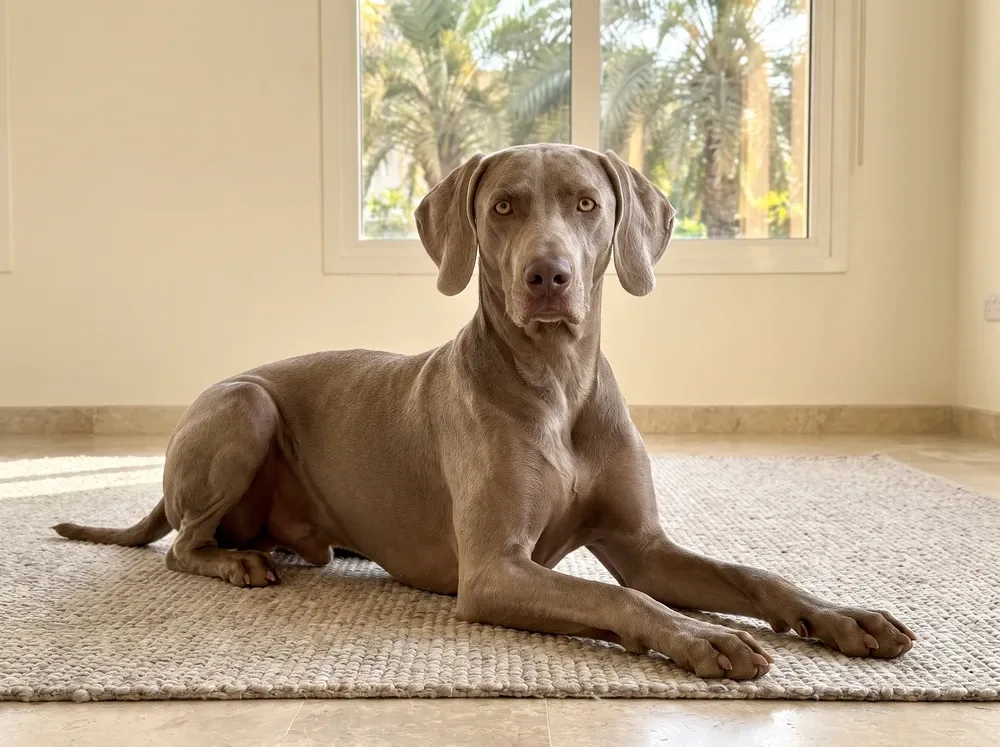
Weimaraner in Dubai, a mouse grey adult lying on a stone-coloured rug, pale eyes, palms outside

Colours

Every shade of grey

Weimaraners come in grey, from a soft mouse grey through roe grey to a pale silver, with light eyes to match. It is why they are called the grey ghost.

Weimaraner in Dubai, a silver grey puppy walking on a park lawn beside a pet parent, date palms behind

The first six months

Caring for a Weimaraner puppy

Vaccinations, microchip and Dubai Municipality registration come first, with a baseline hip screening. Keep walks short and on soft ground while their bones grow, and practise short absences from the first week.

Puppy health, 0 to 6 months
Weimaraner, a roe grey puppy in a tan harness sitting on a villa step by bougainvillea

Getting the home ready

Mealtimes, a harness and a whistle

Plan for two or three smaller meals a day, with a quiet hour around each one. Find a harness, a ten-metre line, a gundog whistle and a sturdy toy that is theirs to carry, so your shoes are not.

Ten things that make their life better
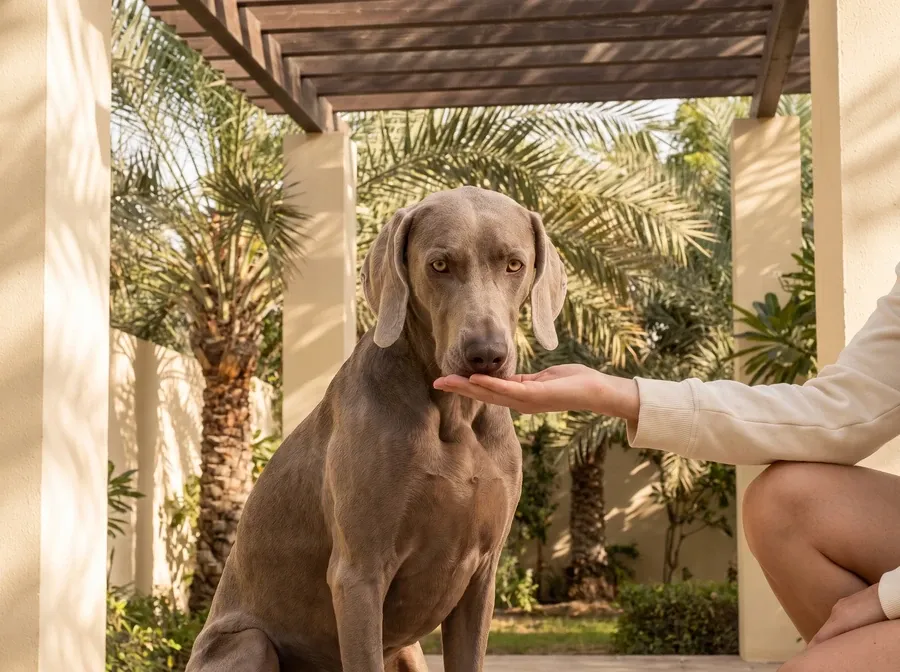
Weimaraner in Dubai, a calm roe grey adult sniffing a pet parent's open hand in a villa garden, palms behind

Before you commit

Ask about the parents' hips

Hip Dysplasia runs in the breed at every age, and many puppies come from parents whose hips were never scored. Ask the breeder for both parents' hip results, and meet the mother if you can.

The reception of a Paws & Co clinic, with long cream benches and a stone reception desk

Before the clinics open

Join the founding families

AED 1,999 of essential care for AED 199. No payment now.

When to see a vet

When it is not behaviour.

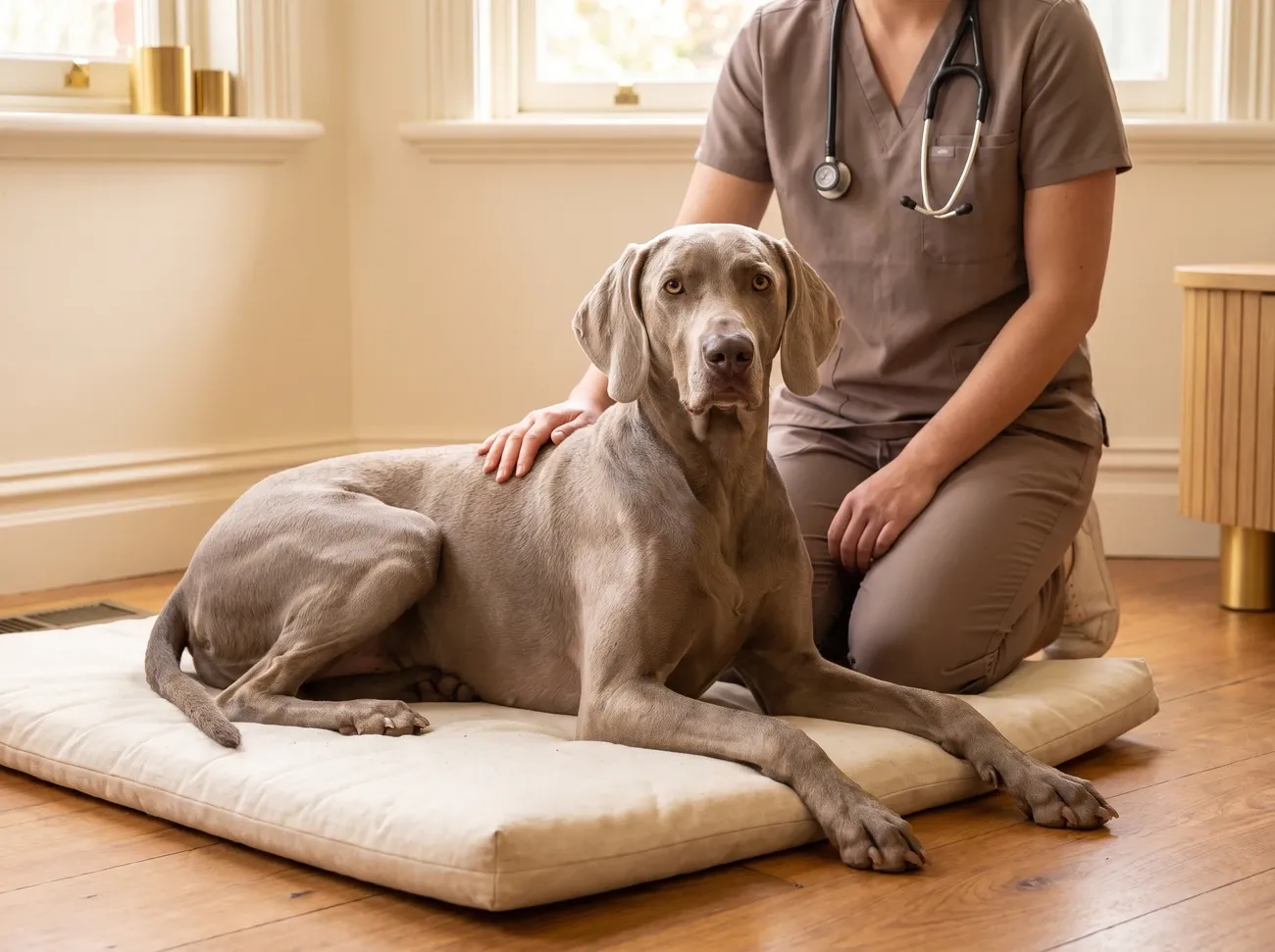
Weimaraner, a silver grey adult on a padded mat as a vet in taupe scrubs rests a hand on their back

Some of this is not a training problem, and treating it like one wastes time your dog may not have. If they are distressed when you leave, if they growl or guard their food, their toys or you, if they are frightened on the lead, or if anything about them changes suddenly at any age, contact your vet the same day. A tip from a website, ours included, is not the answer. If it cannot wait, contact your nearest emergency vet now.

With a Weimaraner, restlessness after a meal is not a behaviour problem. Pacing, trying to be sick with nothing coming up, drooling or a swollen belly can be bloat: contact your vet now. If they panic when you leave, that is separation distress, and a vet can help. From prime adulthood, watch for an underactive thyroid: it can look like a dog who has simply slowed down.

Keep the good shoes upstairs. If she paces after dinner and won't lie down, contact your vet now.

Weimaraner history

Before they were yours.

  1. Weimaraner history, a grey hunting dog running beside riders in an oil painting by Jacobus Leisten, Düsseldorf, 1874
    Riders at the edge of a forest with a grey hunting dog, an oil painting by the Düsseldorf artist Jacobus Leisten, 1874. Public domain, via Wikimedia Commons.

    The early 1800s

    The court at Weimar

    Hunting nobility around Weimar, in Germany, bred a big grey dog to track boar and deer, and to stay close to the one hunter it worked for.

    What they still carryA tracking nose and a strong attachment to one person.

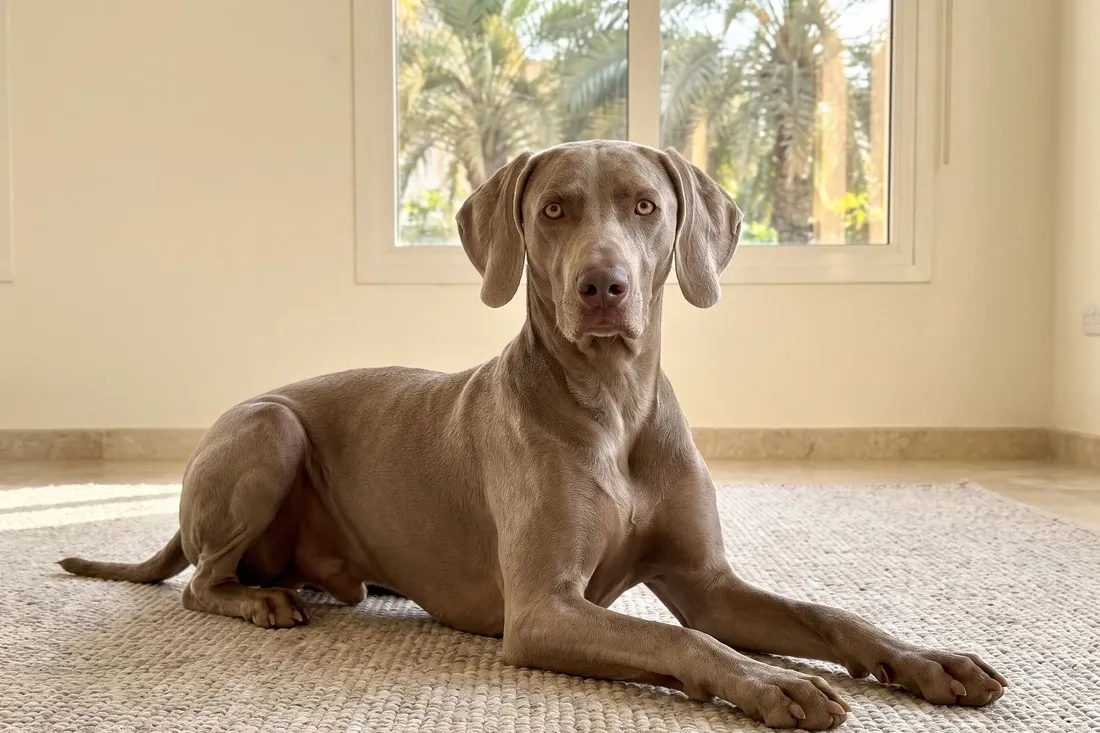
  2. Weimaraner history, a mouse grey adult lying on a rug, pale eyes, palms outside
    A Weimaraner today.

    1897

    A guarded breed

    A German club formed in 1897 and kept the breed close, selling dogs to its members only.

    What they still carryA working dog's need for a job.

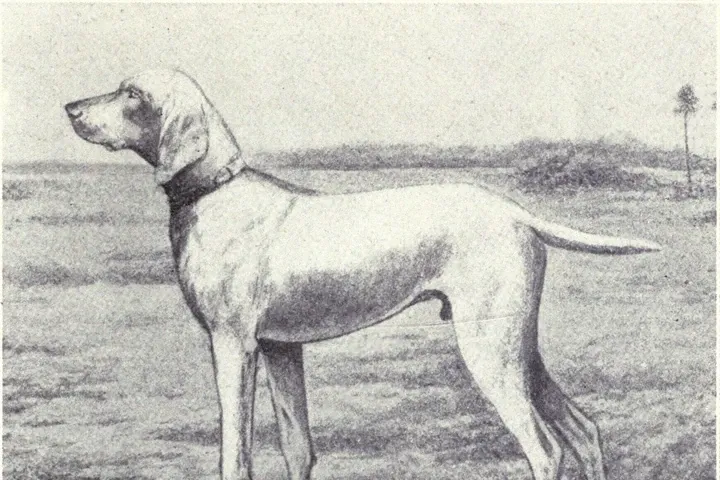
  3. Weimaraner history, a Pointer of Weimar standing in a field, a book illustration, 1915
    The Pointer of Weimar, from Walter Esplin Mason's Dogs of All Nations, 1915. Public domain, via Wikimedia Commons and the Internet Archive.

    Late 1800s to early 1900s

    From big game to birds

    As big game grew scarce, the breed was turned to pointing and retrieving birds, and to tracking wounded game.

    What they still carryThe point, the retrieve, and the big-game dog's size and nerve.

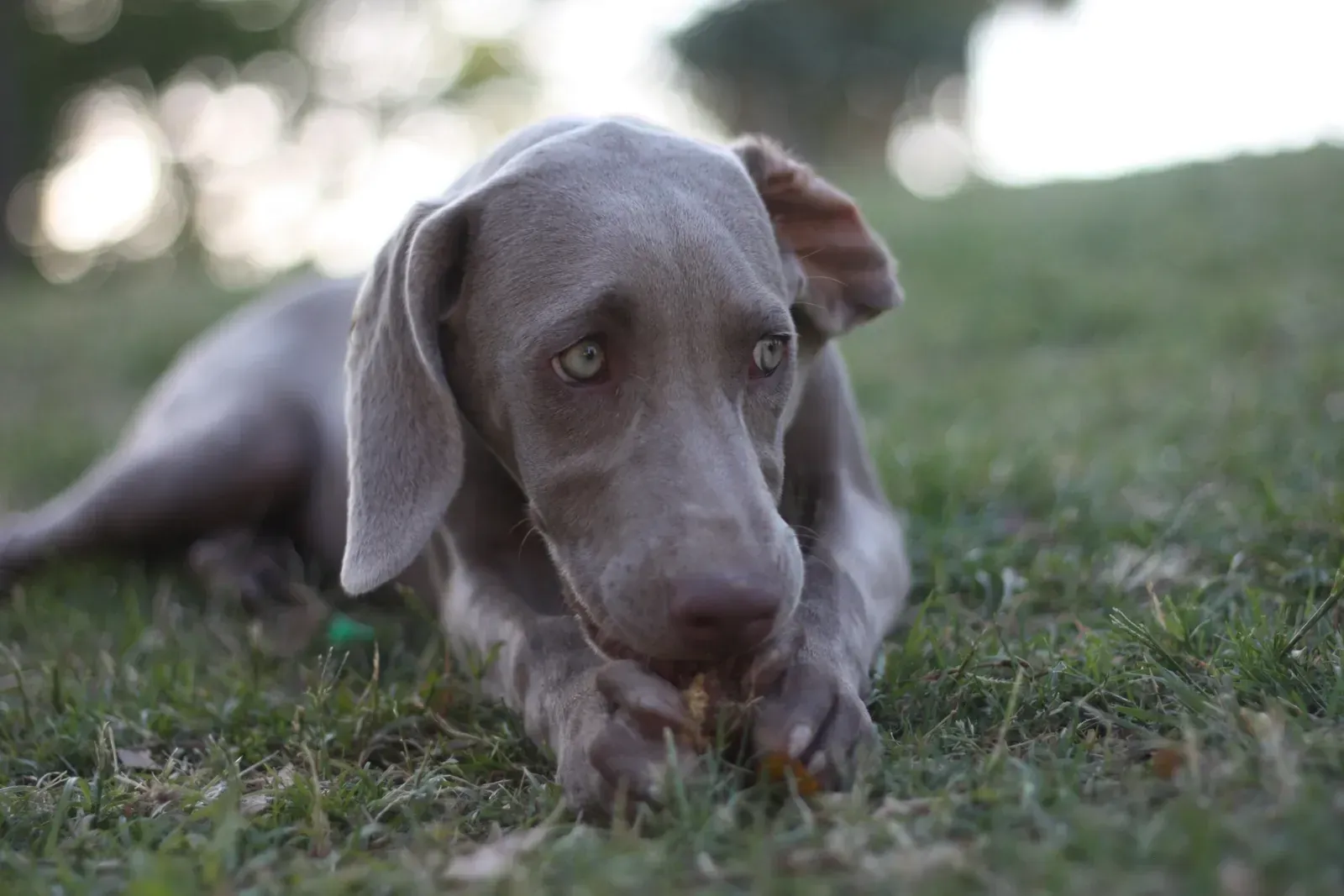
  4. Weimaraner history, a silver grey dog with pale eyes lying on grass, a photograph, 2010
    The silver coat and pale eyes behind the name grey ghost, 2010. Photo: Pedro Lozano, CC BY 2.0, via Wikimedia Commons.

    The early 1940s

    The grey ghost

    Weimaraners reached America in the late 1920s, and the American Kennel Club recognised the breed in the early 1940s. The silver coat and pale eyes earned them a name: the grey ghost.

    What they still carryLooks that stop people in the street, and the nerve of a working dog.

  5. Weimaraner history, the breed today, a silver grey adult sitting on desert sand, Dubai, 2026

    Today

    In Dubai

    A family dog in villas and flats, often alone for the working day, and still wanting to be wherever you are.

    What they still carryA deep-chested hunting dog's body, in 45-degree heat.

Weimaraner questions

The ones you type at midnight.

Most of these get asked late at night, by someone watching their dog and not sure what they are seeing.

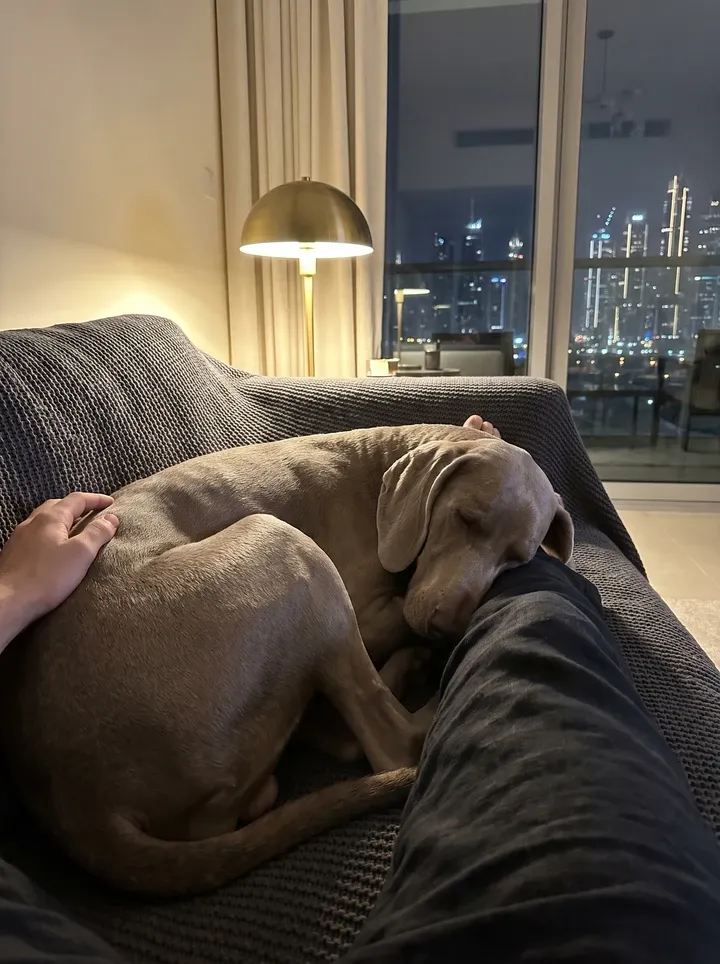
Weimaraner in Dubai, a silver grey adult asleep against a knee, a brass lamp and the lit skyline behind
How long do Weimaraners live?

Weimaraners usually live 11 to 14 years. A UK study of almost 3,000 Weimaraners found half lived to nearly 13.

How big is a Weimaraner dog?

An adult Weimaraner usually weighs 25 to 41 kg. Males usually weigh 32 to 41 kg and females 25 to 34 kg.

Do Weimaraners shed?

Weimaraners shed moderately, with a heavier moult once or twice a year. A rubber mitt once a week is enough for the short coat.

What is bloat in a Weimaraner?

Bloat (GDV) is a twisted stomach, and in a Weimaraner it is an emergency. Restlessness after a meal, retching with nothing coming up or a swollen, tight belly is a reason to contact your vet now.

Can a Weimaraner be left alone?

A Weimaraner can manage a planned day, but many find long hours alone very hard. If yours panics, howls or damages the door when you leave, contact your vet.

Is a Weimaraner a good family dog?

Yes, the Weimaraner is a devoted family dog for an active home that can keep them company. They need serious daily exercise and work for their head as well as their legs.

How do I look after a Weimaraner puppy?

A Weimaraner puppy needs short walks on soft ground, small meals and practice at being alone. If a puppy suddenly won't walk or cries when you touch their legs, contact your vet the same day.

Can a Weimaraner live in Dubai?

Yes, a Weimaraner can live well in Dubai if you plan around the heat. In the summer months, exercise them before sunrise or after dark from May to September, and play search games indoors on the hottest days.

Why is a Weimaraner called the grey ghost?

The Weimaraner is called the grey ghost for its silver-grey coat and pale eyes.

Worried about them? Contact your vet today.