We’re hiring people who love them like we do. Join us careers@pawsandco.comSee open roles
UAE Government Licensed MOCCAE
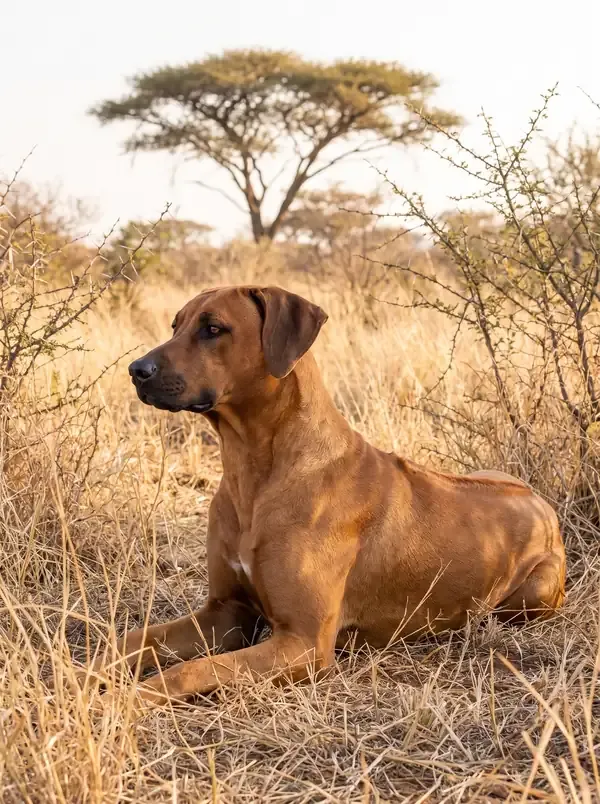
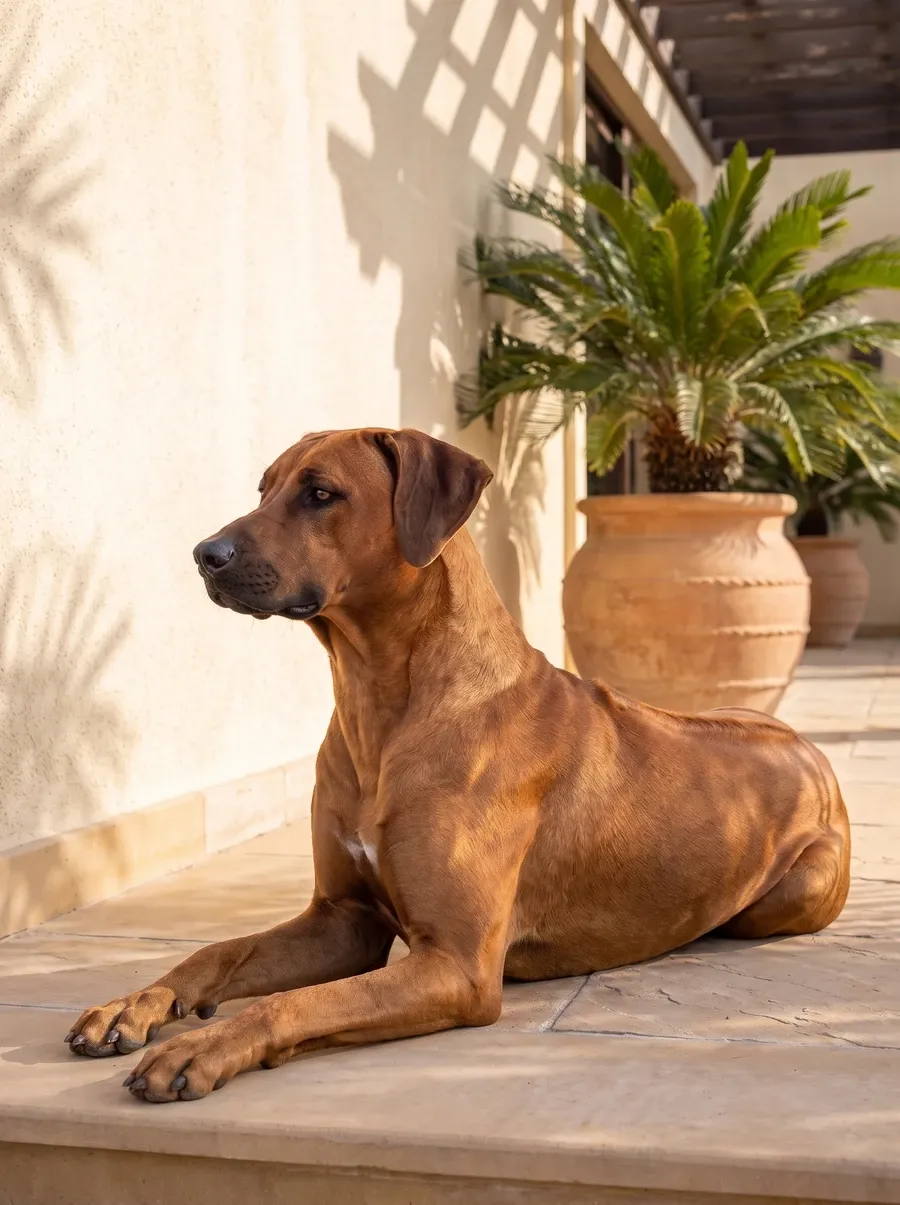
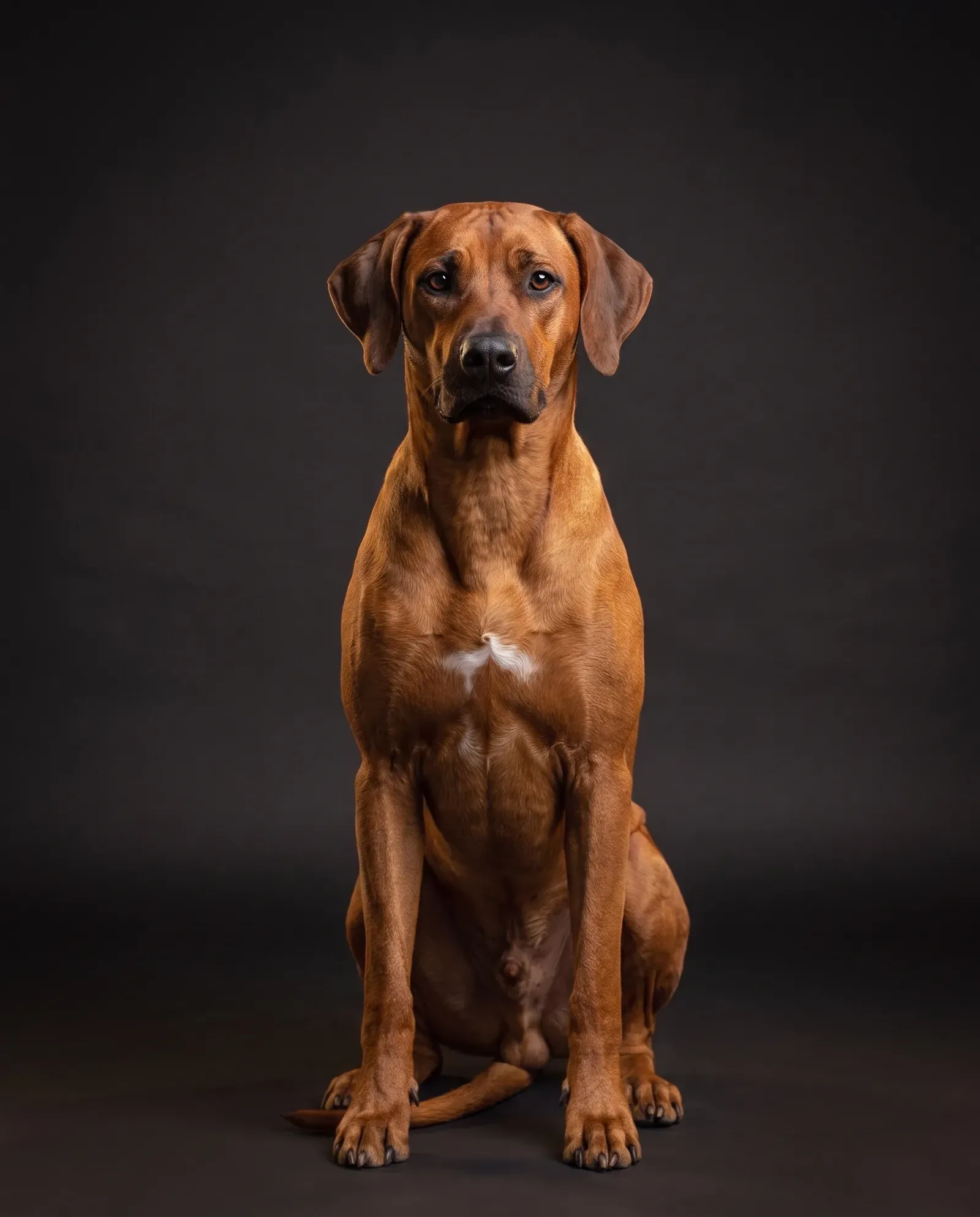
Rhodesian Ridgeback in Dubai, studio portrait of a calm red wheaten adult sitting

Breed guide  ·  Dogs

Rhodesian Ridgeback

Her ancestors tracked lions. She tracks the delivery bag from the lift.

Lifespan
10 to 12 years
Size
Large
Weight
About 32 to 38.5 kg
Shedding
Moderate

Last updated 14 October 2026

Join the founding families. AED 1,999 of essential care for AED 199.

No payment now. We'll be in touch by email and WhatsApp as we open enrolment.

✓
Thank you.

We will be in touch soon to confirm.

Rhodesian Ridgeback traits

What they brought with them.

Tap a card to see what is going on.

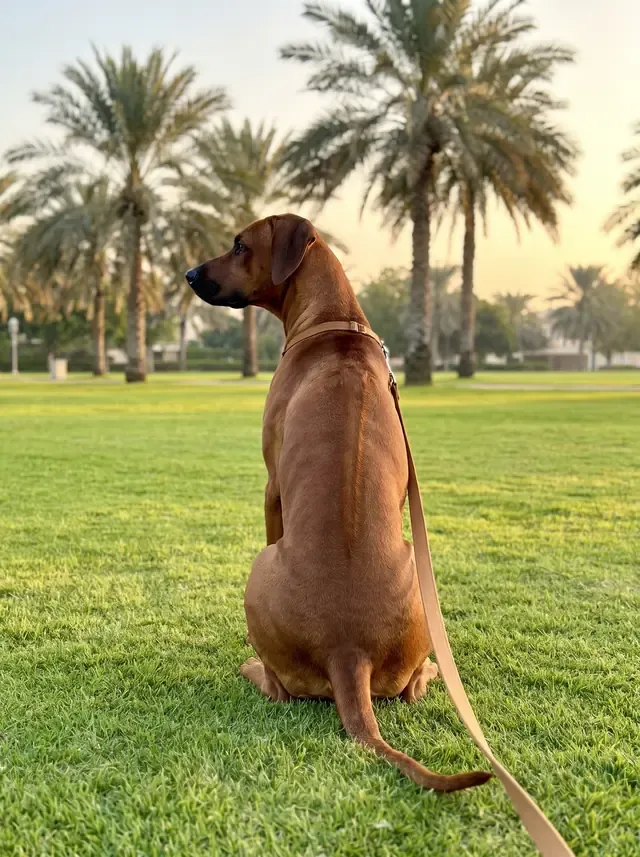
Rhodesian Ridgeback in Dubai, a red wheaten adult on a long line in a park at dawn, the ridge showing, palms behind

At home

Why does my Ridgeback chase everything?

Nose down one minute, gone after a cat the next.

What's going onThey follow a scent like any hound and chase what they see like a sighthound, fast enough for that to matter near a road. Keep them on a lead unless the space is fenced.
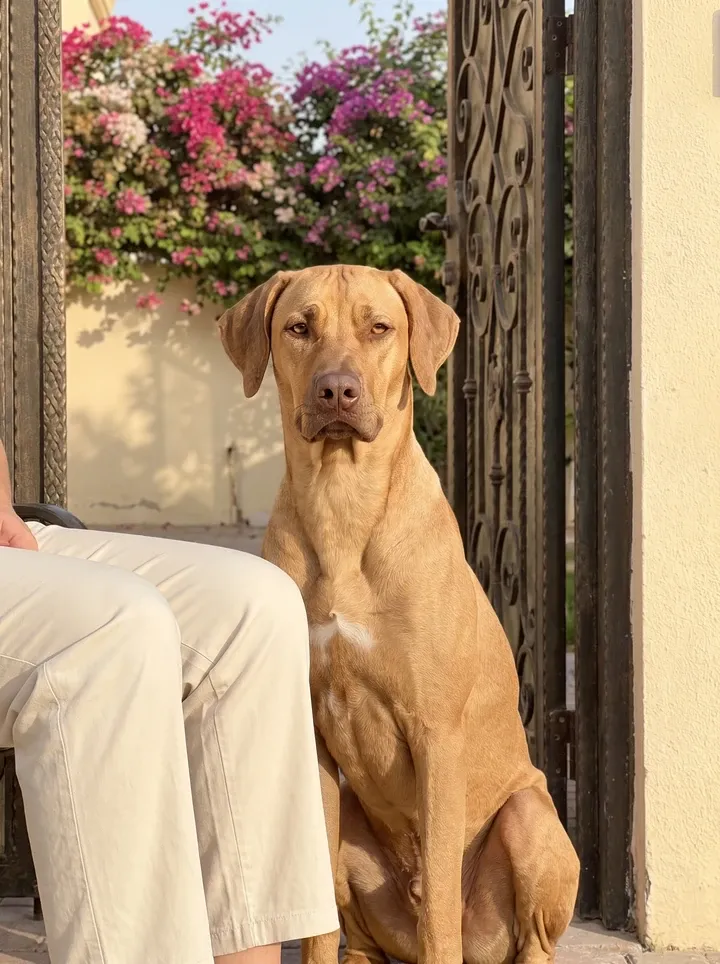
Rhodesian Ridgeback, a liver-nosed wheaten adult sitting calmly by a pet parent at a villa gate

At home

Why is my Ridgeback wary of strangers?

Warm with the family, cool with anyone at the gate.

What's going onRidgebacks guarded farms in the Cape, and many are reserved with strangers and protective at home. Meet lots of people calmly while they are a puppy, and never reward guarding.

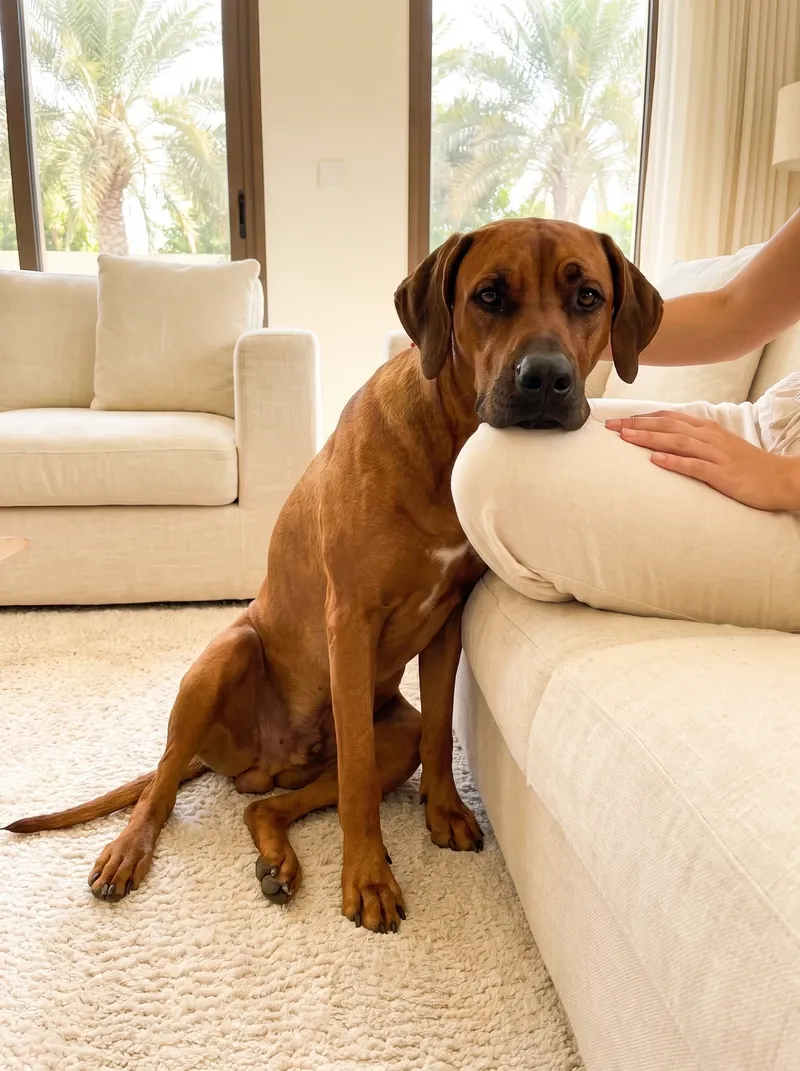
Rhodesian Ridgeback in Dubai, a red wheaten adult leaning against a pet parent's knee by a sofa, palms outside

At home

Why does my Rhodesian Ridgeback lean on me?

You sit down, and they park their full weight against your legs.

What's going onMany Ridgebacks lean on the people they have chosen. It is one of the best things about living with one.

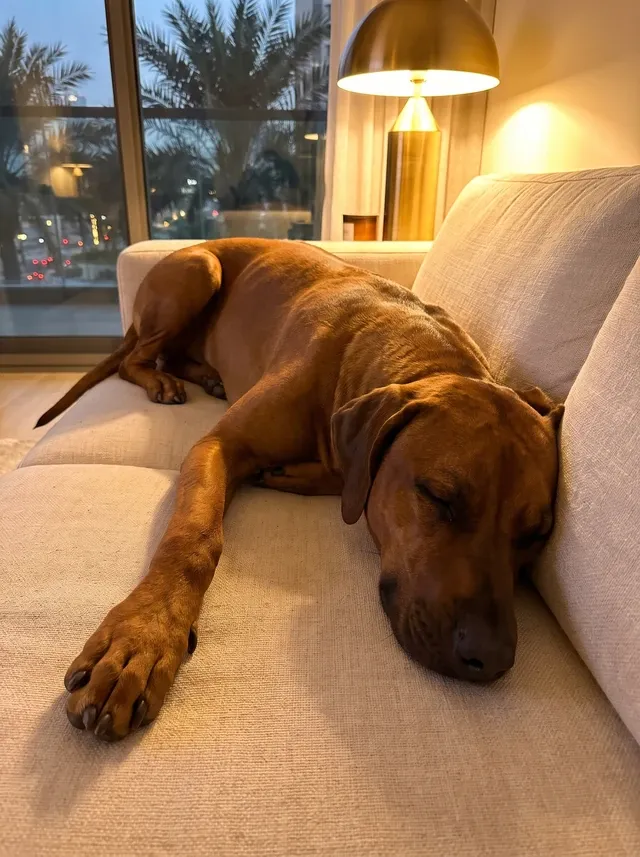
Rhodesian Ridgeback in Dubai, a liver-nosed wheaten adult asleep on a linen sofa by lamp light, palms outside

At home

Sprinter, then sofa

Bursts of speed in the garden, then flat out on the sofa.

What's going onThey were built for bursts of speed, and for tracking. A fenced space for a run and a slow walk where they can sniff do more for them than a long march on the lead.

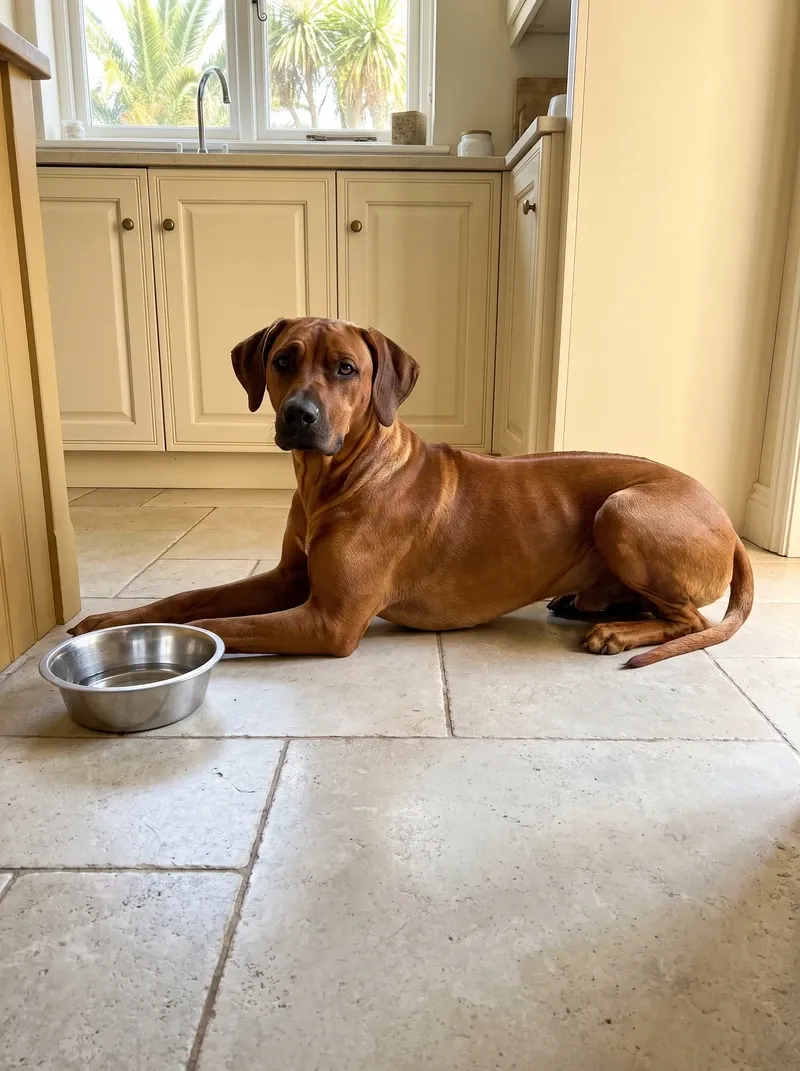
Rhodesian Ridgeback in Dubai, a red wheaten adult lying calmly on kitchen tiles beside an empty bowl, palms outside

At home

Smaller meals, calm after

Dinner gone in seconds, and ready to play straight after.

What's going onBloat (a twisted stomach) is a real risk once they reach their prime. Split their food into two or three meals, and keep hard exercise away from mealtimes.

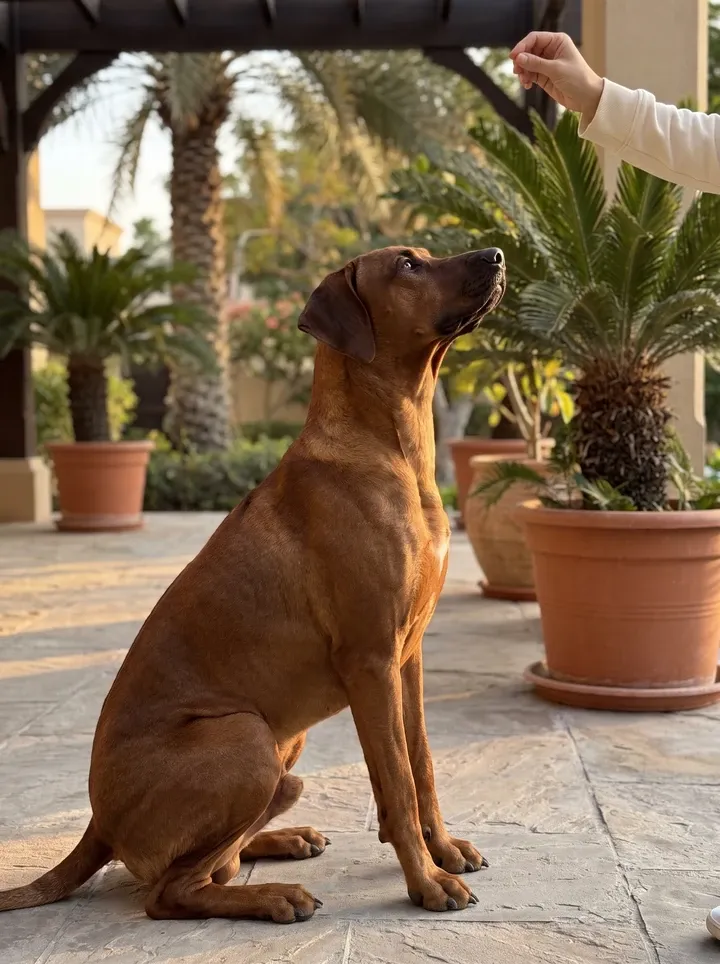
Rhodesian Ridgeback in Dubai, a red wheaten adult on a villa terrace looking up at a pet parent's hand, palms behind

At home

They know the cue, and they are thinking about it

You ask. They look at you, and decide whether it is worth it.

What's going onThey were bred to make decisions around a lion. They learn fast, and calm, consistent training, paid in treats, works where force does not.

A Rhodesian Ridgeback in Dubai

The bit nobody tells you.

Their day

Built for: Covering long distances in African heat.

In Dubai: Often a villa or a flat.

Their work

Built for: Tracking big game, and holding it at bay.

In Dubai: Running far less than their body was built for.

Their guard

Built for: Guarding the farm at night.

In Dubai: Strangers at the gate every day.

The guarding, the chasing, the counter raids and the restlessness mostly come from that gap.

You cannot give them a farm and a lion. You can give them a job, a run and a calm home, and the ten things below are how.

Your plan is built around their breed: the risks on a Rhodesian Ridgeback's record at every age, and the care that goes with each one.

Join the founding families. AED 1,999 of essential care for AED 199.

Daily care for a Rhodesian Ridgeback

Ten things that make their life better.

Many of them are free, and most matter at every age.

  1. They follow their nose and chase what they see, and they are fast.

    Every age

    Under AED 150 for a long line

    Why

    They follow their nose and chase what they see, and they are fast.

    What to do

    Lead or long line anywhere that is not fenced. Check the garden wall and gate for gaps. Nobody opens the front door until someone has hold of them, and keep their microchip registered to your current number.

  2. Tracking was half their work, and searching tires their head as well as their legs.

    Every age, more of it as walks get shorter

    Under AED 150

    Why

    Tracking was half their work, and searching tires their head as well as their legs.

    What to do

    Let them sniff for part of every walk. At home, hide part of their dinner and teach "find it", or scatter it on the grass.

  3. Extra weight strains their hips and elbows, and bloat (GDV, a twisted stomach) becomes a risk in their prime adult years.

    Every age, most of all from 4 years

    Under AED 150, once, for kitchen scalesIn your plan

    Why

    Extra weight strains their hips and elbows, and bloat (GDV, a twisted stomach) becomes a risk in their prime adult years.

    What to do

    Weigh their food on kitchen scales and split it into two or three meals. Keep them calm after they eat, with no running or rough play. Keep food off the counters. From 4 years, their plan includes a talk with your vet about gastropexy (an operation that tacks the stomach in place), so you can decide together.

  4. Hip and Elbow Dysplasia (poorly fitting hip and elbow joints) are the first risks on their health record from puppy to young adult.

    Up to 2 years, evaluation before 2

    Free, or up to AED 1,000 for a car ramp and rugsIn your plan

    Why

    Hip and Elbow Dysplasia (poorly fitting hip and elbow joints) are the first risks on their health record from puppy to young adult.

    What to do

    While they are growing, keep runs short and stairs to a minimum, and use a ramp so they never jump out of the car. Put rugs where they run on marble. Their plan includes a hip and elbow evaluation (X-rays to see how well the joints fit) before they turn two.

  5. The gene behind the ridge also raises the risk of dermoid sinus, a small tube in the skin along the spine that can become infected.

    Every age

    Free

    Why

    The gene behind the ridge also raises the risk of dermoid sinus, a small tube in the skin along the spine that can become infected.

    What to do

    Once a week, look inside their ears, then run your fingers along their ridge and neck, and tell your vet about any small hole, lump or discharge. Ask the breeder whether your puppy was examined for dermoid sinus at birth.

  6. Their short coat copes well with heat, but hot pavement burns their paws like any dog's.

    Every age, most of all puppies and from 7 years

    Free

    Why

    Their short coat copes well with heat, but hot pavement burns their paws like any dog's.

    What to do

    From May to September, walk before sunrise and after dark. Put the back of your hand on the pavement for five seconds. If you cannot keep it there, they cannot walk on it. Save sprints for the coolest hour.

  7. They were built for bursts of speed, and a lead walk alone leaves them restless.

    From 2 years, once their joints are grown

    Free, or the cost of a fenced space

    Why

    They were built for bursts of speed, and a lead walk alone leaves them restless.

    What to do

    Two or three times a week, let them run in a safe, fenced space, in the cool, and not straight after a meal. Add sniffing time to the walk every day.

  8. They were bred to guard, and in a large dog guarding is much easier to prevent than to fix.

    Every age, most of all up to 2 years

    Free

    Why

    They were bred to guard, and in a large dog guarding is much easier to prevent than to fix.

    What to do

    As a puppy, meet many calm people, including at the door. Let guests come in without fuss, and reward them for settling. Never praise barking at the gate. If they start guarding, contact your vet.

  9. They are clever and independent, and they stop listening when training turns into a fight.

    Every age, most of all 6 months to 2 years

    Free

    Why

    They are clever and independent, and they stop listening when training turns into a fight.

    What to do

    Two or three short sessions a day, paid with part of their dinner. Teach a sit at the door, "leave it" and a settle on their bed. Everyone in the house uses the same words.

  10. They are stoic, so a sore joint or a new lump shows up under your hands before they complain.

    Every age, most of all from 7 years

    Free

    Why

    They are stoic, so a sore joint or a new lump shows up under your hands before they complain.

    What to do

    Once a week, run your hands along their ridge, ribs, hips and legs, and note any new lump. Watch how they get up and how they run. Weigh them once a month.

Two of these are in your plan. The rest you can do at home.

Join the founding families. AED 1,999 of essential care for AED 199.

Rhodesian Ridgeback health by age

Their health, at every age.

In a Rhodesian Ridgeback, a change in behaviour is often the first sign that something is wrong. Choose their age to see what to watch for, and the care that goes with it.

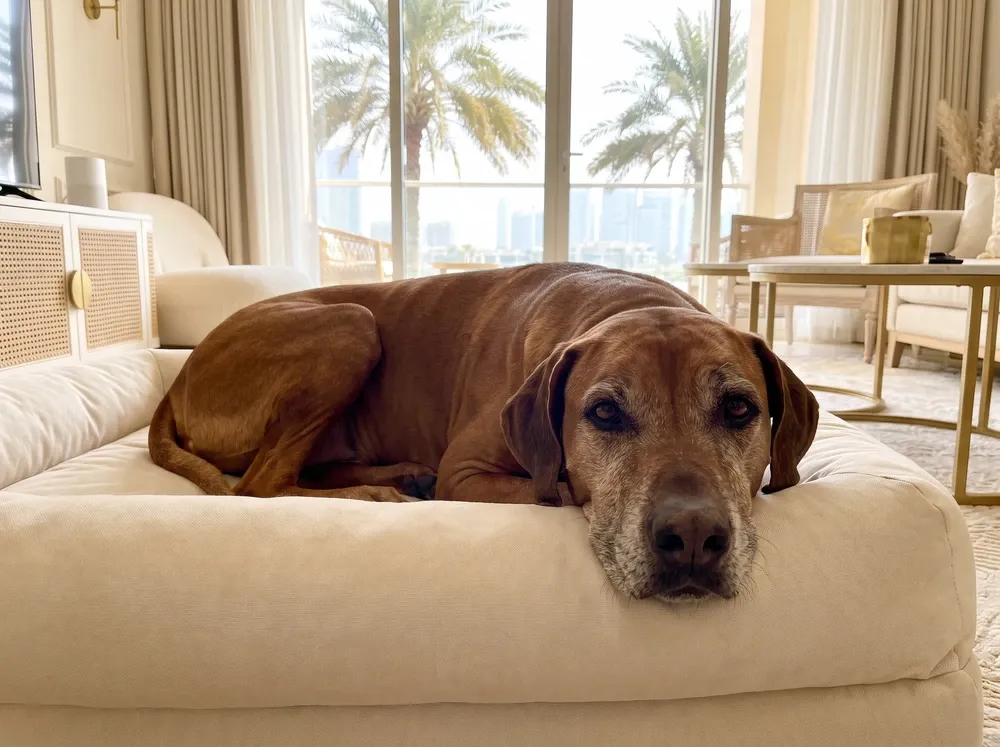
Rhodesian Ridgeback in Dubai, an older liver-nosed dog with a greying muzzle resting on a cream bed, palms outside

How old are they?

Their age

Rhodesian Ridgeback Puppy health

the first six months

What to watch for

  1. Developmental or early clinical signs of Hip Dysplasia (HD, a poorly fitting hip joint)
  2. Developmental or early clinical signs of Elbow Dysplasia (ED, a poorly fitting elbow joint)
  3. Early or congenital expression of Dermoid Sinus (Congenital), a small tube in the skin along the spine
  4. Genetic predisposition to Hypothyroidism (an underactive thyroid), no clinical disease expected at this stage
  5. Retained deciduous teeth (baby teeth that stay in), malocclusion or early dental crowding

The care that goes with it

  1. Core vaccinations, microchip and Dubai Municipality registration
  2. Deworming, and flea and tick prevention
  3. Body Condition Score (a measure of whether they are the right weight), dental, growth and nutritional evaluation, and early socialisation
  4. Baseline screening for Hip Dysplasia (HD)
  5. Follow-up for any early sign of Elbow Dysplasia (ED)
The full care detail
  • Core vaccination programme, microchipping and Dubai Municipality registration. Titre testing discussion where clinically appropriate; not a substitute for completing the core vaccine series
  • Deworming and external parasite prevention tailored to Dubai exposure
  • Body Condition Score (BCS), Muscle Condition Score (MCS), dental, growth and nutritional evaluation, and early socialisation
  • Baseline screening focused on Hip Dysplasia (HD)
  • Early diagnostic follow-up for signs suggestive of Elbow Dysplasia (ED)

Their age

Rhodesian Ridgeback Juvenile health

6 months to 2 years

What to watch for

  1. Emerging Hip Dysplasia (HD) with exercise intolerance or lameness
  2. Emerging Elbow Dysplasia (ED) with exercise intolerance or lameness
  3. Young-dog presentation of Dermoid Sinus (Congenital)
  4. Genetic predisposition to Hypothyroidism, monitoring only
  5. Early periodontal disease (gum disease) and dental crowding

The care that goes with it

  1. Hip and elbow evaluation (x-rays that grade the joints) by age 2, and a lean weight
  2. Dermoid sinus evaluation along the ridge if it was not done at birth, and surgery to remove one if found
  3. Neutering or spaying, timed for a large breed
  4. A yearly thyroid panel (T4, a blood test) from age 2, with medication if needed
  5. A lump or discharge along the spine that keeps coming back is looked into properly, not just treated again
The full care detail
  • Hip and elbow evaluation (OFA or PennHIP) by age 2; maintain lean body weight to reduce joint stress
  • Dermoid sinus evaluation at birth; surgical excision if present to prevent infection and meningitis
  • Neuter/spay timing discussion that accounts for large-breed growth and disease risk
  • Annual thyroid panel (T4) from age 2; levothyroxine if hypothyroidism is confirmed
  • Investigate recurrent signs rather than repeatedly treating presumed Dermoid Sinus (Congenital)

Their age

Rhodesian Ridgeback Young Adult health

2 to 4 years

What to watch for

  1. Hip Dysplasia (HD)
  2. Elbow Dysplasia (ED)
  3. Dermoid Sinus (Congenital)
  4. Genetic predisposition to Hypothyroidism
  5. Dental Disease

The care that goes with it

  1. Hip and elbow evaluation (x-rays that grade the joints), if not done by age 2
  2. Dermoid sinus evaluation along the ridge if it was not done at birth, and surgery to remove one if found
  3. A yearly thyroid panel (T4, a blood test), with medication if needed
  4. Daily tooth brushing, and a professional dental clean every 6 to 12 months
  5. A lean weight, to protect the joints
The full care detail
  • Hip and elbow evaluation (OFA or PennHIP) by age 2; maintain lean body weight to reduce joint stress
  • Dermoid sinus evaluation at birth; surgical excision if present to prevent infection and meningitis
  • Annual thyroid panel (T4) from age 2; levothyroxine if hypothyroidism is confirmed
  • Daily dental brushing; professional dental cleaning every 6-12 months
  • Maintain lean body weight: obesity significantly increases joint disease risk

Their age

Rhodesian Ridgeback Prime Adult health

4 to 7 years

What to watch for

  1. Hip Dysplasia (HD), Progressive
  2. Elbow Dysplasia (ED), Progressive
  3. Hypothyroidism
  4. Bloat / Gastric Dilatation-Volvulus (GDV, a twisted stomach)
  5. Dental Disease (Advanced)

The care that goes with it

  1. Hip and elbow management: supplements, physiotherapy and weight control
  2. Ongoing thyroid care, with a yearly T4 blood test
  3. Gastropexy (an operation that tacks the stomach in place), worth discussing with your vet, and two or three smaller meals a day with no exercise after eating
  4. Yearly dental x-rays, and removal of teeth that could spread infection
  5. A lean weight, to protect the joints
The full care detail
  • Hip and elbow management: joint supplements, physiotherapy, and weight management
  • Ongoing thyroid management: annual T4 monitoring; adjust levothyroxine dose as needed
  • Consider prophylactic gastropexy; feed 2-3 smaller meals daily; avoid exercise after meals
  • Annual dental X-rays; extract compromised teeth to prevent systemic infection
  • Maintain lean body weight: obesity significantly increases joint disease risk

Their age

Rhodesian Ridgeback Senior health

7 to 10 years

What to watch for

  1. Hip Dysplasia (HD), Severe Arthritis
  2. Cancer (Mast Cell Tumour, Osteosarcoma)
  3. Kidney Disease
  4. Heart Disease
  5. Cognitive Dysfunction Syndrome (dementia in older pets)

The care that goes with it

  1. Arthritis care: hydrotherapy, acupuncture, pain relief and joint supplements
  2. Annual physical examination, feeling the legs and skin for lumps
  3. Renal panel (a kidney blood test) twice a year, and a senior diet
  4. Echocardiogram (a heart scan) every year from age 7
  5. Cognitive enrichment (games that keep their mind busy) and a steady daily routine
The full care detail
  • Advanced hip management: hydrotherapy, acupuncture, NSAIDs (anti-inflammatory pain relief), and joint supplements
  • Annual full physical examination with limb palpation and skin mass evaluation for cancer
  • Bi-annual renal panel; transition to senior diet with controlled phosphorus and sodium
  • Annual echocardiogram from age 7; cardiac medication when indicated
  • Cognitive enrichment and consistent daily routine to slow cognitive dysfunction progression

Their age

Rhodesian Ridgeback Geriatric health

10 years and over

What to watch for

  1. Cancer (Advanced)
  2. Severe Arthritis / Mobility Loss
  3. Chronic Kidney Disease (CKD)
  4. Cognitive Dysfunction Syndrome (Advanced)
  5. Heart Disease

The care that goes with it

  1. Mobility support: orthopaedic bedding, ramps and physiotherapy
  2. Kidney and heart care, with medication reviewed often
  3. Cognitive enrichment (games that keep their mind busy) and a steady daily routine
  4. Quality-of-life assessment
  5. Palliative and comfort-focused care
  6. End-of-life planning with your veterinary team
The full care detail
  • Mobility support: orthopaedic bedding, ramps, slings, and physiotherapy for arthritic dogs
  • Renal and cardiac management with regular medication adjustments
  • Cognitive enrichment and consistent daily routine to slow cognitive dysfunction progression
  • Quality-of-life assessments
  • Tailored palliative and comfort-focused care plan
  • Compassionate end-of-life planning with your veterinary team

Breed predispositions indicate an increased risk rather than certainty of disease. What is right for them always comes from their own history and an evaluation.

Getting a Rhodesian Ridgeback puppy in Dubai

Before they come home.

Rhodesian Ridgeback in Dubai, a red wheaten puppy on a cream blanket, the ridge along the back, the skyline outside

Rhodesian Ridgeback puppies

The ridge, and what comes with it

The ridge is the breed's mark: a strip of hair along the spine that grows the opposite way to the rest of the coat. It came from the ridged dogs of southern Africa, and the gene behind it also raises the risk of dermoid sinus, so every puppy should be examined along the ridge at birth.

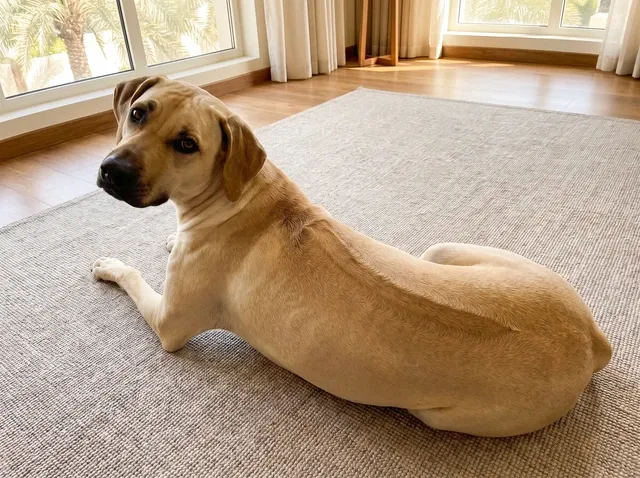
Rhodesian Ridgeback in Dubai, a light wheaten adult lying on a stone-coloured rug, the ridge showing, palms outside

Colours

Every shade of wheaten

From pale, light wheaten to a deep red wheaten, sometimes with a little white on the chest and toes. Against that warm coat, the ridge catches the light.

Rhodesian Ridgeback in Dubai, a red wheaten puppy asleep in a pet parent's lap on a cream sofa, palms outside

The first six months

Caring for a Rhodesian Ridgeback puppy

Vaccinations, microchip and Dubai Municipality registration come first. Let them meet many calm people, including at the door, and hold back long runs, stairs and jumping out of the car while their joints are growing.

Puppy health, 0 to 6 months
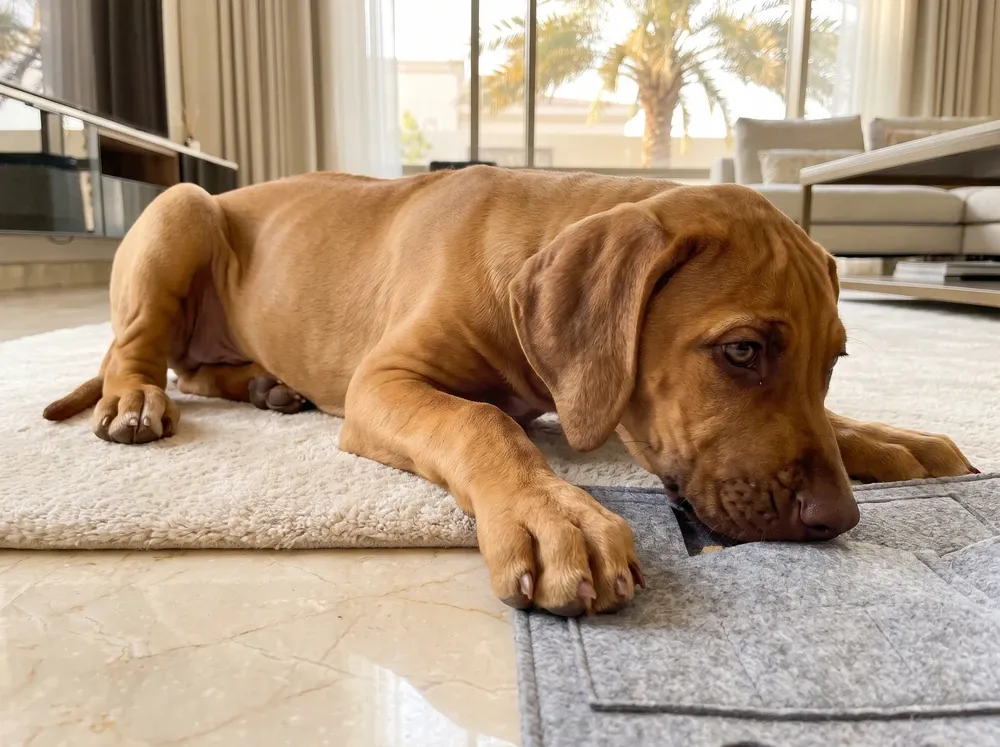
Rhodesian Ridgeback in Dubai, a liver-nosed wheaten puppy nosing a snuffle mat on a rug over marble, palms outside

Getting the home ready

Rugs, a ramp and a lidded bin

Rugs where they run on marble, a ramp for the car, a bin with a lid and clear counters, a snuffle mat, a long line, and a garden gate with no gaps.

Ten things that make their life better
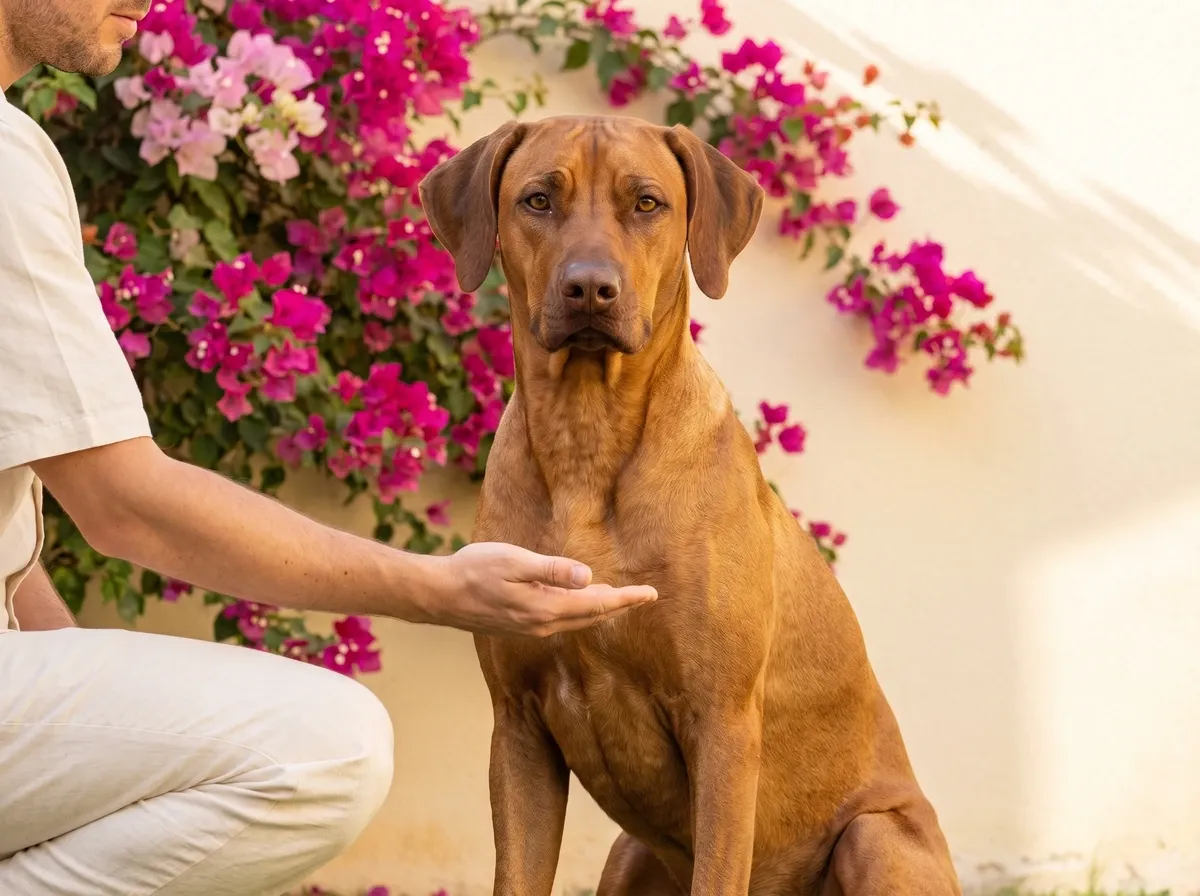
Rhodesian Ridgeback, a calm liver-nosed adult meeting a pet parent's open hand by a bougainvillea wall

Before you commit

Ask about hips, elbows and the ridge

Hip and Elbow Dysplasia are the first risks on a Ridgeback's record, and dermoid sinus comes with the ridge. Ask the breeder for both parents' hip and elbow results, and whether each puppy was examined for dermoid sinus at birth.

The reception of a Paws & Co clinic, with long cream benches and a stone reception desk

Before the clinics open

Join the founding families

AED 1,999 of essential care for AED 199. No payment now.

When to see a vet

When it is not behaviour.

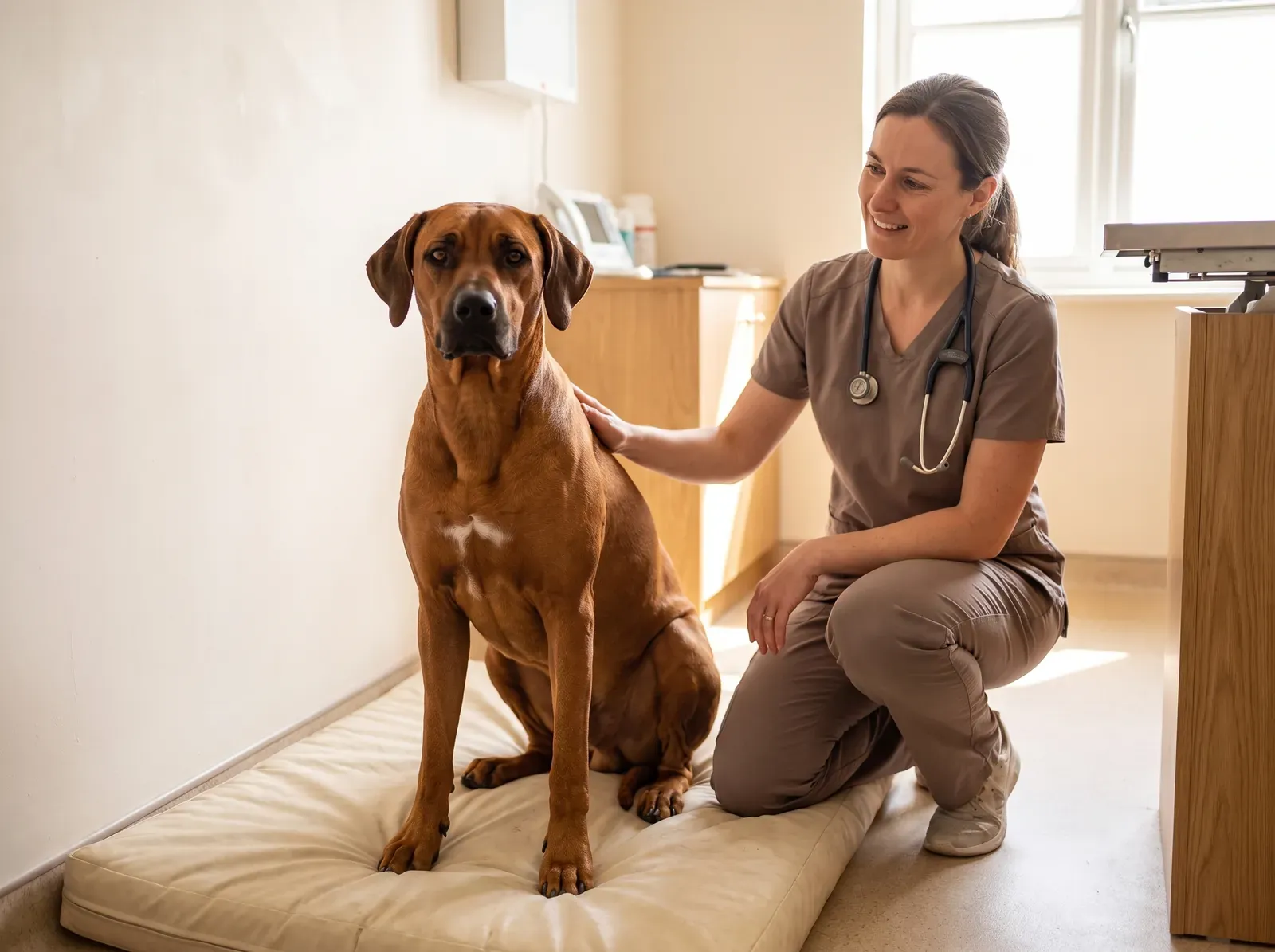
Rhodesian Ridgeback, a red wheaten adult on a padded mat as a vet in taupe scrubs rests a hand on their back

Some of this is not a training problem, and treating it like one wastes time your dog may not have. If they are distressed when you leave, if they growl or guard their food, their toys or you, if they are frightened on the lead, or if anything about them changes suddenly at any age, contact your vet the same day. A tip from a website, ours included, is not the answer. If it cannot wait, contact your nearest emergency vet now.

With a Ridgeback, watch their belly and the way they move. A swollen, tight belly, retching with nothing coming up, restlessness or drooling after a meal is an emergency: contact your vet now. A young Ridgeback who is stiff after exercise or slow to get up may have sore hips or elbows. A Ridgeback who goes flat and heavy may have an underactive thyroid, and one who paces at night as they age may be confused. They are too stoic to tell you themselves.

She'll keep tracking the delivery bag. If she stops meeting it at the lift, call your vet.

Rhodesian Ridgeback history

Before they were yours.

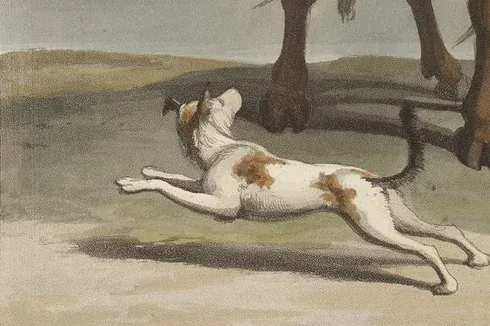
  1. Rhodesian Ridgeback history, a dog of the Kora Khoikhoi running past an ox, an aquatint, southern Africa, 1804
    A dog at a Kora Khoikhoi camp, a detail from Samuel Daniell's aquatint of the Kora preparing to move, African Scenery and Animals, London, 1804. British Library, CC0, via Wikimedia Commons.

    Before the 1700s

    The ridged dogs of the Khoikhoi

    The ridge comes from the dogs of the Khoikhoi people of southern Africa, who kept them to hunt and guard.

    What they still carryThe ridge, and toughness in heat.

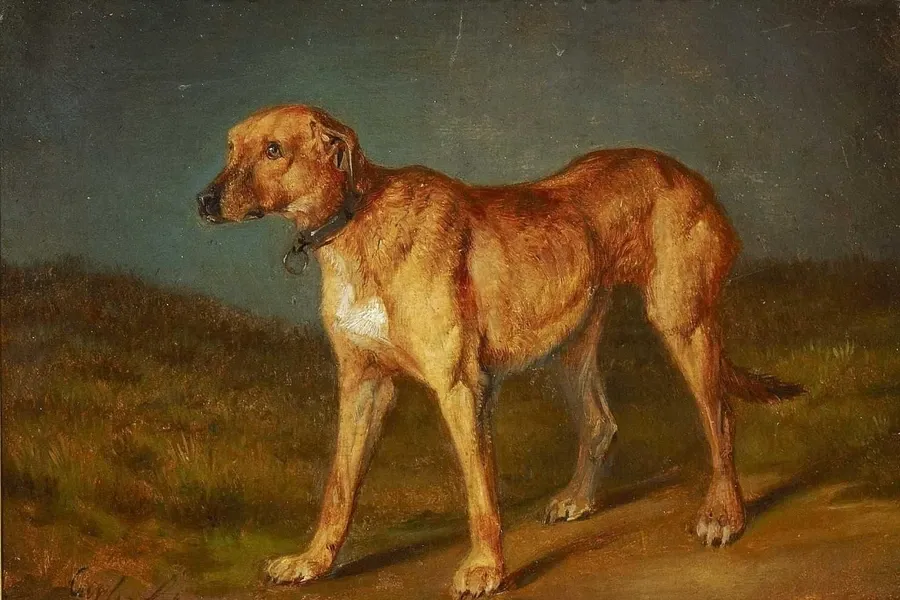
  2. Rhodesian Ridgeback history, a wheaten hound standing in an oil painting by Carl Friedrich Schulz, Germany, 19th century
    A wheaten hound painted by the German artist Carl Friedrich Schulz (1796 to 1866), sold at auction as a Rhodesian Ridgeback. Public domain, via Wikimedia Commons.

    1700s to 1800s

    Cape farm dogs

    Settlers in the Cape crossed their own hounds, mastiffs and terriers with the local ridged dogs, to guard homesteads at night and hunt by day.

    What they still carryThe guarding streak, and devotion to their own people.

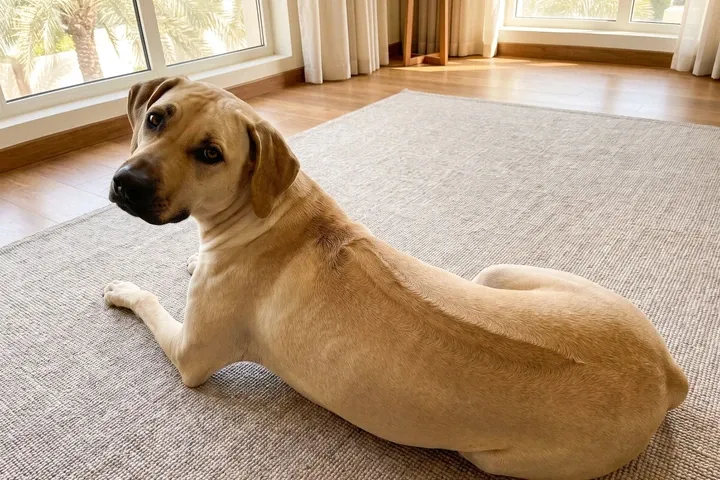
  3. Rhodesian Ridgeback history, a light wheaten adult lying on a rug, the ridge along the back
    A Rhodesian Ridgeback today.

    1879 to the 1900s

    The lion dogs

    In Rhodesia, now Zimbabwe, the hunter Cornelius van Rooyen used small teams of ridged dogs to track lions and hold them at bay. A good one was fast enough to stay out of reach and sensible enough not to attack.

    What they still carrySpeed, a nose and a cool head.

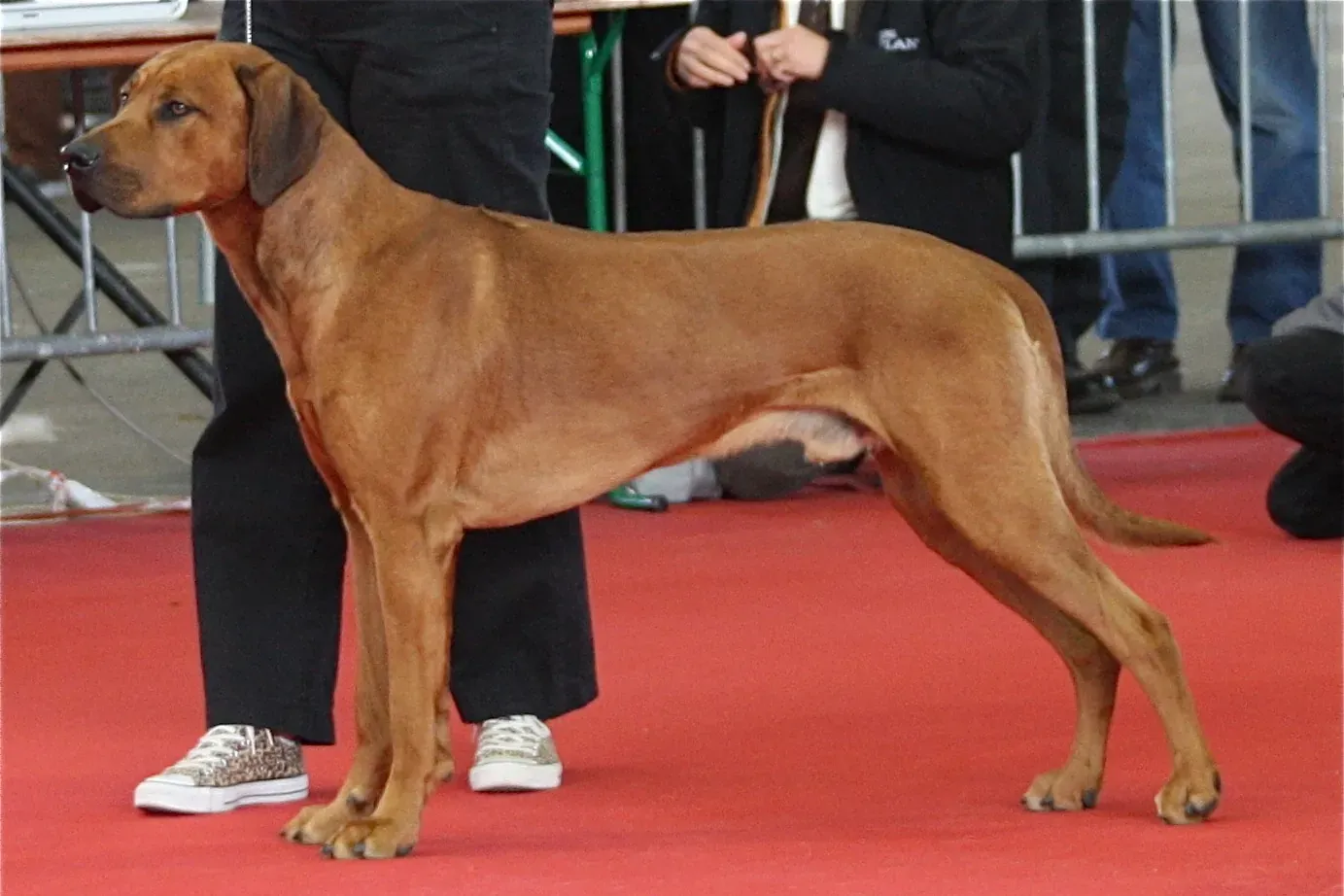
  4. Rhodesian Ridgeback history, a red wheaten Ridgeback standing at a dog show, a photograph, 2012
    A Rhodesian Ridgeback at a dog show, 2012. Photo: Vulkano12, CC BY-SA 3.0, via Wikimedia Commons.

    1922 to 1955

    A name of their own

    Owners met in Bulawayo in 1922 and wrote down what a Ridgeback should be. The American Kennel Club admitted the breed in 1955.

    What they still carryA breed shaped around the ridge, and the dermoid sinus risk that comes with it.

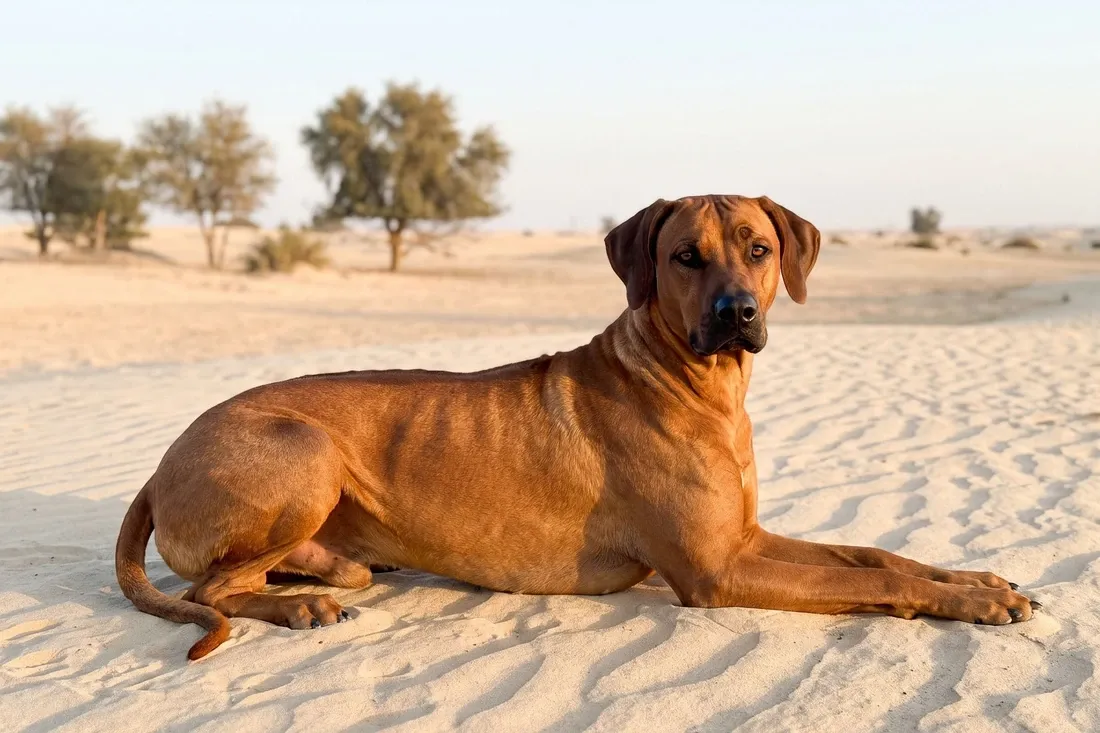
  5. Rhodesian Ridgeback history, the breed today, a red wheaten adult lying on desert sand, Dubai, 2026

    Today

    In Dubai

    In Dubai a Ridgeback lives in a villa or a flat, with a short coat that suits the climate better than most.

    What they still carryA lion-tracking farm dog built for heat and distance, with far less ground to cover.

Rhodesian Ridgeback questions

The ones you type at midnight.

Most of these get asked late at night, by someone watching their dog and not sure what they are seeing.

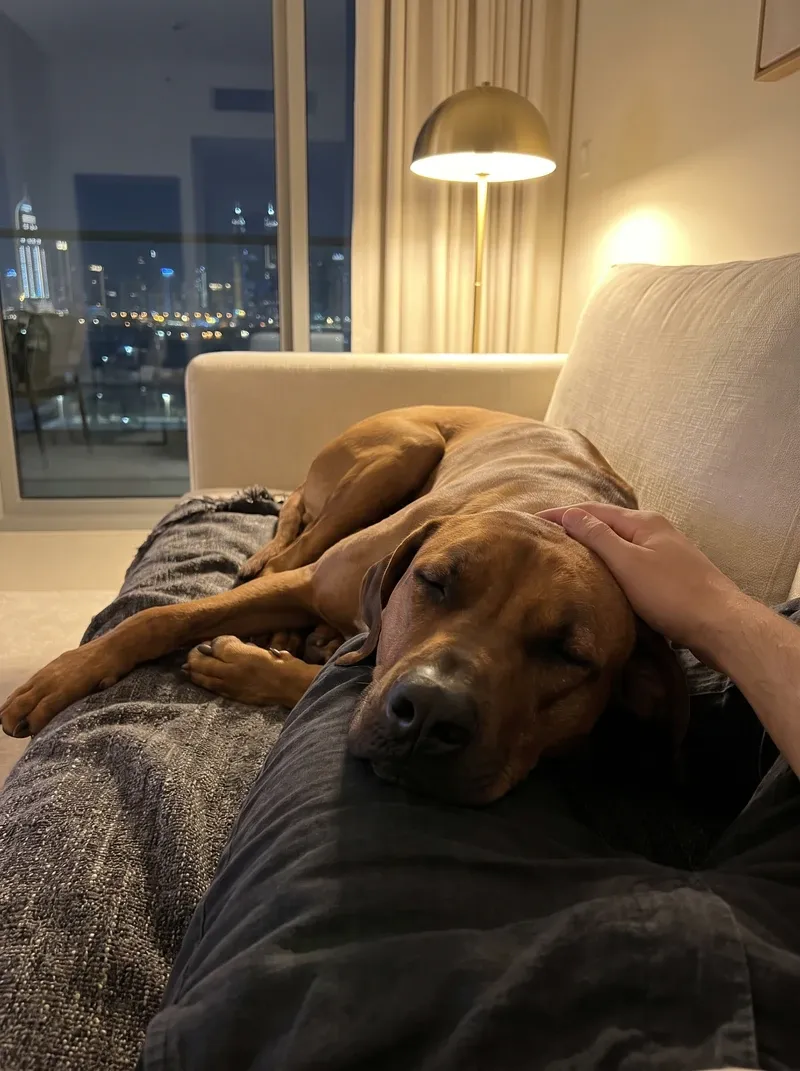
Rhodesian Ridgeback in Dubai, a red wheaten adult asleep against a knee, a brass lamp and the lit skyline behind
How long do Rhodesian Ridgebacks live?

Rhodesian Ridgebacks usually live 10 to 12 years. In a UK study of more than 2,000 Ridgebacks, half lived to 12.

How big does a Rhodesian Ridgeback get?

A Rhodesian Ridgeback is a large dog of about 32 to 38.5 kg, with males usually heavier than females.

Do Rhodesian Ridgebacks shed?

Rhodesian Ridgebacks shed moderately, with a heavier moult once or twice a year. A weekly brush is enough.

Are Rhodesian Ridgebacks good with strangers?

Many Rhodesian Ridgebacks are reserved with strangers and protective at home. Socialise them widely as a puppy, let guests arrive without fuss, and never encourage guarding.

Why do Rhodesian Ridgebacks have a ridge?

A Rhodesian Ridgeback's ridge is a strip of hair along the spine that grows the opposite way to the rest of the coat. It came from the ridged dogs of the Khoikhoi people, and the gene behind it also raises the risk of dermoid sinus.

Did Rhodesian Ridgebacks really hunt lions?

Yes. Rhodesian Ridgebacks tracked lions and held them at bay until the hunter arrived, which is why they were known as lion dogs.

What colours do Rhodesian Ridgebacks come in?

Rhodesian Ridgebacks are always a shade of wheaten, from light wheaten to red wheaten, sometimes with a little white on the chest and toes.

What is dermoid sinus in Rhodesian Ridgebacks?

Dermoid sinus is a small tube in the skin along a Rhodesian Ridgeback's spine that can become infected. Puppies should be examined for it at birth, and a vet can remove one surgically.

Is a Rhodesian Ridgeback a good first dog?

A Rhodesian Ridgeback suits someone who has trained a dog before, or a first-time owner ready for calm, consistent training from day one. They are independent thinkers who need real daily exercise.

Worried about them? Contact your vet today.