We’re hiring people who love them like we do. Join us careers@pawsandco.comSee open roles
UAE Government Licensed MOCCAE
Rottweiler in Dubai, studio portrait of a calm black and rust adult sitting against a dark background

Breed guide  ·  Dogs

Rottweiler

He was bred to pull a butcher's cart. He sits on my feet so I can't leave.

Lifespan
9 to 10 years
Size
Large
Weight
36 to 61 kg
Shedding
Moderate

Last updated 12 October 2026

Join the founding families. AED 1,999 of essential care for AED 199.

No payment now. We'll be in touch by email and WhatsApp as we open enrolment.

✓
Thank you.

We will be in touch soon to confirm.

Rottie traits

What they brought with them.

Tap a card to see what is going on.

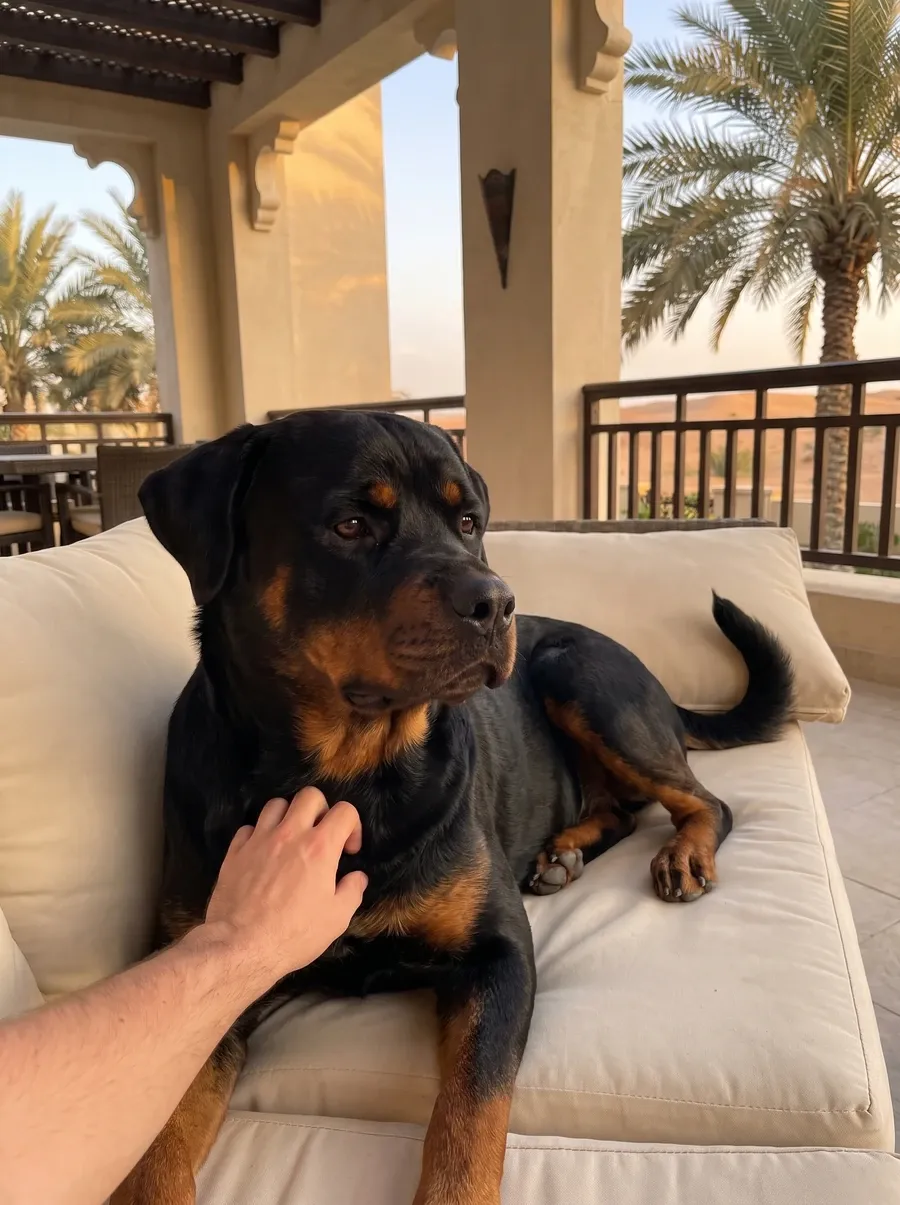
Rottweiler in Dubai, lying on a villa terrace sofa among palms while a pet parent scratches their chest

At home

Why does my Rottweiler rumble?

A deep rumble from the chest while they lean on you, have their chest scratched or settle on the sofa.

What's going onMany Rottweilers rumble when they are happy. Learn what their contented rumble looks like, loose body and soft eyes, so you notice if it ever sounds different. A real growl is a warning: never punish it, stop what is happening and contact your vet.

Rottweiler, lying calmly on a jute mat in a marble villa hallway by the front door

At home

The Rottweiler guard dog at your door

A bark at the doorbell, the lift or footsteps in the corridor, then they stand between you and the door.

What's going onThey were bred to guard the herd and the cart, and they are telling you someone is there. Give them a mat away from the door and a reason to go to it, and they have a job they can get right.

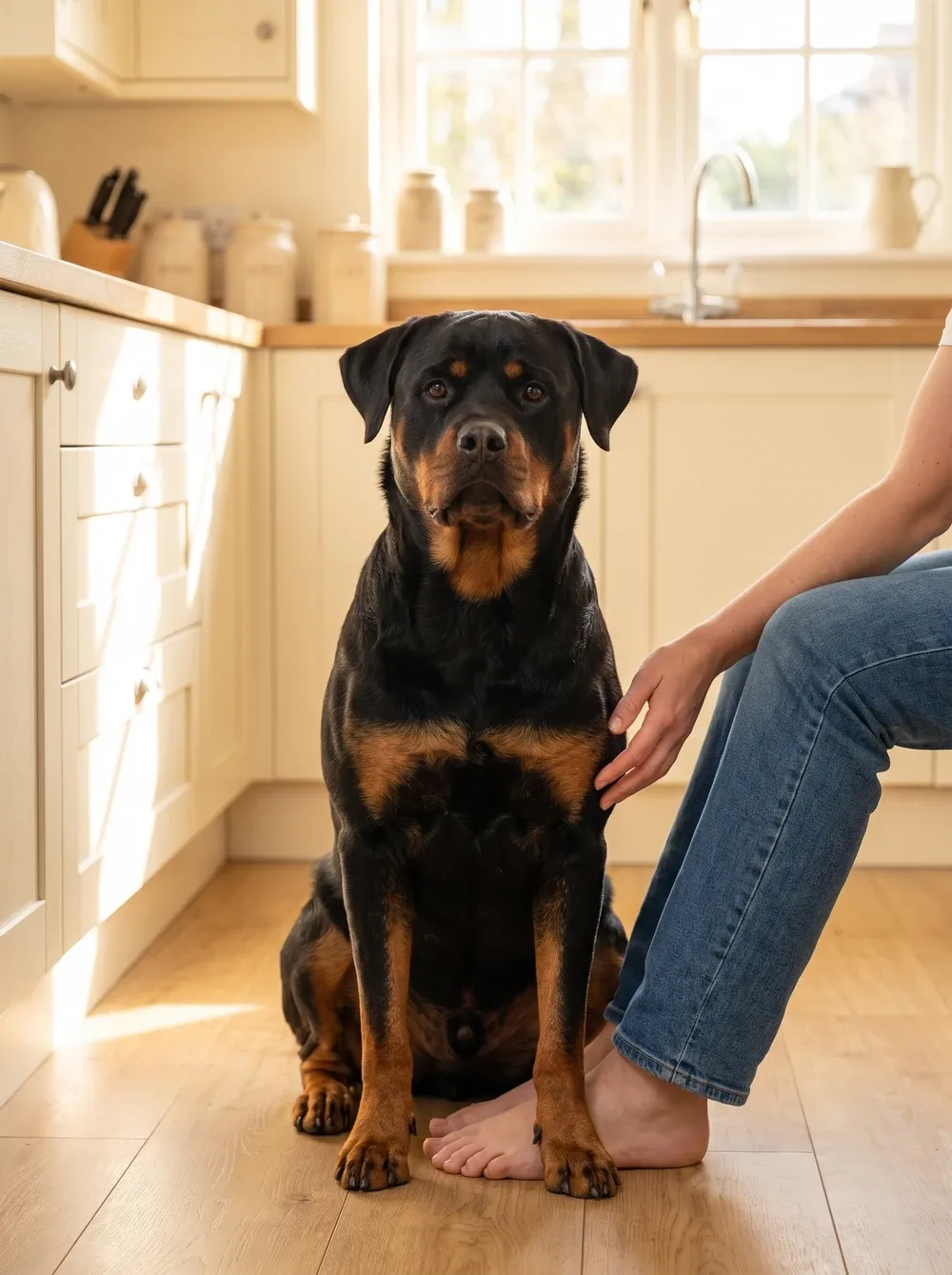
Rottweiler, sitting on a pet parent's bare feet in a sunny cream kitchen

At home

They sit on your feet

Their whole weight against your legs, and they follow you from room to room.

What's going onA Rottweiler was bred to stay with their people on the road, and they still want to be where you are. A long day alone is hard for them. If they are distressed when you leave, that is common and treatable: contact your vet.
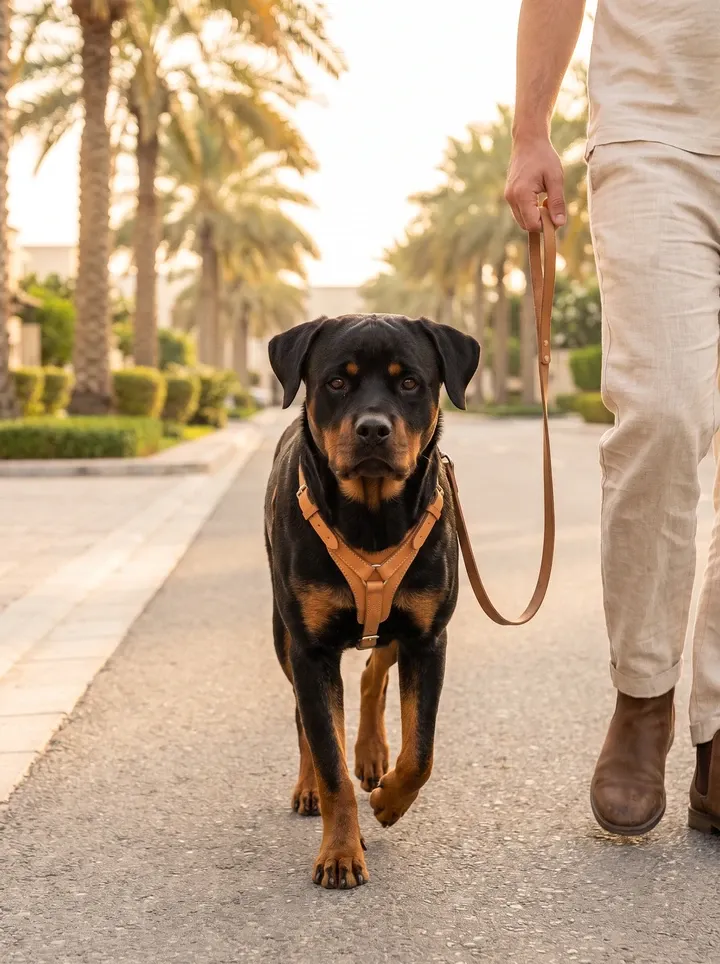
Rottweiler in Dubai, a young dog in a tan harness walking on a loose lead along a palm lined street

At home

Built to pull

They lean into the lead, barge through doors and lean on people to move them.

What's going onThey were bred to pull carts, so they will pull you. Teach a loose lead and a calm "off" while they are small, because at full size they are stronger than you.

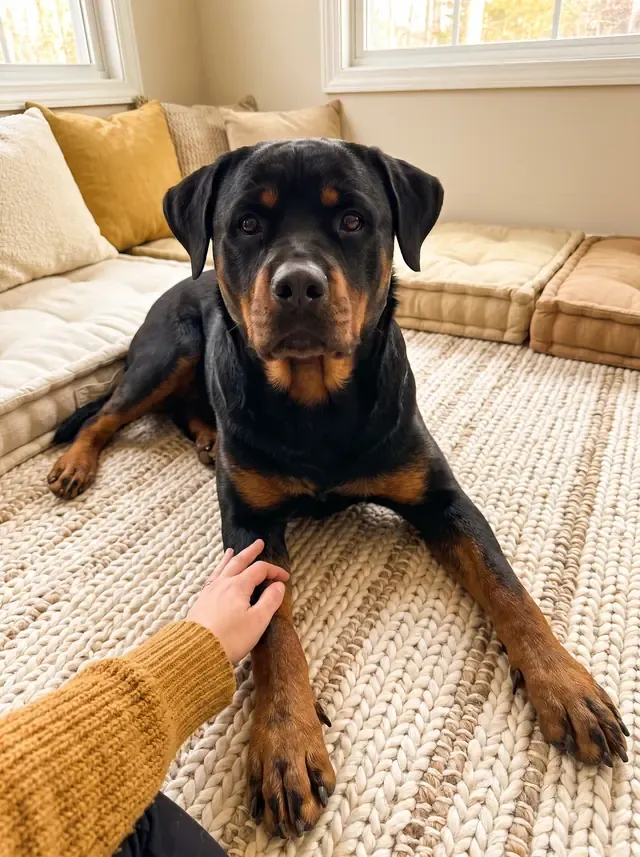
Rottweiler, lying on a woven rug among floor cushions while a pet parent feels a front leg

At home

A limp is worth a call

A limp that comes and goes, or they are slow to get up on one leg.

What's going onOsteosarcoma (bone cancer) is one of the Rottweiler's main health risks, from a young age. If a limp keeps coming back or does not go away, or you find a firm swelling on a leg, contact your vet within days, not weeks.

Rottweiler in Dubai, a puppy held in a pet parent's arms in a shaded courtyard with palms

At home

Finish their vaccinations first

A new puppy who wants to meet every dog in the park, today.

What's going onRottweilers are more vulnerable to parvovirus (a serious, contagious gut virus). Until their puppy vaccinations are finished, carry them, or use clean ground away from other dogs.

A Rottie in Dubai

The bit nobody tells you.

Their day

Built for: Walking cattle to market, all day.

In Dubai: A flat, and too hot to walk far for five months of the year.

Their watch

Built for: Guarding the herd and the cart on the road.

In Dubai: A delivery driver at the door.

Their strength

Built for: Pulling carts of meat.

In Dubai: A lead, a lift and a shared corridor.

The pulling, the barking at the lift and the weight they put on mostly come from that gap.

You cannot give them a herd. You can give them a job and a rule for the door, and the ten things below are how.

Your plan is built around their breed: the health risks for a Rottweiler at every age, and the care that goes with each one.

Join the founding families. AED 1,999 of essential care for AED 199.

Daily care for a Rottie

Ten things that make their life better.

Many of them are free, and most matter at every age.

  1. They will tell you someone is there. A rule keeps them out of the doorway.

    Every age, most of all 6 months to 2 years

    AED 100 to 400 for a mat or bed

    Why

    They will tell you someone is there. A rule keeps them out of the doorway.

    What to do

    Put a mat a few metres from the door, out of sight of it if you can. Long before any visitor, teach them that going there pays: a treat every time. When the bell goes, thank them once and send them there. While they are learning, have deliveries left outside. If they have lunged or snapped at anyone, contact your vet instead.

  2. They judge strangers by the people they have already met, and parvovirus is a bigger risk for them.

    Every age, most of all under 2 years

    FreeIn your plan

    Why

    They judge strangers by the people they have already met, and parvovirus is a bigger risk for them.

    What to do

    In their first months, let them watch all kinds of people from a distance they are happy at: men in caps, children, people in uniform, the concierge. A treat for each, and let them leave if they want to. Carry them, or use clean ground, until their vaccinations are finished.

  3. The lift is a small box where strangers walk straight at them.

    Every age, most of all 6 months to 2 years

    Free

    Why

    The lift is a small box where strangers walk straight at them.

    What to do

    Wait for an empty lift, or stand them in the back corner with you in front. Step aside in corridors and let people pass. Keep the lead short and loose near entrances and blind corners, and ask building staff to let you by rather than reach for them.

  4. A bored Rottweiler finds their own work.

    Every age, most of all 6 months to 2 years

    Under AED 150 for a puzzle feeder

    Why

    A bored Rottweiler finds their own work.

    What to do

    Two or three short training sessions a day, and part of their dinner hidden around the flat or in a puzzle feeder. Stop while they still want more. Ten minutes of thinking often settles them better than an hour of running.

  5. A heavy, dark dog holds heat, and their joints prefer steady walking to sprints.

    Every age, most of all puppies and from 7 years

    Free

    Why

    A heavy, dark dog holds heat, and their joints prefer steady walking to sprints.

    What to do

    From May to September, walk before sunrise and after dark. Put the back of your hand on the pavement for five seconds: if you cannot keep it there, they cannot walk on it. Choose steady walks over ball chasing, and carry water.

  6. A basket muzzle they are used to keeps a stressful moment calm, at the vet or anywhere else.

    Every age, easiest under 2 years

    Under AED 200

    Why

    A basket muzzle they are used to keeps a stressful moment calm, at the vet or anywhere else.

    What to do

    Teach it young and slowly, while nothing is wrong: show it, treat; nose in, treat; a second longer each day. A well-fitted basket muzzle still lets them pant, drink and take a treat. Never put it on for the first time in a hurry.

  7. Your vet will feel their legs every year from young adulthood. Make that easy for them.

    Every age, start as a puppy

    Free

    Why

    Your vet will feel their legs every year from young adulthood. Make that easy for them.

    What to do

    A few minutes, a few times a week: run a hand down each leg, lift a paw, look in an ear, lift a lip, and reward each one. Brush their teeth every day while you are there. Stop before they get uneasy.

  8. New guarding often shows between one and three years, and by then they are very strong.

    6 months to 3 years

    Free

    Why

    New guarding often shows between one and three years, and by then they are very strong.

    What to do

    Reward calm, every time. A flat collar or harness, loose-lead practice, short sessions, never tools that hurt or frighten them, and never punish a growl. If new guarding appears, contact your vet early.

  9. Hip Dysplasia (a poorly fitting hip joint) and Elbow Dysplasia (a poorly fitting elbow joint) are the two main health risks while they grow, and extra weight adds to their joint and cancer risk.

    Every age, most of all while growing and from 7 years

    Free to AED 1,000 for rugs and a rampIn your plan

    Why

    Hip Dysplasia (a poorly fitting hip joint) and Elbow Dysplasia (a poorly fitting elbow joint) are the two main health risks while they grow, and extra weight adds to their joint and cancer risk.

    What to do

    Rugs where they turn on marble, a ramp for the car, and few stairs while they grow. Weigh their food, and have their hips and elbows evaluated before they turn two.

  10. Bone cancer and heart disease are both health risks for the breed, and a Rottweiler can hide pain well.

    Every age, most of all from 2 years

    FreeIn your plan

    Why

    Bone cancer and heart disease are both health risks for the breed, and a Rottweiler can hide pain well.

    What to do

    Once a week, run your hands down each leg, feeling for heat or swelling, and over their ribs and spine. Weigh them monthly. A new lump, a limp or faster breathing at rest is worth telling your vet that week.

Three of these are in your plan. The rest you can do at home.

Join the founding families. AED 1,999 of essential care for AED 199.

Rottie health by age

Their health, at every age.

In a Rottweiler, a limp that lingers, a new grumble when touched or tiring early on a walk is often the body talking, not the temperament. Choose their age to see what to watch for, and the care that goes with it.

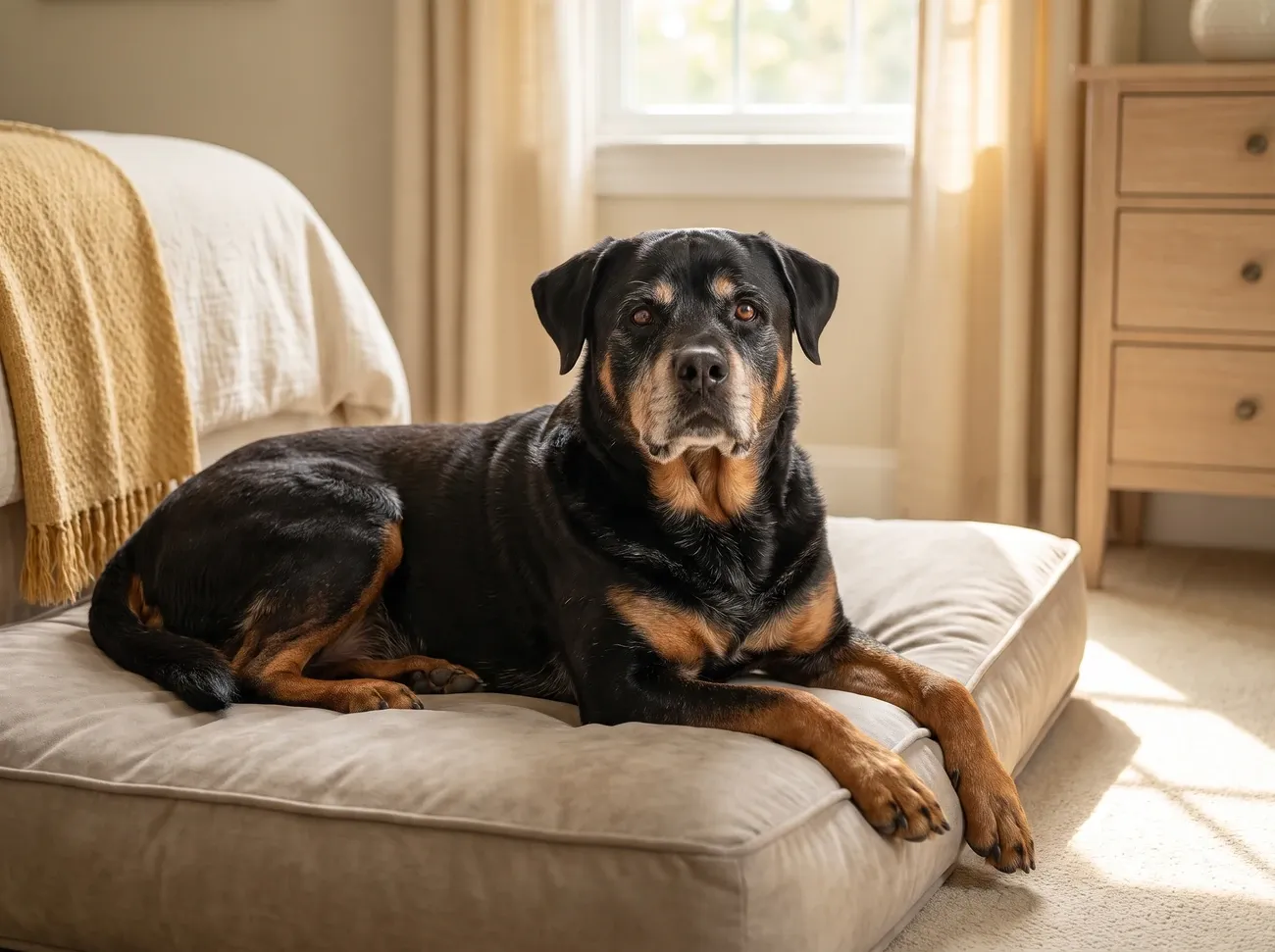
Rottweiler, an older adult with a greying muzzle resting on an orthopaedic dog bed in a bright bedroom

How old are they?

Their age

Rottie Puppy health

the first six months

What to watch for

  1. Developmental or early clinical signs of Hip Dysplasia (HD, poorly fitting hip joint)
  2. Developmental or early clinical signs of Elbow Dysplasia (ED, poorly fitting elbow joint)
  3. Early or congenital expression of Osteosarcoma (Bone Cancer, Early Risk)
  4. Congenital murmur or early cardiac abnormality related to Subvalvular Aortic Stenosis (SAS, narrowing below the heart valve)
  5. Early or congenital expression of Parvovirus Susceptibility (a serious, contagious gut virus)

The care that goes with it

  1. Core vaccinations, microchip and Dubai Municipality registration
  2. Deworming, and flea and tick prevention
  3. Body Condition Score (a check on whether they are the right weight), growth and nutritional evaluation, and early socialisation
  4. Hip Dysplasia (HD, a poorly fitting hip joint) screening, as a baseline
  5. Early follow-up for any signs of Elbow Dysplasia (ED, a poorly fitting elbow joint)
The full care detail
  • Core vaccination programme, microchipping and Dubai Municipality registration. Titre testing discussion where clinically appropriate; not a substitute for completing the core vaccine series
  • Deworming and external parasite prevention tailored to Dubai exposure
  • Body Condition Score (BCS), Muscle Condition Score (MCS), dental, growth and nutritional evaluation, and early socialisation
  • Baseline screening focused on Hip Dysplasia (HD)
  • Early diagnostic follow-up for signs suggestive of Elbow Dysplasia (ED)

Their age

Rottie Juvenile health

6 months to 2 years

What to watch for

  1. Emerging Hip Dysplasia (HD, poorly fitting hip joint) with exercise intolerance or lameness
  2. Emerging Elbow Dysplasia (ED, poorly fitting elbow joint) with exercise intolerance or lameness
  3. Young-dog presentation of Osteosarcoma (Bone Cancer, Early Risk)
  4. Early clinical or screening evidence of Subvalvular Aortic Stenosis (SAS, narrowing below the heart valve)
  5. Young-dog presentation of Parvovirus Susceptibility

The care that goes with it

  1. Hip and elbow evaluation by age 2 (OFA or PennHIP, two x-ray scoring schemes), and a lean body weight
  2. Auscultation (listening to the chest) at age 1 for a heart murmur, and an echocardiogram (an ultrasound scan of the heart) if one is heard
  3. Neutering or spaying, timed for a large breed
  4. Their full vaccination course, including parvovirus
  5. Finding the cause of any limp or swelling that keeps coming back
The full care detail
  • Hip and elbow evaluation (OFA or PennHIP) by age 2; maintain lean body weight to reduce joint stress
  • Cardiac auscultation at age 1 to detect Subvalvular Aortic Stenosis (SAS) murmur; echocardiogram if murmur is detected
  • Neuter/spay timing discussion that accounts for large-breed growth and disease risk
  • Ensure complete vaccination protocol including parvovirus; Rottweilers have elevated susceptibility
  • Investigate recurrent signs rather than repeatedly treating presumed Osteosarcoma (Bone Cancer, Early Risk)

Their age

Rottie Young Adult health

2 to 4 years

What to watch for

  1. Hip Dysplasia (HD, poorly fitting hip joint)
  2. Elbow Dysplasia (ED, poorly fitting elbow joint)
  3. Osteosarcoma (Bone Cancer, Early Risk)
  4. Subvalvular Aortic Stenosis (SAS, narrowing below the heart valve)
  5. Parvovirus Susceptibility

The care that goes with it

  1. Hip and elbow evaluation by age 2, if not done yet, and a lean body weight
  2. Auscultation (listening to the chest) for a heart murmur, and an echocardiogram (an ultrasound scan of the heart) if one is heard
  3. Vaccinations kept up to date, including parvovirus
  4. A yearly feel of their legs by hand for osteosarcoma (bone cancer)
  5. Teeth brushed every day, and a professional dental clean every 6 to 12 months
The full care detail
  • Hip and elbow evaluation (OFA or PennHIP) by age 2; maintain lean body weight to reduce joint stress
  • Cardiac auscultation at age 1 to detect Subvalvular Aortic Stenosis (SAS) murmur; echocardiogram if murmur is detected
  • Ensure complete vaccination protocol including parvovirus; Rottweilers have elevated susceptibility
  • Annual limb palpation for osteosarcoma, Rottweilers have one of the highest bone cancer rates
  • Daily dental brushing; professional dental cleaning every 6-12 months

Their age

Rottie Prime Adult health

4 to 7 years

What to watch for

  1. Hip Dysplasia (HD), Progressive
  2. Osteosarcoma (Bone Cancer)
  3. Elbow Dysplasia (ED), Progressive
  4. Dilated Cardiomyopathy (DCM, enlarged, weakened heart)
  5. Hypothyroidism (an underactive thyroid)

The care that goes with it

  1. Hip and elbow care: joint supplements, physiotherapy and weight management
  2. Yearly leg x-rays and a feel by hand for osteosarcoma (bone cancer), so that if it is found, treatment and pain relief start early
  3. An echocardiogram (an ultrasound scan of the heart) every year from age 4, to find Dilated Cardiomyopathy (DCM, an enlarged, weakened heart) early
  4. A yearly thyroid panel, with treatment if hypothyroidism (an underactive thyroid) is confirmed
  5. A lean body weight, which lowers the risk of cancer and joint disease
The full care detail
  • Hip and elbow management: joint supplements, physiotherapy, and weight management
  • Annual limb X-rays and palpation for osteosarcoma; pain management if confirmed
  • Annual echocardiogram from age 4 to detect Dilated Cardiomyopathy (DCM) early
  • Annual thyroid panel (T4); levothyroxine if hypothyroidism is confirmed
  • Maintain lean body weight: obesity significantly increases cancer and joint disease risk

Their age

Rottie Senior health

7 to 10 years

What to watch for

  1. Osteosarcoma (Advanced)
  2. Hip Dysplasia (HD), Severe Arthritis
  3. Dilated Cardiomyopathy (DCM), Advanced
  4. Kidney Disease
  5. Cognitive Dysfunction Syndrome (dementia in older pets)

The care that goes with it

  1. Hip care: hydrotherapy, acupuncture, anti-inflammatory pain relief and joint supplements
  2. Kidney blood tests twice a year, and a senior diet
  3. Heart medication, as your vet directs, if heart disease is found
  4. If osteosarcoma (bone cancer) is found: pain relief and palliative care (comfort care), with surgery or chemotherapy where it is right for them
  5. Brain games and a steady daily routine, to slow cognitive dysfunction (dementia in older pets)
The full care detail
  • Pain management and palliative care for osteosarcoma; amputation + chemotherapy if appropriate
  • Advanced hip management: hydrotherapy, acupuncture, NSAIDs, and joint supplements
  • Full cardiac medication protocol: Pimobendan, ACE inhibitors, diuretics as directed
  • Bi-annual renal panel; transition to senior diet with controlled phosphorus and sodium
  • Cognitive enrichment and consistent daily routine to slow cognitive dysfunction progression

Their age

Rottie Geriatric health

10 years and over

What to watch for

  1. Cancer (Advanced)
  2. Congestive Heart Failure
  3. Severe Arthritis / Mobility Loss
  4. Chronic Kidney Disease (CKD, long-term kidney failure)
  5. Cognitive Dysfunction Syndrome (Advanced)

The care that goes with it

  1. Mobility support: an orthopaedic bed, ramps, a sling and physiotherapy
  2. Kidney and heart care, with medication adjusted as things change
  3. Brain games and a steady daily routine
  4. Quality-of-life assessments
  5. Palliative care (comfort care)
  6. End-of-life planning with your vet team, when the time comes
The full care detail
  • Mobility support: orthopaedic bedding, ramps, slings, and physiotherapy for arthritic dogs
  • Renal and cardiac management with regular medication adjustments
  • Cognitive enrichment and consistent daily routine to slow cognitive dysfunction progression
  • Quality-of-life assessments
  • Tailored palliative and comfort-focused care plan
  • Compassionate end-of-life planning with your veterinary team

Breed predispositions indicate an increased risk rather than certainty of disease. What is right for them always comes from their own history and an evaluation.

Getting a Rottie puppy in Dubai

Before they come home.

Rottweiler, lying on a cream blanket in a sunroom with linen blinds

The breed

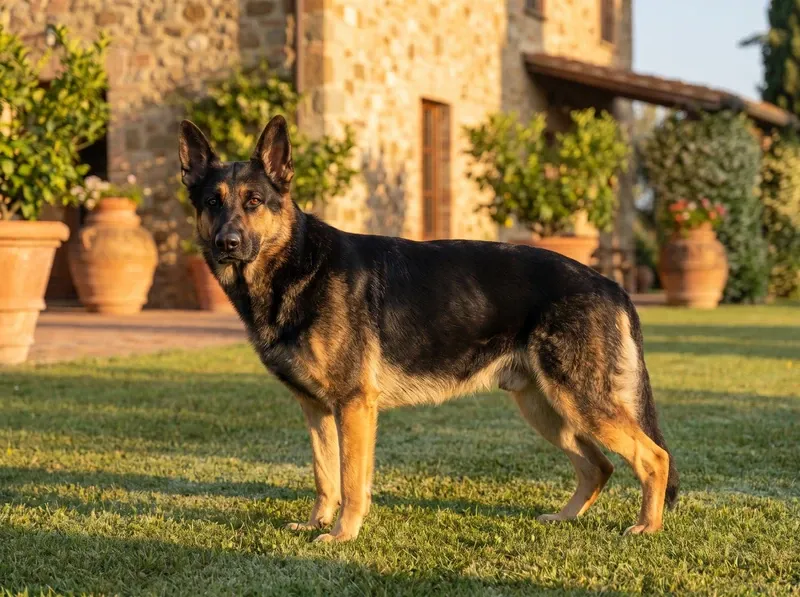
A German working dog

The Rottweiler comes from Germany, and the breed clubs still test for a working temperament. Ask the breeder whether the parents have had that testing too.

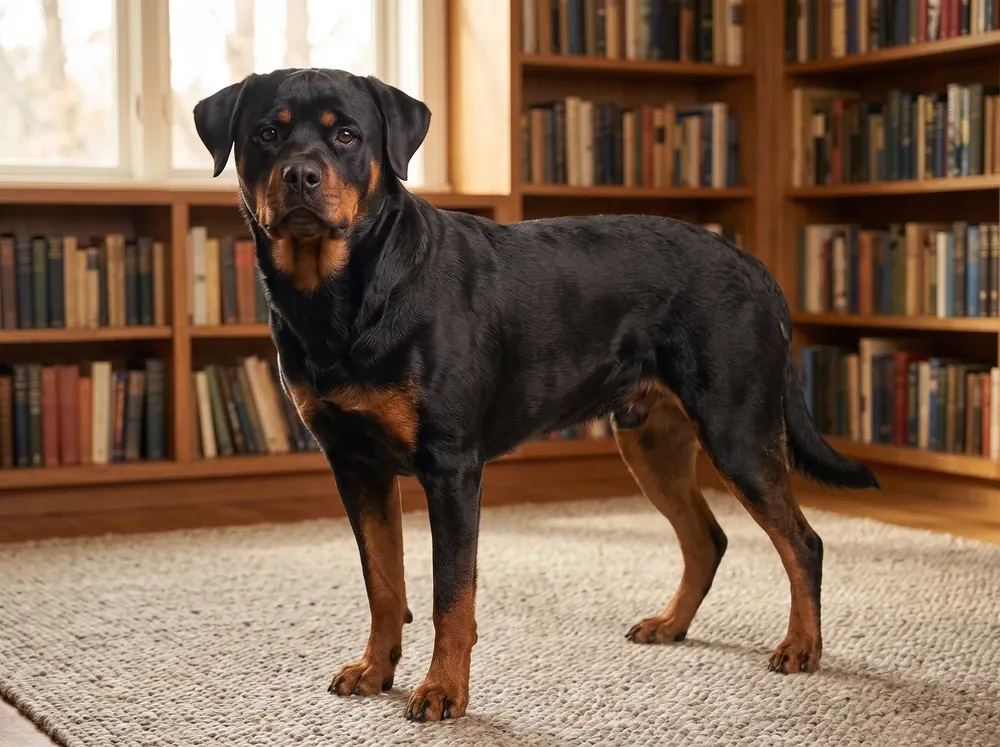
Rottweiler, a black and mahogany adult standing on a wool rug in a reading room

Colours

Black, with rust to mahogany

A Rottweiler is black, with markings that run from warm rust to deep mahogany over the eyes, on the cheeks and muzzle, across the chest and down the legs. If a breeder offers a different colour, ask how the litter was bred.

Rottweiler, a puppy asleep in a pet parent's lap in a linen armchair

The first six months

Rottweiler puppy care

Their full vaccination course comes first, including parvovirus, with a microchip and Dubai Municipality registration. Until it is finished, carry them, or use clean ground. Early socialisation, a baseline look at their hips and soft landings while their joints form matter most now.

Puppy health, 0 to 6 months
Rottweiler, a young dog lying on a cream mat on the marble floor of a bright flat

Getting the home ready

A mat by the door, rugs on the marble

Put a mat a few metres from the front door before they arrive, and rugs or runners where they will turn on marble. Plan a ramp or a lift into the car, and a cool room for the summer.

Ten things that make their life better
Rottweiler in Dubai, a mother lying with a puppy on a shaded villa lawn with palms

Before you commit

Ask about hips, elbows and heart

Ask the breeder whether both parents' hips and elbows have been scored, and whether their hearts have been listened to for a murmur. Then meet the mother. A calm, easy mother is a good sign.

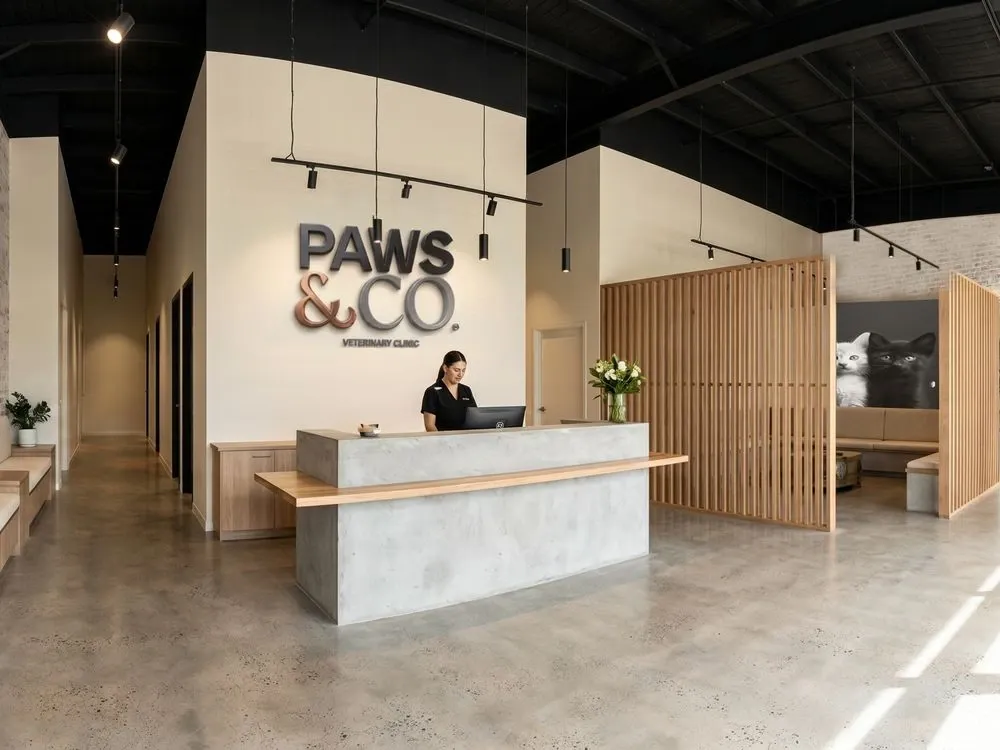
The reception of a Paws & Co clinic, with long cream benches and a stone reception desk

Before the clinics open

Join the founding families

AED 1,999 of essential care for AED 199. No payment now.

When to see a vet

When it is not behaviour.

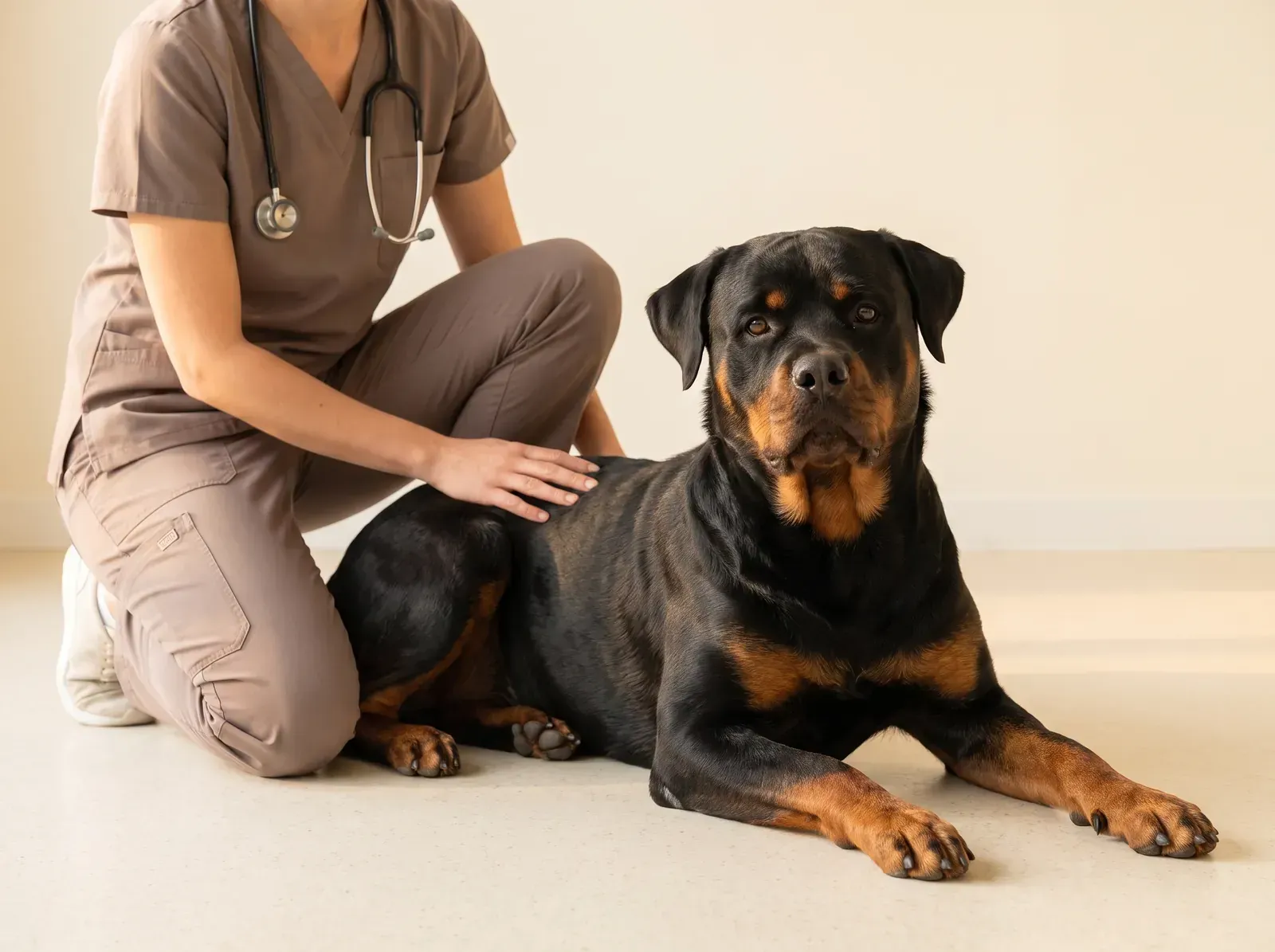
Rottweiler, lying on the floor while a vet in taupe scrubs kneels beside them, one hand on their back

Some of this is not a training problem, and treating it like one wastes time your dog may not have. If they are distressed when you leave, if they growl or guard their food, their toys or you, if they are frightened on the lead, or if anything about them changes suddenly at any age, contact your vet the same day. A tip from a website, ours included, is not the answer. If it cannot wait, contact your nearest emergency vet now.

With a Rottweiler, watch their legs and their mood. If a limp does not go away, or you find a swelling on a leg, contact your vet within days. A Rottweiler who suddenly grumbles when touched, stops wanting to lie down, or guards a spot they never guarded before may be in pain. Fainting or tiring early can be their heart. Vomiting or bloody diarrhoea in a young Rottweiler is an emergency. So is bloat (GDV, a twisted stomach): a swollen, tight belly, retching with nothing coming up, sudden restlessness or drooling. It is most common in large, deep-chested dogs, so skip walks and hard play shortly before and after meals. It is easy to put any of this down to temperament. Telling your vet early buys them time.

They'll keep sitting on your feet. If they stop getting up to follow you, tell your vet.

Rottie history

Before they were yours.

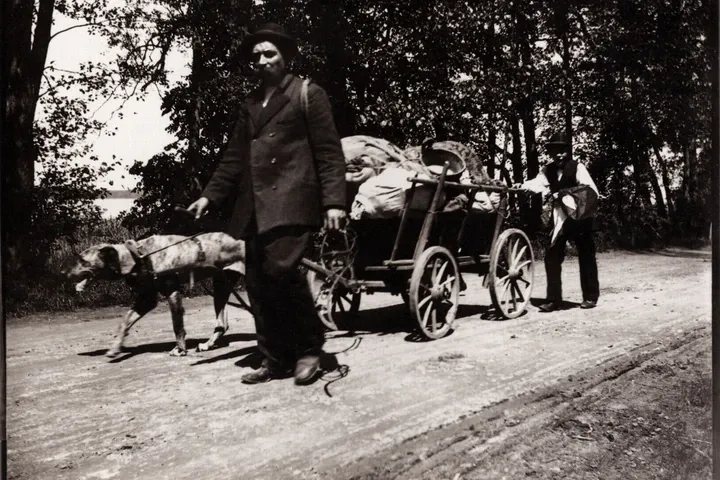
  1. Rottweiler history, a cart dog of the breed's type pulling a hawker's cart on a country road, Germany, around 1900
    A hawker's dog cart on a country road in Germany, photographed by Heinrich Zille around 1900. A cart dog of the Rottweiler type.

    Until the mid-1800s

    Rottweil, the butcher's dog

    The breed is named after Rottweil, a market town in southern Germany. The butcher's dog drove cattle to market, guarded them on the road and pulled carts of meat.

    What they still carryThe power, the pull on the lead, and the quiet, watchful guarding.

  2. Rottweiler history, a black and mahogany adult standing on a wool rug in a reading room
    A Rottweiler today.

    The mid-1800s

    The railways take the job

    Cattle went by rail, carts were no longer needed, and the breed nearly disappeared.

    What they still carryA working dog who still needs something to do.

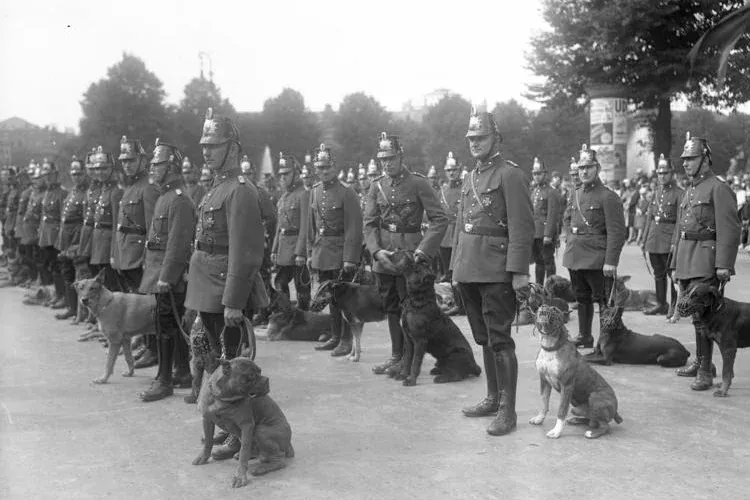
  3. Rottweiler history, police dog handlers lined up with their dogs at a demonstration, Germany, May 1931
    Police dog handlers with their dogs at a demonstration in Germany, May 1931, Rottweiler type dogs among them. Photo: Bundesarchiv, Bild 102-11696, CC BY-SA 3.0 DE

    Early 1900s to 1931

    Police dog, and recognition

    New work with the German police saved the breed. German clubs merged into the ADRK, the German Rottweiler club, in 1921, and the American Kennel Club recognised the Rottweiler in 1931.

    What they still carryThe guard dog, and a steady working temperament the breed clubs still test for.

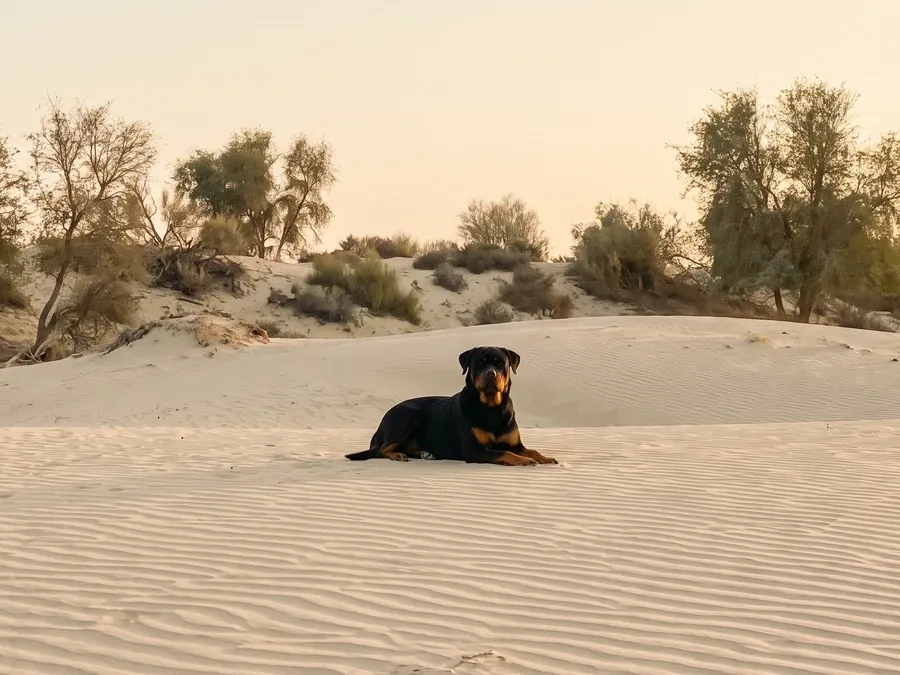
  4. Rottweiler history, the breed today, lying head up on pale desert sand among ghaf trees

    Today

    In Dubai

    In the UAE a Rottweiler is a family dog and a guard dog, often in a flat, with a front door onto a shared corridor, in 45°C heat.

    What they still carryA dog built to walk cattle to market, which is why their day needs a job, a rule for the door and the cool hours.

Rottie questions

The ones you type at midnight.

Most of these get asked late at night, by someone watching their dog and not sure what they are seeing.

Rottweiler in Dubai, asleep on a cream throw beside a pet parent on the sofa at night, the skyline beyond
How long do Rottweilers live?

Most Rottweilers live 9 to 10 years. In a study of Rottweilers seen by vets in the UK, the median was 9 years.

How big is a full grown Rottweiler?

A full grown Rottweiler weighs 36 to 61 kg. Males usually weigh 43 to 61 kg and females 36 to 45 kg.

What is the Rottweiler temperament like?

A well-raised Rottweiler is calm, confident and deeply loyal, devoted to their family and reserved with strangers. They need patient, consistent training and early socialisation.

Are Rottweilers aggressive?

Rottweilers are not aggressive by nature: they were bred to guard, so they watch strangers and the front door. Calm socialisation from puppyhood, reward-based training and never punishing a growl make the difference.

Do Rottweilers shed?

Yes, Rottweilers shed moderately, with more coming out once or twice a year. A weekly brush is enough.

What colour is a Rottweiler?

Rottweilers are black, with markings from rust to mahogany over the eyes, on the cheeks and muzzle, across the chest and down the legs.

Can a Rottweiler live in Dubai?

Yes, a Rottweiler can live well in Dubai with a plan for the heat and the building. Walk before sunrise and after dark from May to September, and give them a rule for the door and a routine for the lift.

Why is my Rottweiler limping?

A Rottweiler who limps may have sore hips or elbows, but bone cancer is also one of the breed's main risks. If a limp does not go away, or you find a firm swelling on a leg, contact your vet within days.

Why does my Rottweiler growl when happy?

What sounds like a growl is often a happy Rottweiler rumble, deep in the chest. It comes when they are leaning on you or having their chest scratched. Learn that rumble, with a loose body and soft eyes, so you notice if it ever changes. A real growl is a warning: never punish it.

Worried about them? Contact your vet today.